Beställningsvara. Skickas inom 10-15 vardagar. Fri frakt över 249 kr.
Beskrivning
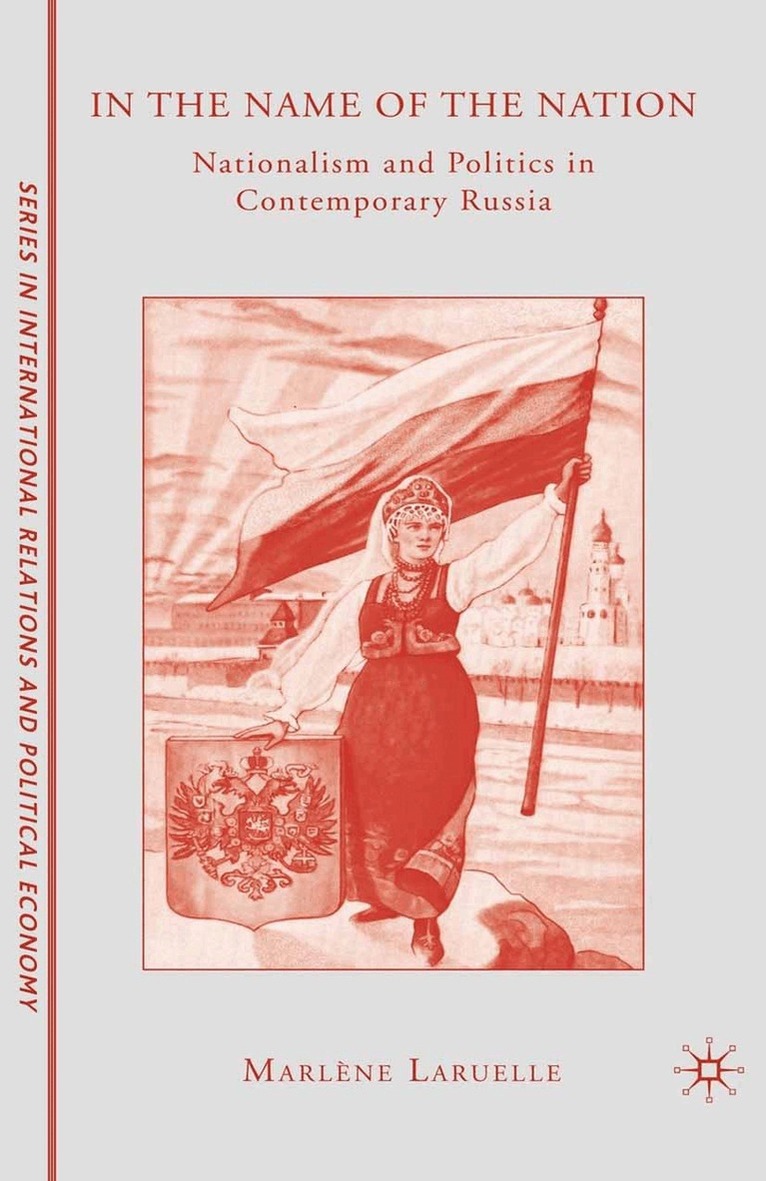
This book deconstructs the equation of nationalism with the extreme right in Russia. This study rejects the interpretation that understands Kremlin-backed patriotism as simply part of a fascist trend in Russia and as a rapprochement between the political authorities and the extreme right.
MARLÈNE LARUELLE is a Research Fellow at the Central Asia and Caucasus Institute, SAIS, Johns Hopkins University, UK.
Recensioner i media
"With In the Name of the Nation, Marlene Laruelle has produced an important and engaging reinterpretation of nationalism's role in Putin's Russia. Drawing on an impressively broad range of sources, she warns against treating Russian nationalism as either the realm of radical extremism or the natural expression of any unique, civilizational Russian alienation from the West. In fact, she presents a strong case that Russian nationalism today is best understood as a reasonably successful Kremlin strategy to reconnect with and reunify Russian society after the tumultuous 1990s and to promote the 'triple goal' of modernization, normalization, and - as provocative as it might sound - westernization. At the same time, this is a nationalism that privileges the state over the individual, the officeholder over the citizen. Covering everything from film to skinhead attacks to high politics, this book will greatly interest anyone who wants to learn more about either Russia or the more general phenomenon of nationalism." - Henry E. Hale, The George Washington University "The aim of the book, to produce a study of Russian nationalism which looks at the connections of the phenomenon with society as a whole and the state, and not only the extreme right, is praiseworthy. Dr Laruelle is seeking to do more than this, however. She is aiming to write a textbook about contemporary Russia, using Russian nationalism as a sort of prism through which to analyze contemporary Russia." - Dr. Peter Duncan, Senior Lecturer in Russian Politics and Society, University College London School of Slavonic and East European Studies
Innehållsförteckning
PART I: MOBILIZING AGAINST THE OTHER: FROM THE EXTREME RIGHT TO MASS XENOPHOBIA The Soviet Origins of Russian Nationalism The Evolution of Political Radicalism, 1990-2000 On the Impossibility of a Typological Classification In Quest of Social Mobilization: The Skinhead Phenomenon Anti-Immigration: the Long-Awaited Ideological Consensus Xenophobia: a Mass Phenomenon in Russia PART II: A POLITICAL ENVIRONMENT SHAPED BY THE NATIONALIST REFERENT 'Identity Populism': The Communist Party and Liberal-Democratic Party Rodina, the New Face of Uncomplicated Nationalism Patriotic Centrism Under the Auspices of the Kremlin United Russia or Nomenklatura Nationalism PART III: THE MOTHERLAND, A NEW SOCIAL CONTRACT? Rediscovering Pride: The Rehabilitation of the Motherland The Army as a Metaphor for the Nation: Patriotic Education Programs Promoting Symbolic Capital: the Orthodox Church Reorganizing the Associative Fabric: the Youth Movements Thinking the Nation in its Complexity: Doctrinal Debates inthe Kremlin