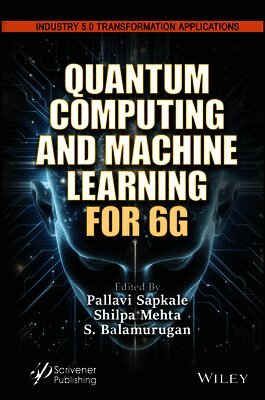
2 253 kr
Beställningsvara. Skickas inom 7-10 vardagar. Fri frakt över 249 kr.
Beskrivning
Produktinformation
- Utgivningsdatum:2026-01-15
- Vikt:839 g
- Format:Inbunden
- Språk:Engelska
- Antal sidor:464
- Förlag:John Wiley & Sons Inc
- ISBN:9781394238088
Utforska kategorier
Mer om författaren
Pallavi Sapkale, PhD is an Assistant Professor, Ramrao Adik Institute of Technology, D.Y. Patil University, Navi Mumbai, Maharashtra, India, with more than 17 years of experience. She has published four books, more than 25 research articles in various international journals and conferences, four international patents, and 12 Indian patents. Her research focuses on quantum computing, machine learning, wireless communication, 5G mobility management, and next-generation networks like 6G. Shilpa Mehta, PhD is a Teaching Assistant at the Auckland University of Technology, New Zealand, with more than five years of teaching experience. She has worked on various interdisciplinary research projects and edited several internationally published books. Her research interests include radio frequency integrated circuits, RF front ends, optimization, Internet of Things, wireless communication, artificial intelligence, healthcare, radars, and smart cities. S. Balamurugan, PhD is the Director of Albert Einstein Engineering and Research Labs, Coimbatore, Tamilnadu, India. He has published more than 60 books, 300 articles in national and international journals and conferences, and 200 patents. He is also the Vice-Chairman of Renewable Energy Society of India (RESI). He also serves as a research consultant for many companies, startups, and micro-, small, and medium enterprises.
Innehållsförteckning
- Preface xixAcknowledgement xxiiiPart I: Introduction 11 Introduction to Wireless Communication and Transition from 1G to 6G 3Krupali Dhawale, Pranali Bhope, Kunika Dhapodkar and Sejal Kumbhare1.1 Introduction to Wireless Communication 41.1.1 Definition and Importance of Wireless Communication 4Importance of Wireless Communications 41.1.2 Role of Wireless Communication in Connecting People and Devices Globally 51.1.3 Evolution of Wireless Communication Technologies 61.2 Generations of Wireless Communication 81.2.1 1G (Analog Cellular) 81.2.2 2G (Digital Cellular) 91.2.3 3G (Mobile Broadband) 101.2.4 4G (LTE and Beyond) 111.2.5 5G (Next-Generation Connectivity) 121.2.6 Anticipating 6G (Future Evolution) 141.3 1G to 4G: Evolution of Wireless Standards 151.3.1 Overview of 1G to 4G Transitions 151.3.2 Advancements in Digital Modulation and Compression 171.3.3 Shift from Analog to Digital Transmission 191.3.4 Introduction of Data Services and Mobile Internet 201.4 Industry and Research Initiatives for 6G 221.4.1 Involvement of Academia, Industry, and Standardization Bodies 221.4.2 Research Goals and Technological Roadmaps 24Conclusion 27References 272 The State-of-the-Art and Future Visioning 6G Wireless Network 29Payal Bansal2.1 Introduction 302.1.1 Heterogeneous Wireless Networks 312.1.2 Vertical Handover 322.2 Handover Management in 6G 342.2.1 History of Handover System 342.2.2 Handover Process 362.2.3 Single-Tier Networks with Handover Skipping Process 382.2.3.1 Coverage Probability 382.2.3.2 Handover Cost 402.2.3.3 Average Throughput 432.3 Two-Tier Network Handover Skipping 43Bibliography 51Part II: Quantum Computing 553 Introduction to Quantum Computing 57Shilpa Mehta and Celestine Iwendi3.1 Introduction 573.1.1 Historical Background 583.1.2 Classical Computing vs Quantum Computing 593.1.3 Why Quantum Computers? 603.1.4 Bits versus Qubits 603.1.5 Quantum Registers 613.1.6 Key Principles of Quantum Computing 613.2 Quantum Gates 623.3 Quantum Algorithms 643.3.1 Fourier Transform–Based Algorithms 643.3.1.1 Overview of Discrete Fourier Transform 653.3.1.2 Quantum Fourier Transform 653.3.2 Amplitude Amplification–Based Algorithms 683.3.2.1 Grover’s Algorithm 683.3.2.2 Quantum Counting 693.3.3 Quantum Walk Based Algorithms 693.3.3.1 Boson Sampling Problem 693.3.3.2 Element Distinctness Problem 703.3.3.3 Triangle Finding Problem 703.3.4 Bounded-Error Quantum Polynomial Time Problems 703.3.4.1 Quantum Simulation 713.3.5 Hybrid Algorithms 713.3.5.1 Quantum Approximate Optimization Algorithm 713.3.5.2 Variational Quantum Eigensolver Algorithm 713.3.5.3 Contracted Quantum Eigensolver Algorithm 723.4 Quantum Hardware and Software 723.4.1 Quantum Hardware 723.4.1.1 Types of Quantum Hardware 733.4.2 Quantum Software 743.5 Applications 753.6 Challenges of Quantum Computing 783.7 Current State-of-the-Art 793.8 Summary and Future Scope 85References 854 Quantum-Secured Concealed Identifier for 6G Technology 89Pratham Desai and Dipali KasatIntroduction 894.1 Quantum Mechanical Properties for Security 904.1.1 Entanglement with Bell-State Example 904.1.2 Entanglement for Bipartite System 924.1.3 No Cloning Theorem 934.2 Quantum Key Distribution Technique (QKD) 964.3 BB84 Algorithm 964.4 Concept of Identifiers 974.5 Drawbacks of Classical Algorithms 994.6 Quantum Concealed Identifiers for 6G Technology 1004.6.1 QKD Protocol with a Multiple Coding Basis 1004.6.2 Parameters and Basic Equipment 1024.6.3 Pseudo-Random Number Seed Key Construction Protocol for Security (PRNSKC) 1044.7 A Post-Quantum SUCI for 6G 1054.7.1 How SUCI is Vulnerable to Quantum Attacks 1054.7.2 Post-Quantum Secure SUCI 1064.7.3 Selecting the Perfect KEM for KEMSUCI 1074.7.4 Understanding the Kyber Algorithm 1094.8 Comparison Between the Existing Schemes 111Conclusion 112Bibliography 1135 Quantum Cryptography: Present and Future 6G 117Dhananjay Manohar Dakhane, Vaibhav Eknath Narawade and Pallavi Sapkale5.1 Introduction 1175.2 Quantum Cryptography 1195.3 Quantum Key Distribution 1205.4 Post Quantum Cryptography 1215.5 Conclusions 121References 1226 Network Intelligence with Quantum Computing for 6G 123H. Bhoomeeswaran, G. Joshva Raj, J. Mangaiyarkkarasi and J. Shanthalakshmi Revathy6.1 Introduction 1246.2 Quantum Computing 1276.3 Spintronic QC 1276.4 Literature Survey 1296.5 Shstno 1306.6 Photonic QC 1336.7 Conclusion 1376.8 Future Scope 138References 139Part III: Machine Learning 1417 Introduction to Machine Learning: Conceptualization, Implementation, and Research Perspective 143Snehasis Dey7.1 Introduction to Machine Learning: Conceptualization Perspective 1447.1.1 Basics of Machine Learning 1447.1.2 Literature Survey 1477.1.3 Problem Statement and Proposed Model 1477.1.4 Evolution of Machine Learning 1487.1.5 Machine Learning as a Powerful Tool for Future Advancement 1507.2 A Dive Into Machine Learning: Implementation Perspective 1517.2.1 Correlations and Differences Between Artificial Intelligence (AI), Machine Learning (ML), and Deep Learning (DL) 1517.2.2 Learning Techniques in Machine Learning 1537.2.3 Algorithms in Machine Learning 1557.3 Recent Trends in Machine Learning: Research Perspective 1567.3.1 Machine Learning in Fourth Industry Revolution or Industry 4.0 (4IR) 1577.3.2 Machine Learning in Real-World Applications: mlfor Everything, for Everywhere and for Everyone 1577.3.3 Machine Learning in 5G Wireless Communications and Beyond 1587.4 Conclusion 159References 1608 6G Wireless Networks: Pioneering with Machine Learning Technologies 161Krupali Dhawale, Shraddha Jha, Mishri Gube, Shivraj Guduri and Khwaish Asati8.1 Introduction 1628.2 Introduction to 6G Wireless Networks and Machine Learning 1628.2.1 6G Wireless Network and Its Significance 1628.2.2 Challenges for 6G Networks 1648.2.3 Goals for 6G Networks 1668.2.4 Introduction to Machine Learning and Its Relevance in Wireless Networks 1678.2.4.1 Importance of Machine Learning in Wireless Networks 1688.2.5 Potential Benefits of Integrating Machine Learning in 6G Technology 1698.3 Machine Learning Techniques for 6G Wireless Networks 1718.3.1 Signal Processing and Optimization 1718.3.2 Adaptive Beamforming and Spatial Processing Using Machine Learning 1738.3.3 Benefits of Adaptive Rendering and Spatial Processing through Machine Learning 1748.3.4 Signal Denoising, Interference Mitigation, and Resource Allocation 1748.3.5 Spectrum Management and Allocation 1768.4 Driven Network Management and Security 1788.4.1 Self-Organizing Networks (SON) 1788.4.2 Automatic Network Configuration and Optimization through AI 1808.4.2.1 Network Management 1808.4.2.2 Network Security 1818.4.3 Fault Detection, Self-Healing, and Network Maintenance 1818.5 Challenges and Future Directions 1828.5.1 Data Privacy and Ethics Issues and Challenges 1828.5.2 Future Directions in Data Privacy and Ethical Considerations 1838.5.3 Balancing Data Usage and User Privacy in AI-Driven Networks 1848.6 Conclusion 185References 1869 Machine Learning–Based Communication and Network Automation: Advancements, Challenges, and Prospects 187J. Shanthalakshmi Revathy and J. Mangaiyarkkarasi9.1 Introduction 1889.2 Advancements in Machine Learning for Communication and Network Automation 1899.2.1 Machine Learning Fundamentals 1909.2.1.1 Supervised, Unsupervised, and Reinforcement Learning in Network Automation 1909.2.2 Applications in Network Automation 1929.2.2.1 Predictive Maintenance and Fault Detection 1929.2.2.2 Quality of Service (QoS) Optimization 1939.2.2.3 Traffic Engineering and Load Balancing 1939.2.3 Data Sources and Preprocessing 1949.2.3.1 Data Collection Methods in Network Environments 1949.2.3.2 Data Preprocessing Techniques 1959.2.3.3 Feature Selection and Engineering 1959.2.4 Model Training and Deployment 1969.3 Challenges in Implementing Machine Learning for Network Automation 1999.3.1 Data Quality and Availability 1999.3.2 Scalability and Resource Constraints 2009.3.3 Interoperability and Standards 2019.3.3.1 Need for Standardization 2019.3.3.2 Compatibility with Existing Network Infrastructure 2029.3.3.3 Vendor-Specific Challenges 2029.3.4 Ethical and Regulatory Considerations 2039.3.4.1 Bias and Fairness in Machine Learning Algorithms 2039.3.4.2 Regulatory Compliance in Network Automation 2049.3.4.3 Ethical Implications of Automation in Communication 2059.4 Prospects and Future Directions 2069.4.1 Emerging Technologies 2069.4.2 AI-Driven Autonomous Networks 2089.4.2.1 Toward Fully Autonomous Networks 2089.4.2.2 Self-Healing and Self-Optimizing Networks 2089.4.2.3 Human-Machine Collaboration in Network Management 2089.5 Research and Development Trends 2099.5.1 Current Research Trends in Machine Learning and Network Automation 2099.5.2 Industry Collaborations and Academic Contributions 2109.5.3 The Importance of Open-Source Projects 2119.6 Conclusion 212References 21310 Empowering 6G Communication Systems: Harnessing Machine Learning for Advancements in Flexible and 3D-Printed Antennas 217Duygu Nazan Gençoğlan and Shilpa Mehta10.1 Introduction 21810.2 Flexible and 3D-Printed Antennas 22210.3 Challenges in 6G Antenna Design 22410.4 Machine Learning for Antenna Design 22510.5 Data-Driven Antenna Optimization 22610.6 Topology Optimization with ml 22710.7 Material Selection and Optimization 22910.8 Simulation and Modeling with ml 23010.9 Hardware-Software Co-Design for ML-Aided Antennas 23110.10 Experimental Validation and Prototyping 23210.11 Conclusion and Future Directions 23210.12 Future Directions 233References 23311 Potential Communication in B5G Networks Through Hybrid Millimeter-Wave Beamforming and Machine Learning: Basics, Challenges, and Future Path 243Snehasis Dey11.1 Introduction 24411.2 Literature Survey 24511.3 HBF Open Challenges 25111.4 Conclusion 258Bibliography 25812 Device-to-Device Communication in 6G Using Machine Learning 261J. Shanthalakshmi Revathy, J. Mangaiyarkkarasi and J. Matcha Rani12.1 Introduction 26212.2 Fundamentals of Device-to-Device Communication 26312.3 Evolution from Previous Generations 26512.3.1 Early Foundations: Peer-to-Peer and Ad Hoc Networks 26512.3.2 Device-to-Device Communications in Cellular Networks 26612.3.3 The 5G Era 26712.3.4 Enhancement in 6G 26712.4 Role of Machine Learning in 6G D2D Communication 26812.4.1 Supervised Learning 26812.4.2 Unsupervised Learning 26912.4.3 Reinforcement Learning 27012.4.4 Integration of Machine Learning in 6G Networks 27112.5 Applications of Machine Learning in D2D Communication Resource Allocation and Spectrum Management 27312.6 Challenges and Solutions 27512.7 Case Studies 27712.7.1 Smart Cities and Urban IoT Networks 27712.7.2 Autonomous Vehicles and Vehicular Communication 27812.7.3 Healthcare and Wearable Devices 27812.7.4 Augmented Reality (AR) and Immersive Media 27912.8 Challenges and Future Scope 27912.9 Conclusion 280References 281Part IV: Quantum Computing and Machine Learning 28313 Integrating Quantum Computing and Machine Learning in 6G Networks 285Ogobuchi D. Okey, Theodore T. Chiagunye, Henrietta U. Udeani, Ikechukwu Nicholas, Renata L. Rosa and Demóstenes R. Zegarra13.1 Introduction 28613.2 Background Study 28813.2.1 Technology Evolutionary Trends Toward 6G Network 28813.2.2 Unique Features of 6G Networks 28913.2.3 The Principle of Quantum Computing 29113.2.4 Machine Learning 29213.3 Quantum Machine Learning Algorithms and Implementation Frameworks 29413.4 Resource Allocation in QML-Enabled 6G Network 30013.5 Security Challenges and Prospects in QML 6G 30113.6 Limitations, Benefits, and Future Directions 30313.7 Conclusion 305References 30514 A Quantum Computing Perspective in 6G Networks: The Challenge of Adaptive Network Intelligence 311Pallavi Sapkale14.1 Introduction 31214.1.1 Quantum Computing in 6G 31214.2 What is Network Intelligence in Quantum Computing? 31314.2.1 Methods to Achieve the Network Intelligence in Quantum Computing 31714.3 How to Accomplish Network Intelligence 31914.4 Quantum Computing Opportunities with 6G 31914.5 Challenges and Research Scope in Quantum Computing with 6G 32014.5.1 Main Challenges in Quantum Computing with 6G 32014.5.2 Research Scope in Quantum Computing 32214.6 Conclusion 323References 32415 Role of QML in 6G Integrated Vehicular Networks 327R. Palanivel, Muthulakshmi P., Snehasis Dey, Shilpa Mehta and Pallavi Sapkale15.1 Introduction 32815.2 Literature Survey 33115.3 Methodology 33215.3.1 Quantum Machine Learning for Traffic Prediction in 6G Networks 33215.3.1.1 Environment Setup 33315.3.1.2 Quantum Traffic Prediction Model 33315.3.1.3 Quantum Circuit Representation 33315.3.1.4 Safety Analysis 33415.3.1.5 Interpretation 33415.3.2 QML for Network Security in Vehicular Communication 33615.3.2.1 Environment Setup 33615.3.2.2 Quantum Key Distribution (QKD) 33715.3.2.3 Node1’s Side (Initialization) 33715.3.2.4 Quantum Communication Channel (Simulated) 33715.3.2.5 Node2’s Measurement 33815.3.2.6 Security and Key Sharing 33815.3.2.7 Interpretation 33815.3.3 6G Network Slicing and Resource Management by QML 33915.3.3.1 Environment Setup 33915.3.3.2 Implementation Process 34015.3.3.3 Interpretation 34115.3.4 Quality-of-Service (QoS) Optimization by QML 34215.3.4.1 Environment Setup and Parameters 34215.3.4.2 Implementation Process 34215.3.4.3 Interpretation 34315.4 Results and Discussion 34415.5 Conclusion 346References 346Part V: Applications 34916 Smart Irrigation Technique Using IoT Based on 5G 351Jyoti B. Deone and Khan Rahat Afreen16.1 Introduction 35216.2 Related Work 35316.3 5G Network on Smart Farming 35716.3.1 The Following Decade Will See the Development of 5G and Smart Farming 35816.4 Proposed Methodology 35916.5 Working Modules of the System 36016.5.1 Login and Registration Module 36016.5.2 Change Number Module 36016.5.3 Check Status Module 36016.5.4 Start Water Pump Module 36016.5.5 Stop Water Pump Module 36116.5.6 Force Start Water Pump Module 36116.5.7 Auto Stopped Module 36116.6 Experimental Result Analysis and Working 36116.7 Conclusion 364References 36417 Modeling and Development of Low-Cost Visible Light Communication System 367Mrinmoyee Mukherjee, Kevin Noronha and Ravi Kumar Bandi17.1 Learning Objectives 36817.2 Introduction to VLC 36817.3 VLC System Description 37417.3.1 Key Parameters - Light-Emitting Diode 37517.3.2 Key Parameters - Photodiode 37817.3.3 Key Parameters - VLC Channel 37917.4 Experimental Implementation of the VLC System 38217.4.1 Block Diagram and Technical Specifications 38217.4.2 Results and Discussions 39017.5 Simulation and Modeling of the VLC System 392References 418Index 423
Du kanske också är intresserad av
Radar and RF Front End System Designs for Wireless Systems
Shilpa Mehta, Rupesh Kumar
3 174 kr
Metamaterial Technology and Intelligent Metasurfaces for Wireless Communication Systems
Shilpa Mehta, Arij Naser Abougreen
2 121 kr
Intelligent Decision Making Through Bio-Inspired Optimization
Ramkumar Jaganathan, Shilpa Mehta
3 078 kr
Emerging Materials, Technologies, and Solutions for Energy Harvesting
Shilpa Mehta, Arij Naser Abougreen, Shashi Kant Gupta
3 918 kr
Optical Sensors and Distributed Sensing
Jose Anand A., Shilpa Mehta, Ambarish G. Mohapatra, Anita Mohanty, Nitaigour Premchand Mahalik, Subrat Kumar Mohanty
1 551 kr
Impact and Potential of Machine Learning in the Metaverse
Shilpa Mehta, Shashi Kant Gupta
3 196 kr
Ensuring Secure Connectivity Through AI-Powered Wireless Systems
Valentina E Balas, Hari Mohan Pandey, Shilpa Mehta
1 990 kr