Del 15 i serien Blackwell Philosophy Anthologies
441 kr
Beställningsvara. Skickas inom 7-10 vardagar. Fri frakt över 249 kr.
Beskrivning
Produktinformation
- Utgivningsdatum:2009-04-07
- Mått:170 x 246 x 36 mm
- Vikt:1 157 g
- Format:Häftad
- Språk:Engelska
- Serie:Blackwell Philosophy Anthologies
- Antal sidor:688
- Förlag:John Wiley and Sons Ltd
- ISBN:9781405175425
Utforska kategorier
Mer om författaren
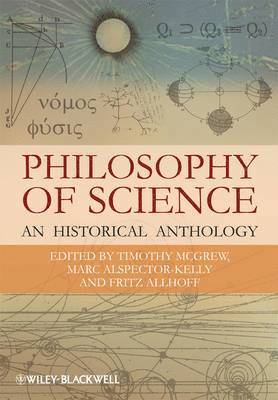
Timothy McGrew is Professor and Chairman of the Department of Philosophy at Western Michigan University. Marc Alspector-Kelly is Associate Professor of Philosophy at Western Michigan University.Fritz Allhoff is Assistant Professor of Philosophy, Adjunct Assistant Professor at the Mallinson Institute for Science Education, and Director of the History and Philosophy of Science Workgroup at Western Michigan University.
Recensioner i media
"The introductions, which occupy one-sixth of the volume, are carefully, clearly, and at times even beautifully written. Perhaps most important, they are always intelligently sympathetic to the authors whose views they are presenting." (The Journal of the International Society for the History of Philosophy of Science, 1 April 2011)"Overall, this is an impressive and versatile volume that should find its way into many classrooms. The commentary is thorough and clear enough to make the readings accessible to students, but not so imposing that instructors cannot add their own interpretation. This book would be suitable for advanced undergraduates who have completed previous coursework in history or philosophy." (Science & Education, 4 March 2011)
Innehållsförteckning
- List of Figures Notes on EditorsPersonal AcknowledgmentsText AcknowledgmentsPart IIntroductionUnit 1 The Ancient and Medieval Periods1.1 Atoms and Empty Space: Diogenes Laertius1.2 Letter to Herodotus: Epicurus1.3 The Paradoxes of Motion: Zeno1.4 Plato’s Cosmology: Plato1.5 The Structure and Motion of the Heavenly Spheres: Aristotle1.6 Change, Natures, and Causes: Aristotle1.7 Scientific Inference and the Knowledge of Essential Natures: Aristotle1.8 The Cosmos and the Shape and Size of the Earth: Aristotle1.9 The Divisions of Nature and the Divisions of Knowledge: Aristotle1.10 On Methods of Inference: Philodemus1.11 The Explanatory Power of Atomism: Lucretius1.12 The Earth: Its Size, Shape, and Immobility: Claudius Ptolemy1.13 The Weaknesses of Hypotheses: Proclus1.14 Projectile Motion: John Philoponus1.15 Free Fall: John Philoponus1.16 Against the Reality of Epicycles and Eccentrics: Moses Maimonides1.17 Impetus and its Applications: Jean Buridan1.18 The Possibility of a Rotating Earth: Nicole OresmeUnit 2 The Scientific Revolution2.1 The Nature and Grounds of the Copernican System: Georg Joachim Rheticus2.2 The Unsigned Letter: Andreas Osiander2.3 The Motion of the Earth: Nicholas Copernicus2.4 The New Star: Tycho Brahe2.5 A Man Ahead of His Time: Johannes Kepler2.6 On Arguments about a Moving Earth: Johannes Kepler2.7 Eight Minutes of Arc: Johannes Kepler2.8 Tradition and Experience: Galileo Galilei2.9 A Moving Earth Is More Probable Than the Alternative: Galileo Galilei2.10 The Ship and the Tower: Galileo Galilei2.11 The Copernican View Vindicated: Galileo Galilei2.12 The "Corpuscular" Philosophy: Robert Boyle2.13 Successful Hypotheses and High Probability: Christiaan Huygens2.14 Inductive Methodology: Isaac Newton2.15 Space, Time, and the Elements of Physics: Isaac Newton2.16 Four Rules of Reasoning: Isaac Newton2.17 General Scholium: Isaac Newton2.18 The System of the World: Isaac NewtonUnit 3 The Modern Period3.1 The Inductive Method: Francis Bacon3.2 Rules for the Discovery of Scientific Truth: René Descartes3.3 Rationalism and Scientific Method: René Descartes3.4 Human Knowledge: Its Scope and Limits: John Locke3.5 The Principle of Least Action: Gottfried Wilhelm Leibniz3.6 Space, Time, and Symmetry: Gottfried Wilhelm Leibniz3.7 The Problem of Induction: David Hume3.8 The Nature of Cause and Effect: David Hume3.9 The Metaphysical Foundations of Natural Science: Immanuel KantUnit 4 Nineteenth and Early Twentieth Century4.1 The Nature of Scientific Explanation: Antoine Lavoisier4.2 Determinism, Ignorance, and Probability: Pierre-Simon Laplace4.3 Hypotheses, Data, and Crucial Experiments: John Herschel4.4 An Empiricist Account of Scientific Discovery: John Stuart Mill4.5 Against Pure Empiricism: William Whewell4.6 The Causes Behind the Phenomena: William Whewell4.7 Catastrophist Geology: Georges Cuvier4.8 Uniformitarian Geology: Charles Lyell4.9 The Explanatory Scope of the Evolutionary Hypothesis: Charles Darwin4.10 Induction as a Self-Correcting Process: Charles Sanders Peirce4.11 The Nature of Abduction: Charles Sanders Peirce4.12 The Role of Hypotheses in Physical Theory: Henri Poincaré4.13 Against Crucial Experiments: Pierre Duhem4.14 On the Method of Theoretical Physics: Albert EinsteinPart IIIntroductionUnit 5 Positivism and the Received View5.1 Theory and Observation: Rudolf Carnap5.2 Scientific Explanation: Carl Hempel5.3 Empiricism, Semantics, and Ontology: Rudolf Carnap5.4 The Pragmatic Vindication of Induction: Hans Reichenbach5.5 Dissolving the Problem of Induction: Peter StrawsonUnit 6 After the Received View: Confirmation and Observation6.1 Empiricist Criteria of Cognitive Significance: Problems and Changes: Carl Hempel6.2 The Raven Paradox: Carl Hempel6.3 Two Dogmas of Empiricism: W. V. O. Quine6.4 The New Riddle of Induction: Nelson Goodman6.5 What Theories Are Not: Hilary Putnam6.6 On Observation: N. R. Hanson6.7 The Ontological Status of Theoretical Entities: Grover MaxwellUnit 7 After the Received View: Methodology7.1 Science: Conjectures and Refutations: Karl Popper7.2 The Structure of Scientific Revolutions: Thomas Kuhn7.3 Science and Pseudoscience: Imre LakatosUnit 8 After the Received View: Explanation8.1 Counterexamples to the D-N and I-S Models of Explanation: Wesley Salmon8.2 The Statistical Relevance Model of Explanation: Wesley Salmon8.3 Why Ask, "Why"?: Wesley Salmon8.4 Explanatory Unification: Philip KitcherUnit 9 After the Received View: The Realism Debate9.1 The Current Status of Scientific Realism: Richard N. Boyd9.2 A Confutation of Convergent Realism: Larry Laudan9.3 Constructive Empiricism: Bas van Fraassen9.4 The Natural Ontological Attitude: Arthur Fine
Mer från samma serie
Modern Philosophy - From Descartes to Nietzsche
Emmanuel, Goold, Steven M. Emmanuel, Patrick Goold
573 kr
Du kanske också är intresserad av
Aesthetics and the Philosophy of Art
Lamarque, Olsen SH, Peter Lamarque, Stein Haugom Olsen
1 740 kr
Minds, Brains, and Computers
Peter Ed. Cummins, Peter Ed Cummins, Robert Cummins, Denise D. Cummins
544 kr