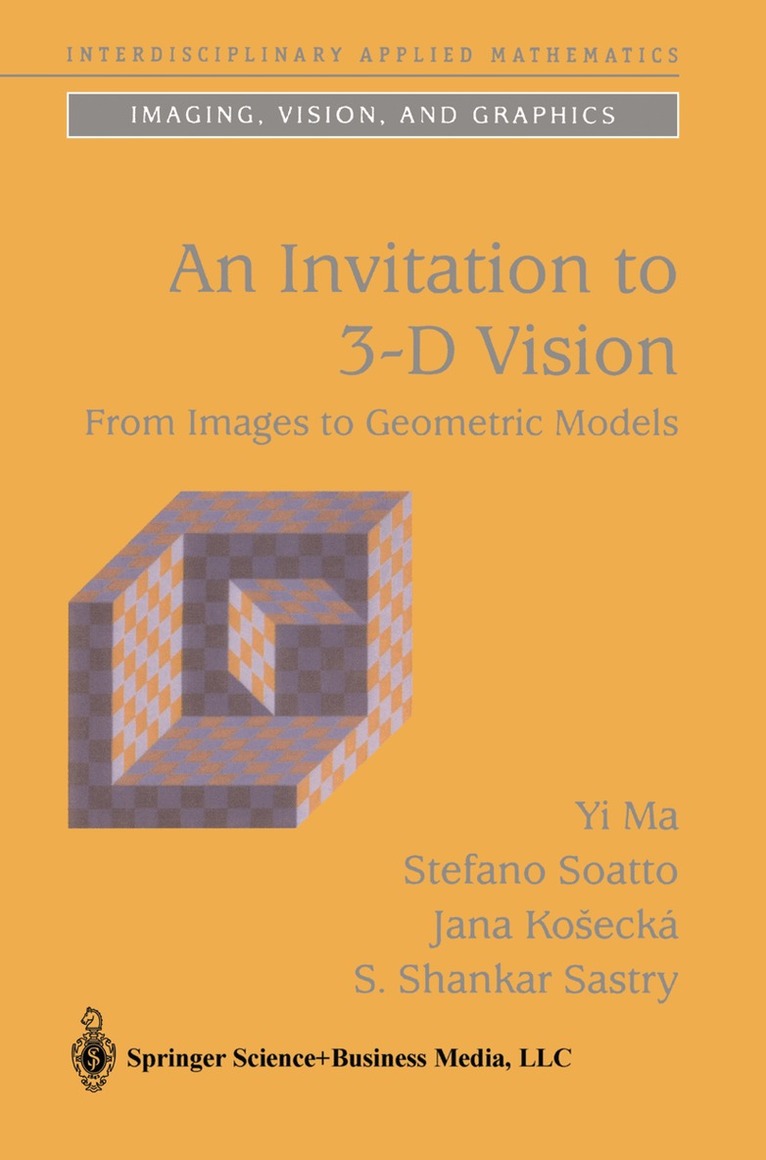
Del 26 i serien Interdisciplinary Applied Mathematics
851 kr
Beställningsvara. Skickas inom 10-15 vardagar. Fri frakt över 249 kr.
Fler format och utgåvor
Beskrivning
Produktinformation
- Utgivningsdatum:2010-11-24
- Mått:156 x 234 x 28 mm
- Vikt:763 g
- Format:Häftad
- Språk:Engelska
- Serie:Interdisciplinary Applied Mathematics
- Antal sidor:528
- Förlag:Springer-Verlag New York Inc.
- ISBN:9781441918468
Utforska kategorier
Recensioner i media
From the reviews: "Computer vision is invading our daily lives ... . Covering all the aspects would be too vast an area to cover in one book, so here, the authors concentrated on the specific goal of recovering the geometry of a 3D object ... . The 22 pages of references form a good guide to the literature. The authors found an excellent balance between a thorough mathematical treatment and the applications themselves. ... the text will be a pleasure to read for students ... ." (Adhemar Bultheel, Bulletin of the Belgian Mathematical Society, Vol. 12 (2), 2005) "This is primarily a textbook of core principles, taking the reader from the most basic concepts of machine vision ... to detailed applications, such as autonomous vehicle navigation. ... It is a clearly written book ... . Everything that is required is introduced ... . an entirely self-contained work. ... The book is aimed at graduate or advanced undergraduate students in electrical engineering, computer science, applied mathematics, or indeed anyone interested in machine vision ... . is highly recommended." (D.E. Holmgren, The Photogrammetric Record, 2004) "This very interesting book is a great book teaching how to go from two-dimensional (2D)-images to three-dimensional (3D)-models of the geometry of a scene. ... A good part of this book develops the foundations of an appropriate mathematical approach necessary for solving those difficult problems. ... Exercises (drill exercises, advanced exercises and programming exercises) are provided at the end of each chapter." (Hans-Dietrich Hecker, Zentralblatt MATH, Vol. 1043 (18), 2004) "This book gives senior undergraduate and beginning graduate students and researchers in computer vision, applied mathematics, computer graphics, and robotics a self-contained introduction to the geometry of 3D vision. That is the reconstruction of 3D models of objects from a collection of 2D images. ... Exercises are provided at the end of each chapter. Software for examples and algorithms are available on the author's website." (Daniel Leitner, Simulation News Europe, Vol. 16 (1), 2006)
Innehållsförteckning
- 1 Introduction.- 1.1 Visual perception from 2-D images to 3-D models.- 1.2 A mathematical approach.- 1.3 A historical perspective.- I Introductory Material.- 2 Representation of a Three-Dimensional Moving Scene.- 3 Image Formation.- 4 Image Primitives and Correspondence.- II Geometry of Two Views.- 5 Reconstruction from Two Calibrated Views.- 6 Reconstruction from Two Uncalibrated Views.- 7 Estimation of Multiple Motions from Two Views.- III Geometry of Multiple Views.- 8 Multiple-View Geometry of Points and Lines.- 9 Extension to General Incidence Relations.- 10 Geometry and Reconstruction from Symmetry.- IV Applications.- 11 Step-by-Step Building of a 3-D Model from Images.- 12 Visual Feedback.- V Appendices.- A Basic Facts from Linear Algebra.- A.1 Basic notions associated with a linear space.- A.1.1 Linear independence and change of basis.- A.1.2 Inner product and orthogonality.- A.1.3 Kronecker product and stack of matrices.- A.2 Linear transformations and matrix groups.- A.3 Gram-Schmidt and the QR decomposition.- A.4 Range, null space (kernel), rank and eigenvectors of a matrix.- A.5 Symmetric matrices and skew-symmetric matrices.- A.6 Lyapunov map and Lyapunov equation.- A.7 The singular value decomposition (SVD).- A.7.1 Algebraic derivation.- A.7.2 Geometric interpretation.- A.7.3 Some properties of the SVD.- B Least-Variance Estimation and Filtering.- B.1 Least-variance estimators of random vectors.- B.1.1 Projections onto the range of a random vector.- B.1.2 Solution for the linear (scalar) estimator.- B.1.3 Affine least-variance estimator.- B.1.4 Properties and interpretations of the least-variance estimator.- B.2 The Kalman-Bucy filter.- B.2.1 Linear Gaussian dynamical models.- B.2.2 A little intuition.- B.2.3 Observability.- B.2.4 Derivation of the Kalmanfilter.- B.3 The extended Kalman filter.- C Basic Facts from Nonlinear Optimization.- C.1 Unconstrained optimization: gradient-based methods.- C.1.1 Optimality conditions.- C.1.2 Algorithms.- C.2 Constrained optimization: Lagrange multiplier method..- C.2.1 Optimality conditions.- C.2.2 Algorithms.- References.- Glossary of Notation.
Mer från samma serie
Nonlinear Dynamics in Physiology and Medicine
Anne Beuter, Leon Glass, Michael C. Mackey, Michele S. Titcombe
550 kr
Geometry and Topology in Hamiltonian Dynamics and Statistical Mechanics
Marco Pettini
1 062 kr
Du kanske också är intresserad av
Mathematical Introduction to Robotic Manipulation
Richard M. Murray, Zexiang Li, S. Shankar Sastry
2 113 kr
- Nyhet
Neurosymbolic AI
Alvaro Velasquez, Alvaro Velasquez, Houbing Herbert Song, Pradeep Ravikumar, S. Shankar Sastry, Sandeep Neema
1 419 kr
Mathematical Introduction to Robotic Manipulation
Richard M. Murray, Zexiang Li, S. Shankar Sastry
2 792 kr