• Fri frakt över 249 kr
  • •
  • Snabba leveranser
  • •
  • Billiga böcker
Kundservice

Du är på sajten för privatpersoner.

Företag, bibliotek eller offentlig verksamhet?

Du handlar på classic.bokus.com, där alla dina funktioner finns intakta.
Till classic.bokus.com
Bokus logotyp. Gå till startsidan.
  • Erbjudanden
  • Nyheter
  • Student
  • Topplistor
  • Barn & ungdom
  • Bokus Play
  • E-böcker
  • Pocketböcker
  • Spel & pussel

10% rabatt på allt med kod: NYSTART10 →

Sidfot

Mina sidor

    Hjälp

    • Kundservice
    • Vanliga frågor och svar
    • Frakt och leverans
    • Retur vid ångerrätt
    • Reklamera vara
    • Betalning
    • Köpvillkor
    • Allmänna villkor
    • Information om webbplatsens tillgänglighet

    Om Bokus

    • Om oss
    • Pressrum
    • För studenter
    • För företag
    • För bibliotek och offentlig verksamhet
    • För leverantörer
    • Hållbarhet

    Populärt

    • Aktuella erbjudanden
    • Presentkort
    • Studentlitteratur
    • Nya böcker
    • Topplistor
    • Signerade böcker
    • Engelska böcker

    Inspiration

    • Boktips
    • BookTok
    • Populära bokserier
    • Barnbokskaraktärer
    • Populära författare
    Logotyp för Bokus
    Följ oss på Facebook (extern länk)Följ oss på Instagram (extern länk)Följ oss på YouTube (extern länk)Följ oss på TikTok (extern länk)
    bokus @ CookiesAnpassa cookiesIntegritetspolicyKöpvillkor
    Till Citymail hemsida (extern länk)Till Budbee hemsida (extern länk)Till Postnord hemsida (extern länk)Till Schenker hemsida (extern länk)Till Early Bird hemsida (extern länk)Till Walleys hemsida (extern länk)
    1. Psykologi och pedagogik
    2. Pedagogik
    3. Skolan och förskolan

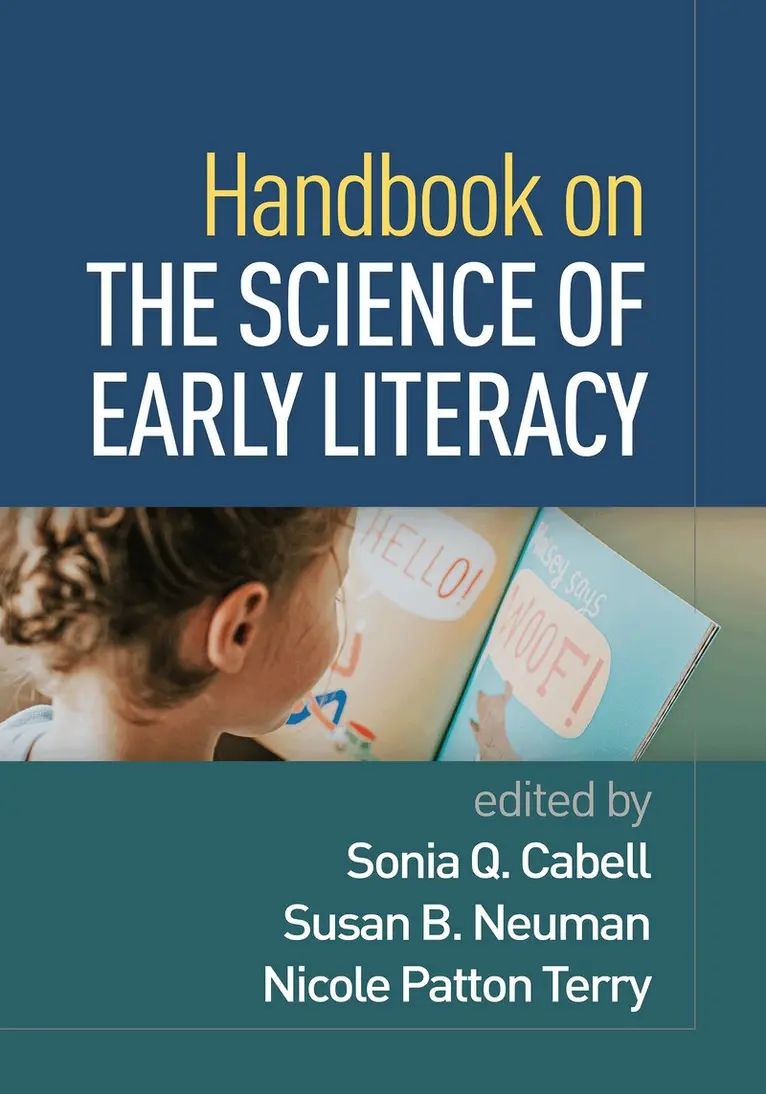
    Handbook on the Science of Early Literacy

    AvSonia Q. Cabell,Susan B. Neuman

    Häftad, Engelska, 2024

    612 kr

    Beställningsvara. Skickas inom 10-15 vardagar. Fri frakt över 249 kr.

    Beskrivning

    Synthesizing the best current knowledge about early literacy, this comprehensive handbook brings together leading researchers from multiple disciplines. The volume identifies the instructional methods and areas of focus shown to be most effective for promoting young children's (PreK-2) growth in reading, writing, oral language, and the connections among them. In 33 chapters, the Handbook covers conceptual foundations; development and instruction of both code- and meaning-related literacy skills; professional development and family engagement; supporting equity across populations; and learning beyond traditional boundaries, including digital and out-of-school contexts. Highlighted throughout are issues around access to high-quality instruction, working with multilingual populations, and data-based decision making and interventions.

    Produktinformation

    • Utgivningsdatum:2024-08-08
    • Mått:178 x 254 x 25 mm
    • Vikt:762 g
    • Format:Häftad
    • Språk:Engelska
    • Antal sidor:436
    • Förlag:Guilford Publications
    • ISBN:9781462555024

    Utforska kategorier

    • Skolan och förskolan inom Psykologi och pedagogik
    • Undervisning i specifika ämnen inom Psykologi och pedagogik
    • Specialundervisning inom Psykologi och pedagogik

    Mer om författaren

    Sonia Q. Cabell, PhD, is Associate Professor in the School of Teacher Education and the Florida Center for Reading Research at Florida State University. Her research focuses on early language and literacy instruction, with a particular interest in the prevention of reading difficulties. Dr. Cabell has authored approximately 80 publications, including peer-reviewed articles, books, book chapters, and early childhood language and literacy curricula. She has served as Principal Investigator or co-Principal Investigator on numerous federally funded grant projects. Dr. Cabell has been an advisor or consultant for a variety of national organizations and state departments of education. She was the 2021 recipient of the International Literacy Association's Diane Lapp & James Flood Professional Collaborator Award (with Tricia Zucker). Previously, Dr. Cabell worked as a second-grade teacher and literacy coach in Oklahoma and Virginia.Susan B. Neuman, EdD, is Professor of Teaching and Learning at New York University. Previously, she was Professor at the University of Michigan and served as the U.S. Assistant Secretary for Elementary and Secondary Education, in which role she established the Early Reading First program and the Early Childhood Educator Professional Development Program, and was responsible for all activities in Title I of the Elementary and Secondary Act. Dr. Neuman has served on the Board of Directors of the International Literacy Association and as coeditor of Reading Research Quarterly. Dr. Neuman has received two lifetime achievement awards for research in literacy development and is a member of the Reading Hall of Fame and a Fellow of the American Educational Research Association. She has published over 100 articles and numerous books.Nicole Patton Terry, PhD, is the Olive and Manuel Bordas Professor of Education in the School of Teacher Education and Director of the Florida Center for Reading Research (FCRR) at Florida State University. She is the founding director of The Urban Child Study Center at Georgia State University and The Village at FCRR, two research entities where researchers collaborate with school and community partners to promote student success. Dr. Patton Terry’s work focuses on young learners who are vulnerable to experiencing difficulty with language and literacy achievement in school, in particular, African American children, children growing up in poverty, and children with disabilities. A former special education teacher, she currently serves as president of the Society for the Scientific Study of Reading and is a Fellow of the American Speech–Language–Hearing Association and the American Educational Research Association (AERA). Dr. Patton Terry is the recipient of AERA's 2026 Exemplary Contributions to Practice-Engaged Research Award.

    Recensioner i media

    "This volume should explode, once and for all, the unhelpful myth that the large body of research known as the science of reading is a narrow, one-size-fits-all enterprise. The editors have wisely updated 'science of reading' to 'science of literacy,' a very welcome course correction. All literacy educators should spend some quality time with this handbook. Their efforts will be repaid, and their students--from preschool to graduate school--will benefit. I expect this handbook to become a standard reference in the field."--Claude Goldenberg, PhD, Nomellini and Olivier Professor of Education, Emeritus, Stanford University"With contributions from leading scholars, this handbook provides a comprehensive review of the research base on early literacy development and instruction. The volume captures the breadth and depth of knowledge about how early literacy emerges in children from diverse backgrounds, and how educators can promote it at home or in school. I recommend this handbook as a resource for preservice and inservice teacher preparation, as well as for ongoing professional learning and doctoral-level coursework. Researchers and practitioners will reference this work for years to come as they endeavor to give children the support they need to develop reading and writing proficiency."--Rebecca D. Silverman, EdD, Stanford Graduate School of Education"This impressive handbook is layered with multiple scholarly perspectives that are needed to advance the science of reading. The research shared has points of convergence and divergence that remind us our corpus of knowledge about early literacy is still expanding. This gift of a book should be studied and interrogated by those concerned about early literacy the world over."--Alfred W. Tatum, PhD, Provost and Executive Vice President for Academic Affairs, Metropolitan State University of Denver-

    Innehållsförteckning

    • Foreword, David K. DickinsonIntroduction, Sonia Q. Cabell, Susan B. Neuman, and Nicole Patton TerryI. Conceptualizing the Science of Early Literacy1. Simplicity Meets Complexity: Expanding the Simple View of Reading with the Direct and Indirect Effects Model of Reading, Young-Suk Grace Kim2. Early Environmental Influences on Language, Meredith L. Rowe, Rachel R. Romeo, and Kathryn A. Leech3. Prioritizing Dual Language Learners’ Language Comprehension Development to Support Later Reading Achievement, Jeannette Mancilla-Martinez4. Early Literacy, Response to Intervention, and Multi-Tiered Systems of Support, Dayna Russell Freudenthal, Mai W. Zaru, and Stephanie Al Otaiba5. The Neuroscience of Early Literacy Development, Rachel R. RomeoII. Development and Instruction of Code-Related Literacy Skills6. Learning the Code, Barbara R. Foorman7. The Science of Early Alphabet Instruction: What We Do and Do Not Know, Shayne B. Piasta8. Invented Spelling: An Integrative Review of Descriptive, Correlational, and Causal Evidence, Monique Sénéchal, Gene Ouellette, and H. N. Lam Nguyen9. Early Spelling Development: Influences, Theory, and Educational Implications, Nenagh Kemp and Rebecca Treiman10. Supporting Students’ Early Writing Development through Data-Based Instruction, Kristen L. McMaster, Seyma Birinci, Emma Shanahan, and Erica LembkeIII. Development and Instruction of Meaning-Related Literacy Skills11. Language Is the Basis of Skilled Reading Comprehension, Laura M. Justice and Hui Jiang12. Language Interventions in Early Childhood: Summary and Implications from a Multistudy Program of Research, Beth M. Phillips13. Content Literacy: Integrating Social Studies and Language, Sharolyn D. Pollard-Durodola and Jorge E. Gonzalez14. Supporting Integrated Instruction in Science and Literacy in K−2 Classrooms, Tanya S. Wright and Amelia Wenk Gotwals15. Leveraging Content-Rich English Language Arts Instruction in the Early Grades to Improve Children’s Language Comprehension, Sonia Q. Cabell and HyeJin Hwang16. Feeding Two Birds with One Hand: Instructional Simultaneity in Early Literacy Education, Nell K. Duke, Julia B. Lindsey, and Crystal N. Wise17. Comprehension: From Language to Reading, Ellen Orcutt, Victoria Johnson, and Panayiota KendeouIV. Using the Science of Early Literacy in Professional Development and Family Engagement18. Measuring and Improving Teachers’ Knowledge in Early Literacy, Anne E. Cunningham, Allison R. Firestone, and Mónica Zegers19. Professional Development in Early Language and Literacy: Using Data to Balance Effectiveness and Efficiency, Annemarie H. Hindman and Barbara A. Wasik20. Using the Science of Early Literacy to Design Professional Development for Writing, Hope K. Gerde and Gary E. Bingham21. Structuring Adaptations for Scaling Up Evidence-Based Literacy Interventions, James S. Kim and Douglas Mosher22. Together We Can Do So Much: Aligned School and Home Efforts Using a Multi-Tiered System of Support Framework, Tricia A. Zucker, Gloria Yeomans-Maldonado, Sarah Surrain, and Susan H. Landry23. Family Engagement for Early Literacy: Interventions That Promote Family−School Partnerships, Karalynn E. Brown and Susan M. SheridanV. Using the Science of Early Literacy to Support Equity24. Literacy Architectures: Making the Case for Systems of Learning and Teaching to Cultivate Readers and Writers in Linguistically Diverse Schools, Emily Phillips Galloway and Nonie K. Lesaux25. The Development of Early Orthographic Representations in Children: The Lexical Asymmetry Hypothesis and Its Implications for Children with Dyslexia, Donald L. Compton, Laura M. Steacy, Nuria Gutiérrez, Valeria M. Rigobon, Ashley A. Edwards, and Nancy C. Marencin26. Developmental Language Disorder: What It Is and Why It Matters, Maura Curran and Tiffany Hogan27. Autism and Early Literacy: The State of the Science, Kelly Whalon and Veronica P. Fleury28. Multi-Tiered Systems of Support: An Approach for Reducing Disparities in School Readiness and Increasing Equity in Early Literacy and Learning Opportunities for Young Children, Judith J. Carta and Charles R. Greenwood29. Factors Associated with Black Children’s Early Development and Learning, Iheoma U. Iruka, Amber B. Sansbury, Nicole A. Telfer, Nneka Ibekwe-Okafor, Nicole Gardner-Neblett, and Tonia R. DurdenVI. Using the Science of Early Literacy to Learn Across Boundaries30. Early Literacy in Everyday Spaces: Creating Opportunities for Learning, Susan B. Neuman31. Digital Picture Books: Opportunities and Utilities, Adriana G. Bus and Trude Hoel32. e-Books with a Digital Dictionary as a Support for Word Learning, Ofra Korat and Ora Segal-Drori33. Leveraging Research−Practice Partnerships to Support Evidence Use in Early Childhood: Lessons Learned from Atlanta 323, Nicole Patton Terry, Gary E. Bingham, Anita Faust Berryman, Janelle Clay, and Kate CatonIndex