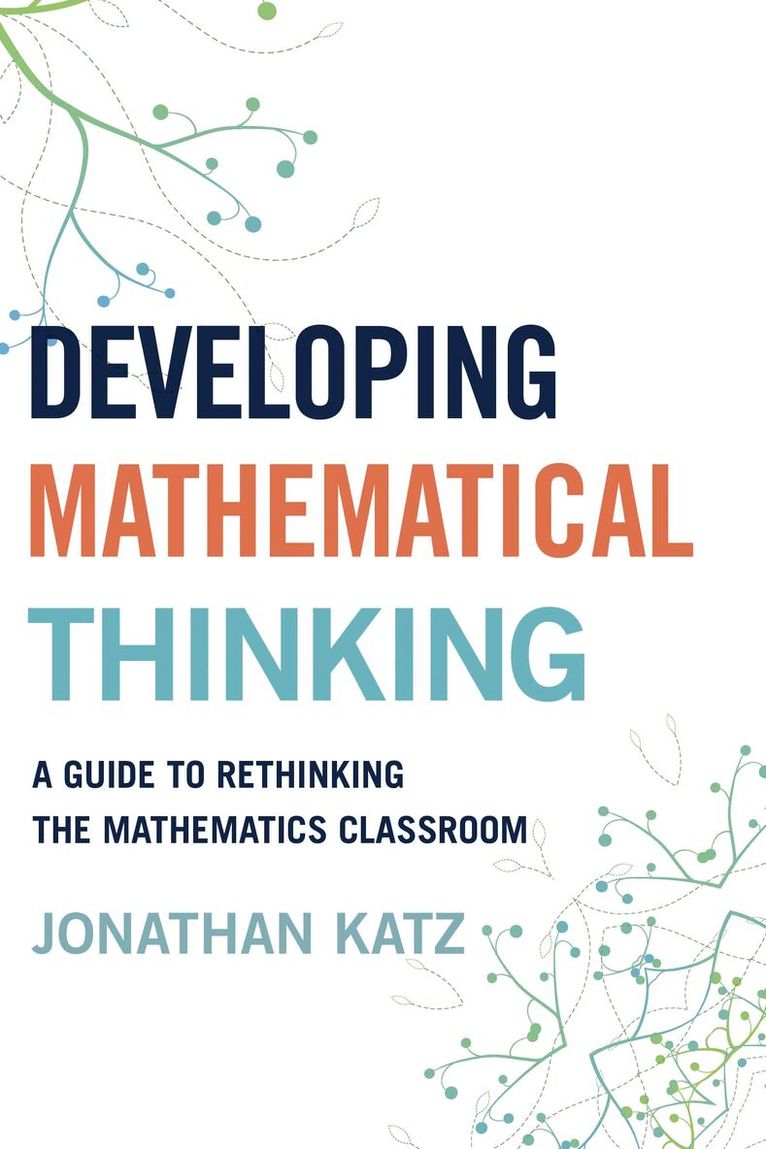
Developing Mathematical Thinking
A Guide to Rethinking the Mathematics Classroom
496 kr
Beställningsvara. Skickas inom 10-15 vardagar. Fri frakt över 249 kr.
Fler format och utgåvor
Beskrivning
Produktinformation
- Utgivningsdatum:2014-07-07
- Mått:153 x 230 x 11 mm
- Vikt:227 g
- Format:Häftad
- Språk:Engelska
- Antal sidor:144
- Förlag:Bloomsbury Publishing Plc
- ISBN:9781475810578
Utforska kategorier
Mer om författaren
Jonathan Katz has been involved in math education a both a teacher and math coach for 33 years. He received his doctorate from Columbia University Teachers College in 2009.
Recensioner i media
I recommend Developing Mathematical Thinking for anyone interested in the transformation of a mathematics classroom to a place of inquiry, creativity, and excitement for both teacher and students. It would be an excellent resource to build collaboration among middle and secondary in-service and preservice teachers, mathematics teacher educators, mathematics coaches, and professional development facilitators.
Innehållsförteckning
- PrefaceIntroductionWhat Will You Find in This BookChapter 1: An Explanation of the ISA Approach to Teaching and Learning MathematicsIntroductionA Vision of Mathematics in an ISA ClassroomGuide To Creating a Vision and Four-Year PlanISA Mathematics RubricIndicators of Teacher Instructional Practices That Elicit Student Mathematical ThinkingIndicators of Student Demonstration of Mathematical ThinkingChapter 2: A Guide to Teaching and Learning Mathematics Using the Five Dimensions of the ISA RubricIntroductionDimension 1: Problem SolvingProblem Solving Definition and OverviewTeaching Idea #1: Choosing the Appropriate ProblemTeaching Idea #2A: Use Problems with Multiple StrategiesTeaching Idea #2B: Selecting an Appropriate StrategyTeaching Idea #3: Value Process and AnswerTeaching Idea #4: Answer Student Questions to Foster UnderstandingTeaching Idea #5: Error as a Tool for InquiryTeaching Idea #6: Students Create Their Own ProblemsDimension II: Reasoning and ProofReasoning and Proof Definitions and OverviewTeaching Idea #1: ConjecturingTeaching Idea #2: Evidence and ProofTeaching Idea #3: MetacognitionDimension III: CommunicationCommunication Definition and OverviewTeaching Idea #1: Writing in JournalsTeaching Idea #2: Writing in Problems and ProjectsTeaching Idea #3: Oral CommunicationDimension IV: ConnectionsConnections Definition and OverviewXTeaching Idea #1: There Are Common Structures That Bind Together the Multiple Ideas of MathematicsTeaching Idea #2: The History of Mathematics Helps Students Make Sense of and Appreciate MathematicsTeaching Idea #3: Using Contextual Problems That Are Meaningful to StudentsDimension V: RepresentationRepresentation Definition and OverviewTeaching Idea #1A: Learning to Abstract - Moving from Arithmetic to AlgebraTeaching Idea #1B: Learning to Abstract - Use Examples of Physical StructuresTeaching Idea #2: Making Sense of Confusion to Solve ProblemsTeaching Idea #3: Interpreting and ExplainingTeaching Idea #4A: Mathematical Modeling – Modeling Mathematical Ideas and Real World SituationsTeaching Idea #4B: Mathematical Modeling – Projects of the World That Use Rich MathematicsChapter 3: Problems, Investigations, Lessons, Projects, and Performance TasksIntroductionExample 1: Display Dilemma Problem – Using Multiple Strategies / Looking for PatternsExample 2: Shakira’s Number – Valuing ProcessExample 3: Crossing the River – Valuing ProcessExample 4: Checker Board Problem – Simplifying the ProblemExample 5: When Can I Divide? – Using Errors as a Tool of InquiryExample 6: Creating a Mathematical Situation: Three Examples – Students Create Their Own ProblemsExample 7: The Game of 27 – Reasoning and ConjecturingExample 8: The String Problem – ConjecturingExample 9: Congruence and Similarity – Conjecturing and ProofExample 10: The Race – Metacognition on Multiple StrategiesExample 11: Murder Mystery – Evidence and ProofExample 12: The Locker Problem – MetacognitionExample 13: Gaming the Dice – Writing in ProblemsExample 14: Does Penelope Crash Into Mars? – Problems Are Meaningful to StudentsExample 15: Consecutive Sums Problem – Patterns and ConjecturingExample 16: Activity to Lead to Definition and Multiple Representations of a Function – Structures in MathematicsExample 17: The Pythagorean Triplets – The History of MathematicsExample 18: Laws of Exponents – Moving From Arithmetic to AlgebraExample 19: Working with Variables – Learning to Abstract: Moving from Arithmetic to AlgebraExample 20: Models of the Seagram Building – Use of Physical StructuresExample 21: How Tall Is Your School Building? – Use of Physical StructuresExample 22: Model Suspension Bridge Project – Modeling Real World SituationsExample 23: Shoe Size Problem – Modeling Real World SituationsExample 24: The Peg Game – Using Games to Understand MathematicsExample 25: Concentration of Medication in a Patient’s Blood Over Time – Modeling Using Real World DataExample 26: Marcella’s Bagels – Working BackwardsExample 27: What is normal? – Modeling Mathematical Ideas and Real World SituationsExample 28: Can You Build the Most Efficient Container? – Mathematical ModelingExample 29: Salary Choice – Mathematical ModelingExample 30: Border Problem – Learning to Abstract: Moving from Arithmetic to AlgebraExample 31: The Magical Exterior Angles – Encouraging the Use of Evidence and Proof in Daily Problem SolvingExample 32: Creating a Fair Game – Projects of the World That Use Rich MathematicsChapter 4: Various Guides for TeachersIntroductionSchool Mathematics: A Self-AssessmentWhat Does An Inquiry Process Look Like In Mathematics?How to Write an Inquiry LessonQuestions to Think About When Planning an Inquiry-Based Common Core Aligned UnitList of Questions to Think About When Writing a Mathematical Performance TaskGuide to Writing an Inquiry LessonInquiry-Based Lesson Planning TemplateBig Ideas in AlgebraBig Ideas in GeometryBig Ideas in Probability and StatisticsQuestions for Students to Ask Themselves When Solving a ProblemAn Inquiry Approach to Look at Student WorkAn Inquiry Approach to Look at a Teacher-Created Task, Activity, or LessonTeacher’s Perceptions ContinuumStudent’s Perceptions ContinuumSchool Mathematics: A Self-AssessmentReferences
Mer från samma författare
Amos Badertscher Images and Stories
Hunter O'Hanian, Hunter O’Hanian, Jonathan D. Katz, Beth Saunders
Inbunden, 2025
577 kr
Du kanske också är intresserad av
- -19%
- 4 för 3
En flicka som kallas Alice
Kristin Hannah
Pocket, 2025
99 kr
- -22%
- -30%
- Nyhet
- -30%
- 4 för 3
- -23%
- 4 för 3
Brevbäraren i Lizzanello
Francesca Giannone
Pocket, 2026
99 kr