• Fri frakt över 249 kr
  • •
  • Snabba leveranser
  • •
  • Billiga böcker
Kundservice

Du är på sajten för privatpersoner.

Företag, bibliotek eller offentlig verksamhet?

Du handlar på classic.bokus.com, där alla dina funktioner finns intakta.
Till classic.bokus.com
Bokus logotyp. Gå till startsidan.
  • Erbjudanden
  • Student
  • Topplistor
  • Barn & ungdom
  • Bokus Play
  • E-böcker
  • Ljudböcker
  • Pocketböcker
  • Spel och pussel

Pocketfynda! Hundratals böcker för 49 kr/st →

Sidfot

Mina sidor

    Hjälp

    • Kundservice
    • Vanliga frågor och svar
    • Frakt och leverans
    • Retur vid ångerrätt
    • Reklamera vara
    • Betalning
    • Köpvillkor
    • Allmänna villkor
    • Information om webbplatsens tillgänglighet

    Om Bokus

    • Om oss
    • Pressrum
    • För studenter
    • För företag
    • För bibliotek och offentlig verksamhet
    • För leverantörer
    • Hållbarhet

    Populärt

    • Aktuella erbjudanden
    • Presentkort
    • Studentlitteratur
    • Nya böcker
    • Topplistor
    • Signerade böcker
    • Engelska böcker

    Inspiration

    • Boktips
    • BookTok
    • Barnbokskaraktärer
    • Populära författare
    Logotyp för Bokus
    Följ oss på Facebook (extern länk)Följ oss på Instagram (extern länk)Följ oss på YouTube (extern länk)Följ oss på TikTok (extern länk)
    bokus @ CookiesAnpassa cookiesIntegritetspolicyKöpvillkor
    Till Citymail hemsida (extern länk)Till Budbee hemsida (extern länk)Till Postnord hemsida (extern länk)Till Schenker hemsida (extern länk)Till Early Bird hemsida (extern länk)Till Walleys hemsida (extern länk)
    1. Historia och arkeologi
    2. Historia
    3. Militärhistoria
    4. Modern militärhistoria

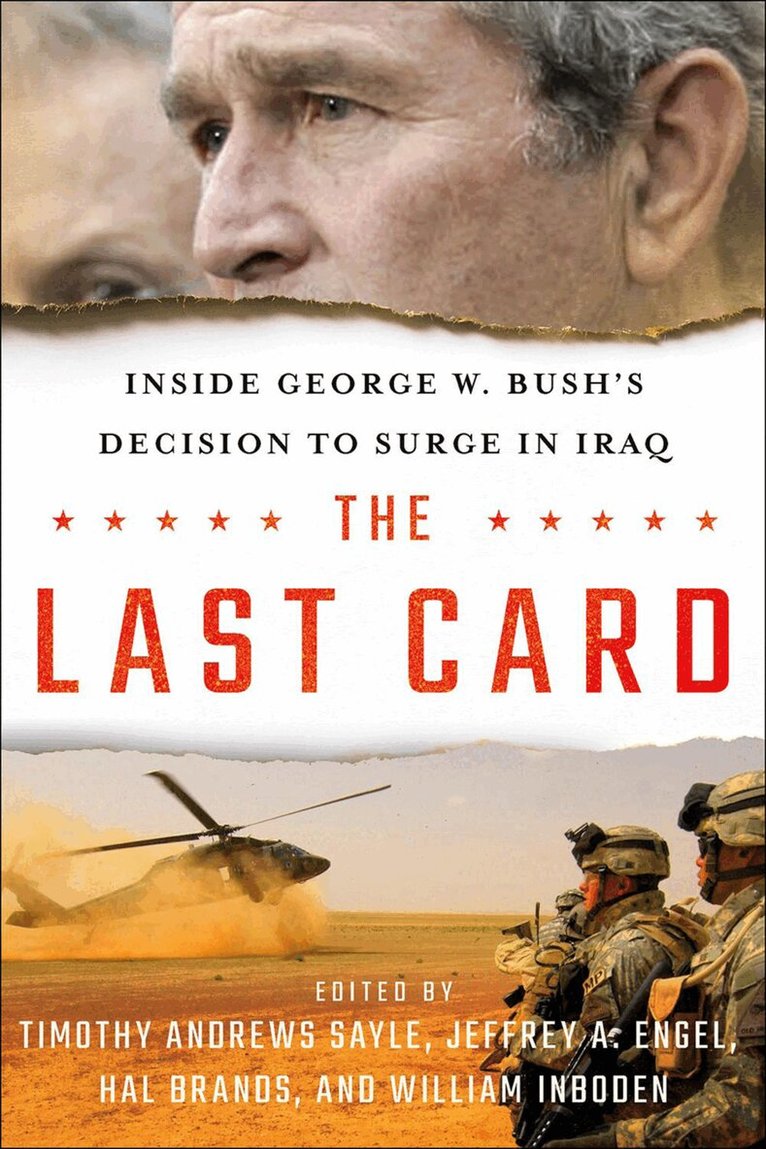
    Last Card

    Inside George W. Bush's Decision to Surge in Iraq

    AvTimothy Andrews Sayle,Jeffrey A. Engel

    Inbunden, Engelska, 2019

    390 kr

    Beställningsvara. Skickas inom 3-6 vardagar. Fri frakt över 249 kr.

    Beskrivning

    This is the real story of how George W. Bush came to double-down on Iraq in the highest stakes gamble of his entire presidency. Drawing on extensive interviews with nearly thirty senior officials, including President Bush himself, The Last Card offers an unprecedented look into the process by which Bush overruled much of the military leadership and many of his trusted advisors, and authorized the deployment of roughly 30,000 additional troops to the warzone in a bid to save Iraq from collapse in 2007.The adoption of a new counterinsurgency strategy and surge of new troops into Iraq altered the American posture in the Middle East for a decade to come. In The Last Card we have access to the deliberations among the decision-makers on Bush's national security team as they embarked on that course. In their own words, President George W. Bush, Vice President Dick Cheney, National Security Advisor Stephen Hadley, Secretary of State Condoleezza Rice, White House Chief of Staff Joshua Bolten, Secretary of Defense Robert Gates, and others, recount the debates and disputes that informed the process as President Bush weighed the historical lessons of Vietnam against the perceived strategic imperatives in the Middle East. For a president who had earlier vowed never to dictate military strategy to generals, the deliberations in the Oval Office and Situation Room in 2006 constituted a trying and fateful moment.Even a president at war is bound by rules of consensus and limited by the risk of constitutional crisis. What is to be achieved in the warzone must also be possible in Washington, D.C. Bush risked losing public esteem and courted political ruin by refusing to disengage from the costly war in Iraq. The Last Card is a portrait of leadership—firm and daring if flawed—in the Bush White House.The personal perspectives from men and women who served at the White House, Foggy Bottom, the Pentagon, and in Baghdad, are complemented by critical assessments written by leading scholars in the field of international security. Taken together, the candid interviews and probing essays are a first draft of the history of the surge and new chapter in the history of the American presidency.

    Produktinformation

    • Utgivningsdatum:2019-09-15
    • Mått:152 x 229 x 38 mm
    • Vikt:907 g
    • Format:Inbunden
    • Språk:Engelska
    • Antal sidor:416
    • Förlag:Cornell University Press
    • ISBN:9781501715181
    • Utmärkelser:Runner-up for Link-Kuehl Prize for Documentary Editing 2020 (United States)

    Utforska kategorier

    • Modern militärhistoria inom Historia och arkeologi
    • Konflikter efter andra världskriget inom Historia och arkeologi

    Mer om författaren

    Timothy Andrews Sayle is Assistant Professor in the Department of History at the University of Toronto.Jeffrey A. Engel is Director of the Center for Presidential History at Southern Methodist University.Hal Brands is the Henry A. Kissinger Distinguished Professor of Global Affairs at the Johns Hopkins School of Advanced International Studies and a scholar at the American Enterprise Institute. He is the author of What Good is Grand Strategy?William Inboden is Executive Director and William Powers, Jr., Chair of the Clements Center for National Security at the University of Texas at Austin.

    Recensioner i media

    This is a fascinating contribution to the history of the war.(Foreign Affairs) An expertly researched and written oral and narrative history, The Last Card examines the excruciatingly complex process of American decision making in the run-up to the 2007 surge against al Qaeda in Iraq... This precious narrative history shows the complexities of war planning and is a most welcome addition to modern American war studies, though it is best intended for advanced readers.(Choice) It is essential to learn the right lessons from the Iraq War, and The Last Card is an important first step in what one hopes will be a much longer journey of discovery.(Survival) The Last Card is an excellent resource for scholars. It provides important and authoritative insights into one of the seminal events in American history.(The US Army War College Quarterly) The Last Card makes an invaluable contribution to the emerging literature on the subsequent course of the war, bringing scholars and policy-makers together to explore how and why the surge came to be.(International Affairs) The Last Card is unique in that the book looks to make primary and secondary contributions simultaneously. Without a doubt, the work adds to narratives regarding the Bush administration and its handling of the war in Iraq. It provides insight on a thematically complex subject, offering immediate value to scholars in several fields.(Presidential Studies Quarterly) This oral history of the decision for "the surge" in Iraq in 2007 provides a valuable resource for scholars trying to grapple with the larger course of the Iraq War. The Last Card is an exemplary effort by this team of scholars to consider this event as history, and o a fantastic resource for teachers who want to assign interviews or essays à la carte to help their students wrestle with the surge's origins and impact.(H-Net)

    Innehållsförteckning

    • Introduction: The American Occupation of Iraq by 2006 and the Search for a New Strategy1. America's War in Iraq: 2003–20052. This Strategy Is Not Working: January–June 20063. Together Forward? June–August 20064. Silos and Stovepipes: September–October 20065. Setting the Stage: Early November 20066. A Sweeping Internal Review: Mid–Late November 20067. Choosing to Surge: December 20068. What Kind of Surge? Late December 2006–January 20079. How the "Surge" Came to Be10. Iraq, Vietnam, and the Meaningof Victory11. Decisions and Politics12. Blood, Treasure, and Time: Strategy-Making for the Surge13. Strategy and the Surge14. Civil-Military Relations and the 2006 Iraq Surge15. The Bush Administration's Decision to Surge in Iraq: A Long and Winding Road16. The President as Policy Entrepreneur: George W. Bush and the 2006 Iraq Strategy Review