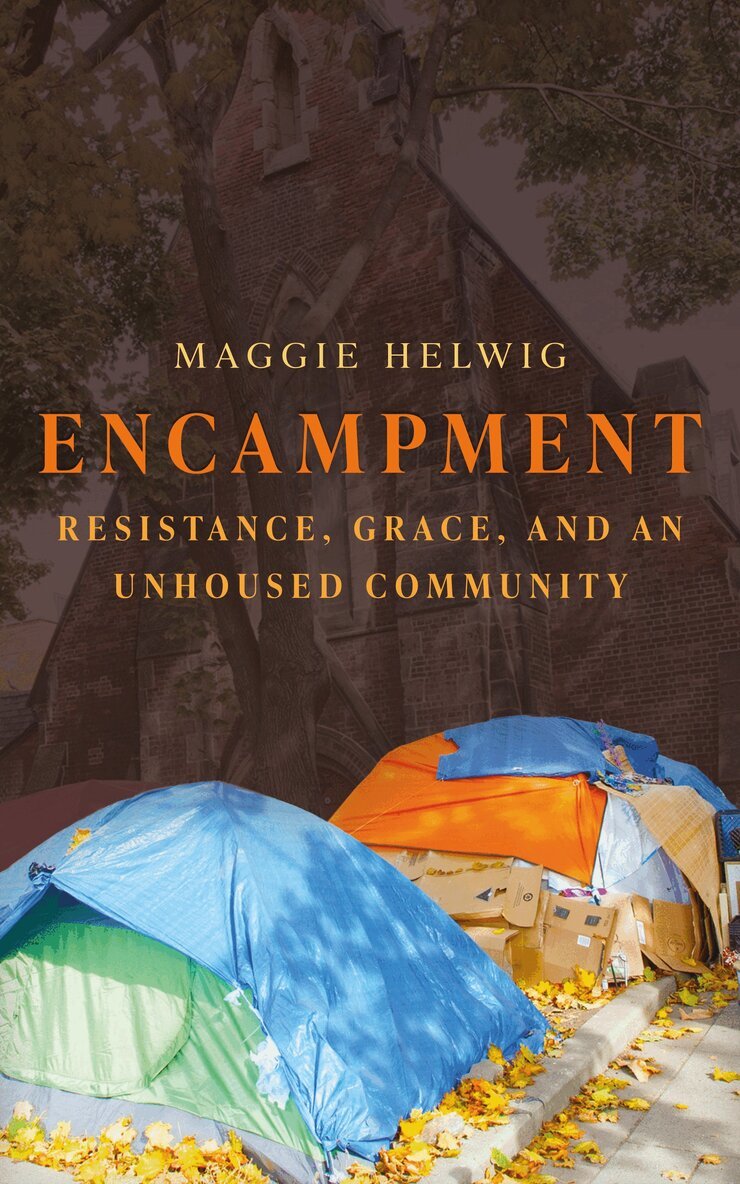
'[S]tirring ... Helwig achieves the improbable, shedding fresh light on overfamiliar stories such as the parable of the Good Samaritan ... [her] vibrant voice speaks truth to power.' – Rebecca Foster, Shelf Awareness'What I found in Helwig’s latest book was a way of peering slantwise through the stained glass, a way of hearing the well-worn bible stories of my childhood anew.' – Emily Hoven, The Toronto Review'[Instructions for the End of the World] provides an antidote to the Christian nationalism that so often dominates the public conversation in North America. Canon Helwig returns to Christianity’s roots as an outsider movement – a faith found not in the halls of power, but in the margins.' – Martha Holmen, The Anglican‘Mother Maggie dares to reimagine the church as a space for provocative engagement. Poet, writer, and disruptor, she sheds light on our shortcomings and motivates us to unite to improve our shared experience.’ – Sook-Yin Lee'Remarkable... [A]n edifying, beautifully composed wellspring of moral courage.' – Publishers Weekly, ★ STARRED Review'In this stunning collection of sermons, Maggie Helwig offers a masterclass in public theology: grounded in biblical reflection and leadership in a particular community of faith, yet with an expansive view of the Church's role in serving the common good. With every word, she reminds us that prophetic witness is, at its core, a pastoral response to those whose lives are at risk. Read on, and be changed.' – Bishop Mariann Budde, author of How We Learn to Be Brave: Decisive Moments in Life and FaithPraise for the Author:‘In crystalline prose, [Encampment] sheds light on not only the struggles of the unhoused but the heartlessness of a society that would rather not see them at all.’ – Publishers Weekly, ★ STARRED Review‘Helwig is a natural storyteller who effortlessly weaves the various threads of her worlds into a rich, compelling tapestry. She is a candid and surprisingly non-judgmental writer. She also has a wonderfully dry sense of humour with an eye for the comical and absurd – a precious asset for a book such as this.’ – Stuart Mann, The Anglican, on Encampment‘Encampment represents an important contribution to literature regarding homelessness.’ – James Hughes, Literary Review of Canada‘In Encampment, Helwig casts an unapologetic gaze at how our government and society fail to provide homeless people with the basic necessities of life, spotlighting the beliefs and rationalizations that lead to these failures, and the dire implications for the health and well-being of unhoused people.’ – Christina Palassio, The Philanthropist Journal‘It’s like the start of a bad joke: an Anglican priest walks into a homeless encampment. Except it’s her churchyard the encampment is in, and the people who live there become her community. She experiences life with them, grieves with them when a friend is lost or a temporary dwelling is uprooted yet again; she administers Narcan and stands with them before the Claw the city uses to tear down their tents. She fights with them, and in doing so invites us to look unflinchingly at a population many of us would prefer to ignore. These people are real, the systems that keep them on the streets are deeply rooted, and it is important for us to see, to bear witness, to engage.’ – Anneka Weicht, Changing Hands Bookstore (AZ), on Encampment‘Helwig is a priest, human rights activist, poet, caregiver, friend, mother, Mother. And she is, most admirably, a reader – a reader of sacred texts, yes, but also a reader of a city, of a neighbourhood, of bureaucracy, of poetry, of law by turns incensing and nonsensical, and of a community frequently deemed illegible or illegitimate in their living because the living looks different. With this book, Helwig maps a space for difference. Encampment enacts the gesture of a hand reaching out to meet another, of a question being formed, and of a need – however difficult to translate its utterance – that is listened to with respect and responded to with attention. Reader to reader, Helwig asks us: How might we better live together?’ – Claire Foster, Type Books (Toronto, ON)