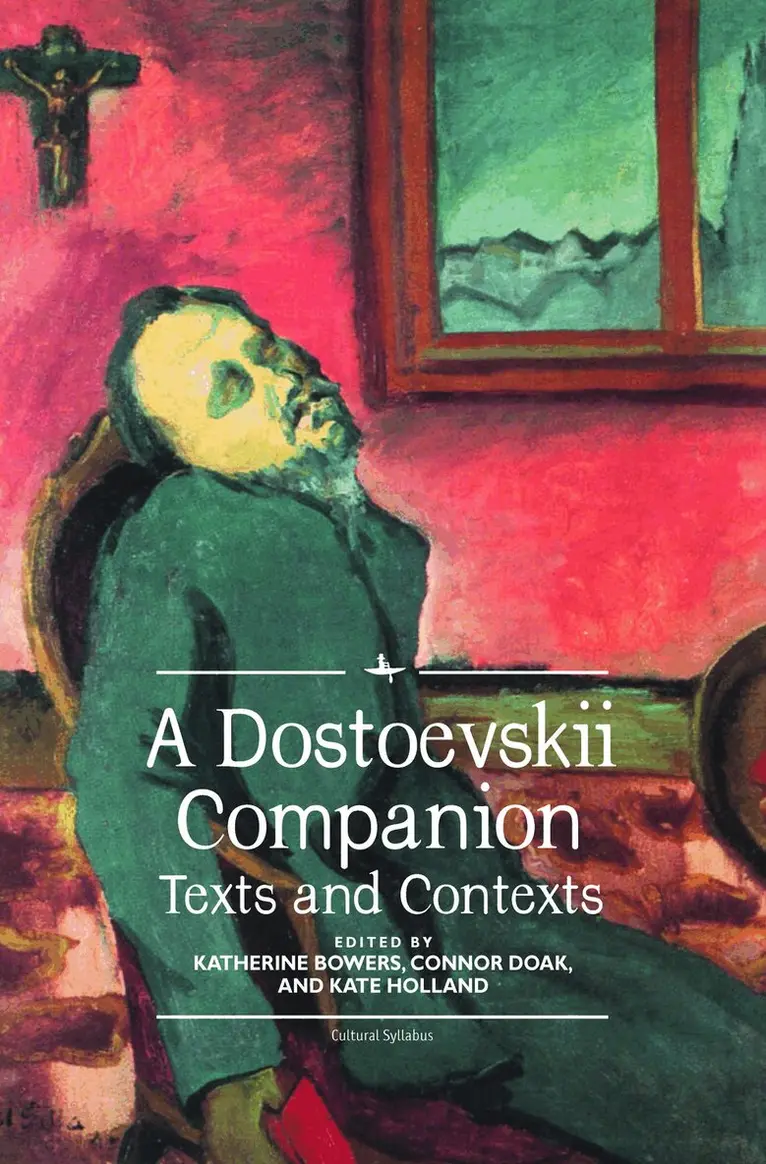
Del i serien Cultural Syllabus
1 905 kr
Beställningsvara. Skickas inom 5-8 vardagar. Fri frakt över 249 kr.
Beskrivning
Produktinformation
- Utgivningsdatum:2018-11-29
- Mått:155 x 234 x 37 mm
- Vikt:1 004 g
- Format:Inbunden
- Språk:Engelska
- Serie:Cultural Syllabus
- Antal sidor:556
- Förlag:Academic Studies Press
- ISBN:9781618117267
Utforska kategorier
Mer om författaren
Katherine Bowers is an Assistant Professor of Slavic Studies at the University of British Columbia. A specialist in nineteenth-century Russian literature and culture, she is currently completing a monograph about gothic fiction’s influence on Russian realism.Connor Doak is a lecturer in Russian at the University of Bristol. He works primarily on nineteenth- and twentieth-century Russian literature, with a special interest in gender and sexuality in Russian culture. He has authored articles on authors including Dostoevsky, Chekhov, Petrushevskaia and Pushkin, and is currently working on a study of masculinity in Maiakovsky’s poetry.Kate Holland is Associate Professor of Russian Literature at the University of Toronto. She is the author of the monograph, The Novel in the Age of Disintegration: Dostoevsky and the Problem of Genre in the 1870s (2013), as well as articles on Dostoevsky, Tolstoy, Herzen, Saltykov-Shchedrin and Veselovsky.
Recensioner i media
“This fascinating and useful collection combinesDostoevsky’s own texts (fictional excerpts, letters, articles) with a number ofilluminating essays to shed light on various aspects of the author’s life, work,and thought. Designed with undergraduate students in mind, the collection,edited by Katherine Bowers, Connor Doak, and Kate Holland, will be of greathelp to students and to those who teach them, capturing what professors talkabout when they talk about Dostoevsky.” —Vladimir Golstein, Brown University, Russian Review Vol. 78, No. 2
Innehållsförteckning
- AcknowledgmentsHow to Use this BookNote on Translation, Transliteration, and ReferencingTimeline of Dostoevskii’s Life and WorksBiography and ContextChapter 1: The Early DostoevskiiIntroduction“A Noble Vocation” (2012) by Robert BirdThe Ribbon Theft Incident from Confessions (1789) by Jean-Jacques RousseauA Son’s Revenge from The Robbers (1781) by Friedrich SchillerFirst Glimpse of Udolpho (1794) by Ann RadcliffeThe House of Monsieur Grandet in Eugénie Grandet (1833) by Honoré de BalzacLittle Nell in The Old Curiosity Shop (1841) by Charles DickensThe Overcoat (1842) by Nikolai Gogol′ Poor Folk (1846) by Fedor DostoevskiiFirst Night from “White Nights” (1848) by Fedor DostoevskiiLetter to Gogol′ (1847) by Vissarion BelinskiiThree Documents from the Petrashevskii Trial (1849)The Mock Execution: Letter to Mikhail Dostoevskii, December 22, 1849 by Fedor DostoevskiiChapter 2: Dostoevskii and His ContemporariesIntroductionA Review of The Double (1846) by Vissarion BelinskiiThoughts on The Double (1847) by Valerian MaikovThe Row with Turgenev: Letter to Apollon Maikov, August 16, 1867 by Fedor DostoevskiiThe Caricature of Turgenev in Demons (1872) by Fedor DostoevskiiReaction to Demons: Letter to Mariia Miliutina, December 3, 1872 by Ivan Turgenev“Landowners’ Literature”: Letter to Nikolai Strakhov, May 18, 1871 by Fedor DostoevskiiThoughts on Anna Karenina (1877) by Fedor DostoevskiiTiny Alterations of Consciousness (1890) by Lev TolstoyFrom A Cruel Talent (1882) by Nikolai MikhailovskiiTolstoy and Dostoevskii (1902) by Dmitrii MerezhkovskiiThe Root and the Flower: Dostoevskii and Turgenev (1993) by Robert Louis JacksonPoeticsChapter 3: AestheticsIntroductionMr. —bov and the Question of Art (1861) by Fedor DostoevskiiThe Defense of the Ideal: Letter to Apollon Maikov, December 11, 1868 by Fedor DostoevskiiApropos of the Exhibition (1873) by Fedor DostoevskiiPoet of the Underground (1875) by Fedor DostoevskiiDmitrii Karamazov on Beauty (1878) by Fedor DostoevskiiTwo Kinds of Beauty (1966) by Robert Louis JacksonDostoevskii’s Fantastic Pages (2006) by Vladimir ZakharovChapter 4: CharactersIntroductionMakar Devushkin (2009) by Carol ApollonioUnderground Man (1963) by Mikhail BakhtinRaskol′nikov (2002) by Konstantine KlioutchkineMyshkin (1998) by Liza KnappNastas′ia Filippovna (2004) by Sarah J. YoungStavrogin (1969) by Joseph FrankFedor Karamazov (2003) by Deborah A. MartinsenIvan Karamazov and Smerdiakov (1992) by Harriet MuravAlesha Karamazov (1977) by Valentina VetlovskaiaChapter 5: The NovelIntroductionA Novel of Disintegration from the Notebooks for The Adolescent (1874) by Fedor DostoevskiiAn Exceptional Family from The Adolescent (1875) by Fedor DostoevskiiRemaking the Noble Family Novel (2013) by Kate HollandA New Kind of Hero (1963) by Mikhail Bakhtin“Chronicle Time” in Dostoevskii (1979) by Dmitrii LikhachevThe Narrator of The Idiot (1981) by Robin Feuer MillerSideshadowing in Dostoevskii’s Novels (1994) by Gary Saul MorsonThe Plot of Crime and Punishment (2016) by Robert L. BelknapChapter 6: From Journalism to FictionIntroductionFeuilleton, April 22, 1847 by Fedor DostoevskiiThe Petersburg Feuilletons (1979) by Joseph FrankDostoevskii’s “Vision on the Neva” (1979) by Joseph FrankExcerpts from the Notebooks for The Idiot (1867) by Fedor DostoevskiiNastas′ia Filippovna’s History from The Idiot (1869) by Fedor DostoevskiiOl′ga Umetskaia and The Idiot (2017) by Katherine BowersTwo Suicides from A Writer’s Diary (1876) by Fedor DostoevskiiFrom “The Meek One: A Fantastic Story” (1876) by Fedor DostoevskiiA Case Study: October, November, December 1876 (2013) by Kate HollandA Writer’s Diary as a Historical Phenomenon (2004) by Igor′ VolginA Writer’s Diary, April 1877 issue in fullThemesChapter 7: Captivity, Free Will, and UtopiaIntroductionDostoevskii’s Prison Years (2013) by James P. ScanlanPrison Life: Letter to Mikhail Dostoevskii, February 22, 1854 by Fedor DostoevskiiThe Prison from Notes from the House of the Dead (1862) by Fedor DostoevskiiThe Eagle from Notes from the House of the Dead (1862) by Fedor DostoevskiiDostoevskii Responds to the Censorship Committee (1986) by Joseph FrankVera Pavlovna’s Fourth Dream from What Is to Be Done? (1863) by Nikolai ChernyshevskiiThe Prison of Utopia (1986) by Joseph FrankThe Crystal Palace from Notes from Underground (1864) by Fedor DostoevskiiTwice Two from Notes from Underground (1864) by Fedor DostoevskiiPhilosophical Pro et Contra in Part I of Crime and Punishment (1981) by Robert Louis JacksonMeta-utopia (1981) by Gary Saul MorsonA Note on His Wife’s Death (1864) by Fedor DostoevskiiThe Speech at the Stone from Brothers Karamazov (1880) by Fedor DostoevskiiOde to Joy (2004) by Robert Louis JacksonChapter 8: Dostoevskii’s OthersIntroductionPortrait of Alei in Notes from the House of the Dead (1862) by Fedor DostoevskiiPortrait of Isai Fomich in Notes from the House of the Dead (1862) by Fedor DostoevskiiThe Jewish Question (1877) by Fedor DostoevskiiChristians, Muslims, and Jews in Notes from the House of the Dead (2008) by Susan McReynoldsFrom “A Few Words about George Sand” (1876) by Fedor DostoevskiiFrom “About Women Again” (1876) by Fedor DostoevskiiThe Woman Question in Crime and Punishment (1994) by Nina Pelikan StrausThe Mothers Karamazov (2009) by Carol ApollonioChapter 9: RussiaIntroductionFellow Convicts from Notes from the House of the Dead (1862) by Fedor DostoevskiiAfter the Emancipation (1860) by Fedor DostoevskiiGoing Beyond Theory (1862) by Fedor DostoevskiiDostoevskii and the Slavophiles (2003) by Sarah HudspithThe Coming Apocalypse from the Notebooks for Demons (1870) by Fedor DostoevskiiPeasant Marei (1876) by Fedor DostoevskiiPushkin Speech (1880) by Fedor DostoevskiiChapter 10: GodIntroductionA Confession of Faith: Letter to Natal′ia Fonvizina, early March 1854 by Fedor DostoevskiiMyshkin and Rogozhin Exchange Crosses in The Idiot (1869) by Fedor DostoevskiiDostoevskii’s Religious Thought (1903) by Lev ShestovOn the Grand Inquisitor (1921) by Nikolai BerdiaevHagiography in Brothers Karamazov (1985) by Nina PerlinaOn the Koranic Motif in The Idiot and Demons (2012) by Diane Oenning ThompsonFrom Dostoevskii’s Religion (2005) by Steven CassedyIndex