• Fri frakt över 249 kr
  • •
  • Snabba leveranser
  • •
  • Billiga böcker
Kundservice

Du är på sajten för privatpersoner.

Företag, bibliotek eller offentlig verksamhet?

Du handlar på classic.bokus.com, där alla dina funktioner finns intakta.
Till classic.bokus.com
Bokus logotyp. Gå till startsidan.
  • Erbjudanden
  • Student
  • Topplistor
  • Barn & ungdom
  • Bokus Play
  • E-böcker
  • Ljudböcker
  • Pocketböcker
  • Spel och pussel

Pocketfynda! Hundratals böcker för 49 kr/st →

Sidfot

Mina sidor

    Hjälp

    • Kundservice
    • Vanliga frågor och svar
    • Frakt och leverans
    • Retur vid ångerrätt
    • Reklamera vara
    • Betalning
    • Köpvillkor
    • Allmänna villkor
    • Information om webbplatsens tillgänglighet

    Om Bokus

    • Om oss
    • Pressrum
    • För studenter
    • För företag
    • För bibliotek och offentlig verksamhet
    • För leverantörer
    • Hållbarhet

    Populärt

    • Aktuella erbjudanden
    • Presentkort
    • Studentlitteratur
    • Nya böcker
    • Topplistor
    • Signerade böcker
    • Engelska böcker

    Inspiration

    • Boktips
    • BookTok
    • Barnbokskaraktärer
    • Populära författare
    Logotyp för Bokus
    Följ oss på Facebook (extern länk)Följ oss på Instagram (extern länk)Följ oss på YouTube (extern länk)Följ oss på TikTok (extern länk)
    bokus @ CookiesAnpassa cookiesIntegritetspolicyKöpvillkor
    Till Citymail hemsida (extern länk)Till Budbee hemsida (extern länk)Till Postnord hemsida (extern länk)Till Schenker hemsida (extern länk)Till Early Bird hemsida (extern länk)Till Walleys hemsida (extern länk)
    1. Psykologi och pedagogik
    2. Psykologi
    3. Socialpsykologi och gruppsykologi

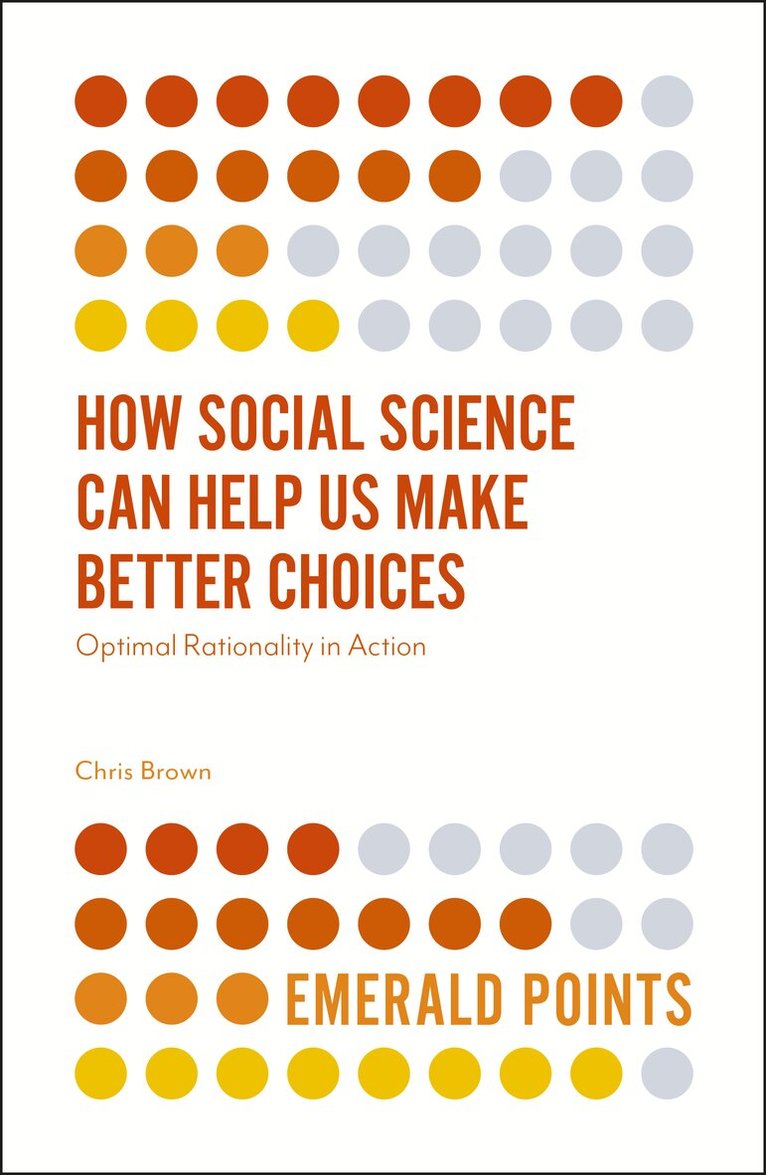
    How Social Science Can Help Us Make Better Choices

    Optimal Rationality in Action

    AvChris Brown

    Häftad, Engelska, 2018

    Del i serien Emerald Points

    616 kr

    Beställningsvara. Skickas inom 5-8 vardagar. Fri frakt över 249 kr.

    Fler format och utgåvor

    E-bok

    503 kr

    E-bok

    503 kr

    Beskrivning

    In a world beset with problems, how can we encourage people to act differently? It seems almost daily that new studies emerge telling us how human action is causing planetary degradation, how changes to our diets could lead to us living longer healthier lives, or that financially we are in danger of returning to the debt related crises of the previous decade. At the same time how many of us adjust our behaviour in response to such information?;In this new book Professor Chris Brown explores people’s reactions to Optimal Rational Positions: propositions that set out requirements for change. For example the need to reduce carbon emissions to minimize the impacts of climate change is an Optimal Rational Position; as is the need to engage in 30 minutes of exercise a day, to eat more healthily or to drink less alcohol. It seems obvious that we should want to pursue Optimal Rational Positions because they espouse the types of behaviours that will enable us to live healthier, happier or more productive lives; that can improve the lives and outcomes of others; or that can help us ensure social and environmental sustainability. Yet at the same time we often fail to change our behaviours to those which might be most optimal. Outlining an exciting and innovative route forward, and with real-life case studies from education,;How Social Science Can Help Us Make Better Choices provides a new way to think about why people make the choices they make and, vitally, the role social science can play in response.

    Produktinformation

    • Utgivningsdatum:2018-04-20
    • Mått:129 x 198 x 8 mm
    • Vikt:156 g
    • Format:Häftad
    • Språk:Engelska
    • Serie:Emerald Points
    • Antal sidor:136
    • Förlag:Emerald Publishing Limited
    • ISBN:9781787543560

    Utforska kategorier

    • Socialpsykologi och gruppsykologi inom Psykologi och pedagogik
    • Sociala och etiska frågor inom Samhälle och politik
    • Sociologi inom Samhälle och politik

    Mer om författaren

    Chris Brown is Professor of Education at the University of Portsmouth, UK. He is author of Achieving Evidence Informed Policy and Practice in Education: Evidenced and Leading the Use of Research and Evidence in Schools. In 2016, he was awarded the Jeffrey V. Bennett Award for Outstanding International Research.

    Recensioner i media

    The author considers the role of social science in helping people make better choices and explores people's reactions to optimal rational positions, propositions that set requirements for change. He argues that because these positions consist of a combination of hard facts and a general desire to improve people's lives, they present people with a substantive requirement to do something different, and that people should want to pursue optimal rational positions because they put forth the types of behaviors that will enable them to live healthier, happier, or more productive lives; improve the lives and outcomes of others; or ensure social and environmental sustainability. He discusses how optimal rational positions can be obtained by understanding what is needed to change people's perspectives and behaviors, and how the plan of action can be implemented to help achieve this change. He describes the idea of optimal rationality; how semiotic analysis can fill gaps in rationality; an optimal rationality case study from education (of teachers who are not using evidence-informed practice to improve teaching and student outcomes); how the semiotic idea of "scenes" can be used to change the desirability of an optimal rational position and people's wish to be associated with it; and lessons from this work for social science and the ways researchers can develop approaches to maximize the types of optimal rational position-related behavior to improve lives.

    Innehållsförteckning

    • Introduction1. An Introduction to Optimal Rationality2. Using Semiotic Analysis to Fill Rationality Gaps3. A Case Study from Education - Part 14. A Case Study from Education - Part 25. Attending to the Signifier - Using 'Scenes' to Make Optimal Rational Positions More Attractive;6. Lessons for Social Science Moving ForwardAppendix 1: Full Analysis of the Interview Data from Chapter 3;