• Fri frakt över 249 kr
  • •
  • Snabba leveranser
  • •
  • Billiga böcker
Kundservice

Du är på sajten för privatpersoner.

Företag, bibliotek eller offentlig verksamhet?

Du handlar på classic.bokus.com, där alla dina funktioner finns intakta.
Till classic.bokus.com
Bokus logotyp. Gå till startsidan.
  • Erbjudanden
  • Student
  • Topplistor
  • Barn & ungdom
  • Bokus Play
  • E-böcker
  • Ljudböcker
  • Pocketböcker
  • Spel och pussel

5% studentrabatt – använd koden KURSBOK27 →

Sidfot

Mina sidor

    Hjälp

    • Kundservice
    • Vanliga frågor och svar
    • Frakt och leverans
    • Retur vid ångerrätt
    • Reklamera vara
    • Betalning
    • Köpvillkor
    • Allmänna villkor
    • Information om webbplatsens tillgänglighet

    Om Bokus

    • Om oss
    • Pressrum
    • För studenter
    • För företag
    • För bibliotek och offentlig verksamhet
    • För leverantörer
    • Hållbarhet

    Populärt

    • Aktuella erbjudanden
    • Presentkort
    • Studentlitteratur
    • Nya böcker
    • Topplistor
    • Signerade böcker
    • Engelska böcker

    Inspiration

    • Boktips
    • BookTok
    • Barnbokskaraktärer
    • Populära författare
    Logotyp för Bokus
    Följ oss på Facebook (extern länk)Följ oss på Instagram (extern länk)Följ oss på YouTube (extern länk)Följ oss på TikTok (extern länk)
    bokus @ CookiesAnpassa cookiesIntegritetspolicyKöpvillkor
    Till Citymail hemsida (extern länk)Till Budbee hemsida (extern länk)Till Postnord hemsida (extern länk)Till Schenker hemsida (extern länk)Till Early Bird hemsida (extern länk)Till Walleys hemsida (extern länk)
    1. Historia och arkeologi
    2. Historia
    3. Historia: särskilda händelser och ämnen
    4. Socialhistoria och kulturhistoria

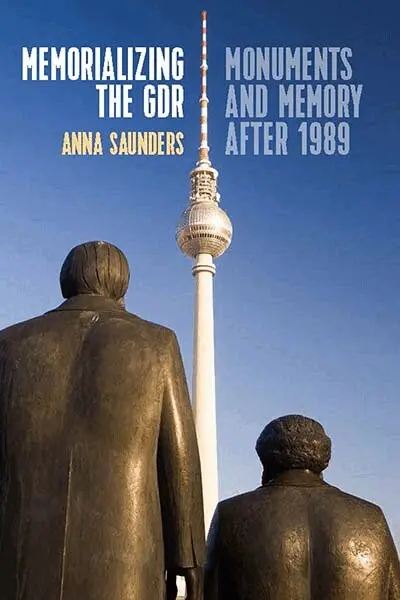
    Memorializing the GDR

    Monuments and Memory after 1989

    AvAnna Saunders

    Häftad, Engelska, 2020

    657 kr

    Beställningsvara. Skickas inom 3-6 vardagar. Fri frakt över 249 kr.

    Fler format och utgåvor

    Inbunden

    2 239 kr

    E-bok

    374 kr

    Beskrivning

    Since unification, eastern Germany has witnessed a rapidly changing memorial landscape, as the fate of former socialist monuments has been hotly debated and new commemorative projects have met with fierce controversy. Memorializing the GDR provides the first in-depth study of this contested arena of public memory, investigating the individuals and groups devoted to the creation or destruction of memorials as well as their broader aesthetic, political, and historical contexts. Emphasizing the interrelationship of built environment, memory and identity, it brings to light the conflicting memories of recent German history, as well as the nuances of national and regional constructions of identity.

    Produktinformation

    • Utgivningsdatum:2020-07-01
    • Mått:152 x 229 x 35 mm
    • Vikt:564 g
    • Format:Häftad
    • Språk:Engelska
    • Antal sidor:382
    • Förlag:Berghahn Books
    • ISBN:9781789208016

    Utforska kategorier

    • Socialhistoria och kulturhistoria inom Historia och arkeologi
    • Arkitektur inom Kultur

    Mer om författaren

    Anna Saunders is Professor of Modern Languages and Cultures in the School of Histories, Languages and Cultures at the University of Liverpool. Her publications include the monograph Honecker’s Children: Youth and Patriotism in Eastern Germany (2007) and the collection Remembering and Rethinking the GDR: Multiple Perspectives and Plural Authenticities (2013, coedited with Debbie Pinfold).

    Recensioner i media

    “I highly recommend this thoughtful, well-written book for all who are interested in understanding the place of the GDR in contemporary debates about the past and the present and for gaining insight into a certain sense of German national identity by examining lessons Germans draw from this past.” • Sehepunkte“The volume, which is based on a solid and extensive bibliography, but also on the examination of daily principles and archival research, offers a very readable, detailed and extensive analysis. The theme of monuments, in its various aspects, offers itself as a useful tool to deepen the process of memorialization of the German Democratic Republic, treasuring the most recent debates.” • Richerche di Storia Politica“All in all, Saunders makes a firm contribution to the field by showing how monuments can be important sites for democratic engagement around which multiple narratives can converge. Her wide-ranging monograph provides a needed update of the classic question about the relationship between monuments and memory and is a welcome addition to the growing literature on the memory of the GDR. Often poignant, sometimes playful, and occasionally provocative, the cases presented here ultimately tell of a grappling with the recent past that is, in its own way, one of the unheralded success stories of unification.” • H-Soz-Kult“Saunders’ greatest achievement with this thoroughly researched and persuasively argued book is revealing the catalyzing role monuments have played as vehicles for negotiating new postreunification German identity. Her balanced approach to monuments, which considers them above all ‘as processes and social spaces, rather than as fixed spaces or static objects’ is unique and should be a model for other researchers.” • German Politics and Society“This is a consistently high-quality monograph, founded on a thorough awareness of memory politics. It reaches persuasive conclusions that challenge established theoretical positions in the field, especially in the way it highlights the dynamic two-way relationship between communicative and cultural memory in the evolution of post-unification memorials.” • Dennis Tate, University of Bath

    Innehållsförteckning

    • List of IllustrationsAcknowledgementsList of Abbreviations and Key TermsIntroductionChapter 1. Memory, Monuments and MemorializationChapter 2. Socialist Icons: From Heroes to Villains?Chapter 3. Soviet Special Camps: Reassessing a Repressed PastChapter 4. 17 June 1953 Uprisings: Remembering a Failed RevolutionChapter 5. The Berlin Wall: Historical Document, Tourist Magnet or Urban Eyesore?Chapter 6. Remembering the 'Peaceful Revolution' and German UnityConclusion: Beyond the PalimpsetBibliographyIndex