• Fri frakt över 249 kr
  • •
  • Snabba leveranser
  • •
  • Billiga böcker
Kundservice

Du är på sajten för privatpersoner.

Företag, bibliotek eller offentlig verksamhet?

Du handlar på classic.bokus.com, där alla dina funktioner finns intakta.
Till classic.bokus.com
Bokus logotyp. Gå till startsidan.
  • Erbjudanden
  • Student
  • Topplistor
  • Barn & ungdom
  • Bokus Play
  • E-böcker
  • Ljudböcker
  • Pocketböcker
  • Spel och pussel

Pocketfynda! Hundratals böcker för 49 kr/st →

Sidfot

Mina sidor

    Hjälp

    • Kundservice
    • Vanliga frågor och svar
    • Frakt och leverans
    • Retur vid ångerrätt
    • Reklamera vara
    • Betalning
    • Köpvillkor
    • Allmänna villkor
    • Information om webbplatsens tillgänglighet

    Om Bokus

    • Om oss
    • Pressrum
    • För studenter
    • För företag
    • För bibliotek och offentlig verksamhet
    • För leverantörer
    • Hållbarhet

    Populärt

    • Aktuella erbjudanden
    • Presentkort
    • Studentlitteratur
    • Nya böcker
    • Topplistor
    • Signerade böcker
    • Engelska böcker

    Inspiration

    • Boktips
    • BookTok
    • Barnbokskaraktärer
    • Populära författare
    Logotyp för Bokus
    Följ oss på Facebook (extern länk)Följ oss på Instagram (extern länk)Följ oss på YouTube (extern länk)Följ oss på TikTok (extern länk)
    bokus @ CookiesAnpassa cookiesIntegritetspolicyKöpvillkor
    Till Citymail hemsida (extern länk)Till Budbee hemsida (extern länk)Till Postnord hemsida (extern länk)Till Schenker hemsida (extern länk)Till Early Bird hemsida (extern länk)Till Walleys hemsida (extern länk)
    1. Naturvetenskap och teknik
    2. Teknik och industri
    3. Elektronik och kommunikationer

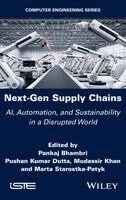
    Next-Gen Supply Chains

    AI, Automation, and Sustainability in a Disrupted World

    AvPankaj Bhambri,Pankaj Bhambri

    Inbunden, Engelska, 2026

    Del i serien ISTE Invoiced

    1 723 kr

    Beställningsvara. Skickas inom 5-8 vardagar. Fri frakt över 249 kr.

    Beskrivning

    In an era defined by global disruptions, sustainability mandates and rapid technological advancement, Next-Gen Supply Chains provides an essential roadmap for navigating the complex transformation of global supply networks. This comprehensive book moves beyond isolated trends to present an integrated framework where generative AI, blockchain, autonomous systems and the Internet of Things converge to build resilient, efficient and responsible operations.This book masterfully bridges the critical gap between theoretical concepts and practical implementation, offering readers actionable strategies, detailed case studies from industry leaders such as Amazon and Lenovo, and robust frameworks for risk management, ethical AI governance and circular economy integration. With its unique emphasis on the synergy between technological innovation and the necessary human capital development, the book is an indispensable resource for supply chain executives, operations managers, technology implementers and academics seeking to future-proof their organizations and master the strategic imperatives of the modern supply chain landscape.

    Produktinformation

    • Utgivningsdatum:2026-03-24
    • Mått:156 x 234 x 24 mm
    • Vikt:757 g
    • Format:Inbunden
    • Språk:Engelska
    • Serie:ISTE Invoiced
    • Antal sidor:416
    • Upplaga:26001
    • Förlag:ISTE Ltd
    • ISBN:9781836690740

    Utforska kategorier

    • Elektronik och kommunikationer inom Naturvetenskap och teknik
    • Systemvetenskap och AI inom Data och IT
    • Projektledning inom Ekonomi och Ledarskap

    Mer om författaren

    Pankaj Bhambri is an associate professor and a Stanford Top 2% Scientist. He is a postdoctoral researcher, specializing in machine learning and wireless communications. His research focuses on AI, blockchain and sustainable computing.Pushan Kumar Dutta is an associate professor and Erasmus Mundus scholar, specializing in AI and edge computing. His research focuses on bridging data analytics and sustainable technology for smart cities and healthcare.Mudassir Khan is an assistant professor and postdoctoral fellow, specializing in big data analytics and AI. His research on deep learning and IoT applications concerns healthcare and computer science.Marta Starostka-Patyk is a professor specializing in logistics and supply chain management. Her research focuses on sustainable logistics, reverse logistics and information technologies in modern supply chains.

    Innehållsförteckning

    • Preface xixPankaj BHAMBRI, Pushan KUMAR DUTTA, Mudassir KHAN and Marta STAROSTKA-PATYKChapter 1. AI and Automation: Building Resilient and Sustainable Supply Chains in Uncertain Times 1Sanam SOOMRO, Mingyue FAN, Ranjeeta SADHWANI and Safia SOOMRO1.1. Introduction 11.2. Understanding supply chain resilience 21.3. Risk management frameworks 21.4. Impact of the pandemic on supply chain vulnerabilities 31.5. Building resilience post-pandemic 51.6. The future of supply chain resilience 71.7. Conclusion 101.8. References 11Chapter 2. Generative AI's Impact on Supply Chain Decision-Making 17Pankaj BHAMBRI and Himani SHARMA2.1. Introduction 172.2. Literature review 182.3. Comparison table 222.4. Challenges 282.5. Technologies 292.6. Future scope 302.7. References 31Chapter 3. Circular Supply Chain Economics 35Vijay Kumar SINHA and Balajee MARAM3.1. Introduction 353.2. Conceptual foundations 363.3. Circular supply-chain economic mechanisms 373.4. Demand and revenue models 383.5. Operations research models: closed-loop inventory, pricing and remanufacturing 403.6. Metrics for businesses and products 413.7. Rules and standards set by the government 443.8. Changes in jobs and structures 453.9. Case studies and empirical evidence 453.10. Barriers and enablers 463.11. Evidence from the real-world and case studies 473.12. Things that get in the way and things that help 483.13. A plan for companies to follow to put it into action 513.14. Research priorities and gaps 513.15. Conclusion 523.16. References 53Chapter 4. IoT Architecture for End-to-End Visibility 59Marta STAROSTKA-PATYK4.1. Introduction 594.2. Visibility of supply chains 604.3. Internet of Things (IoT) in logistics and supply chains 614.4. IoT for end-to-end visibility in supply chains 644.5. IoT challenges and barriers to end-to-end visibility in supply chains 664.6. The future of IoT in supply chains and their visibility E2E 684.7. Conclusions 694.8. References 69Chapter 5. Building Blocks of a Transparent IoT Ecosystem 73Bhagwat KAULWAR, Milind GODASE, Chandrani SINGH and Pankaj BHAMBRI5.1. Introduction 745.2. Characteristics of IoT 765.3. IoT architecture 775.4. IoT as XaaS 805.5. Conclusion 835.6. References 84Chapter 6. Blockchain Implementation for Supply Chain Transparency Modeling 87Helena KOSCIELNIAK6.1. Introduction 876.2. Experimental methods and materials 896.3. Results and discussion: case studies 906.4. Conclusion 986.5. References 99Chapter 7. Autonomous Systems in Supply Chain Operations 101Agnieszka PACUD7.1. Introduction 1017.2. Objective and scope of the chapter 1047.3. Research procedure 1047.4. Analysis of results and discussion 1067.5. Conclusions 1117.6. References 113Chapter 8. Leveraging Data and Analytics for Next-Generation Supply Chain Resilience 117Karina ZACHARSKA8.1. Introduction 1178.2. The challenges of today's supply chains 1198.3. The role of data as the foundation for optimization 1198.4. The importance of data in supply chain management 1208.5. Technologies supporting data collection and analysis 1218.6. Analytical methods and optimization models in supply chain management 1268.7. Conclusion 1298.8. References 130Chapter 9. Data-driven Supply Chain Optimization 133Rafa³ NIEDBAL, Paula PYP£ACZ and Muhammad Asif KHAN9.1. Introduction 1339.2. Literature review 1349.3. Automated ML in supply chain optimization 1409.4. Conclusion 1519.5. References 152Chapter 10. Sustainability Transformation Roadmaps 159Paula BAJDOR10.1. Introduction 15910.2. Sustainability transformation 16110.3. Sustainability roadmap structures 16210.4. Building a sustainable transformation roadmap 16910.5. Conclusion 17110.6. References 172Chapter 11. Reimagining Supply Chains: Nearshoring and Network Redesign in the Age of AI, Automation and Sustainability 175Jeffy JOHNSON11.1. Introduction 17611.2. Experimental methods and materials 17611.3. Nearshoring as a resilience strategy 17611.4. Conceptual foundations of nearshoring 17711.5. Drivers of nearshoring adoption 17711.6. Benefits of nearshoring 17811.7. Challenges and risks of nearshoring 17911.8. Industry case studies 18011.9. Theoretical and analytical frameworks 18111.10. Future directions in nearshoring research 18111.11. Network redesign and digital twins 18111.12. Challenges and future directions 18411.13. Sustainability and ESG compliance in supply chains 18711.14. Analysis of supply chain performance graphs 18911.15. Recommendations 19211.16. Conclusion 19311.17. References 193Chapter 12. Digital Supply Chain Talent Development: Preparing the Workforce for Next-Gen Supply Chains 197Pankaj BHAMBRI and Sita RANI12.1. Introduction: the looming talent crisis in a digital era 19712.2. Defining the next-generation supply chain professional 20012.3. A strategic framework for talent development 20212.4. The critical role of academia and industry partnerships 20512.5. Case study: building a future-ready talent pipeline in practice 20612.6. Conclusion: securing competitive advantage through strategic talent management 20712.7. References 210Chapter 13. Change Management for Supply Chain Transformation 213S. KAVITHAMBIKA, K.M. SANTHOSHA, R. KIRAN and Pankaj BHAMBRI13.1. Introduction 21313.2. Theoretical foundations of change management 21413.3. Framework for supply chain change management 21913.4. Importance of leadership and governance structures 22113.5. Challenges and barriers 22113.6. Enablers and best practices 22213.7. The future 22213.8. References 223Chapter 14. Future Horizons: Emerging Technologies and Models 227Krishi Pallab SAIKIA, Debjit DHAR, Rik DAS and Saranik MAHAPATRA14.1. Introduction 22814.2. A unified framework for intelligent data migration 23114.3. The role of generative AI in cross-domain data migration 23714.4. Real-world applications across domains: bridging petrochemical and medical data ecosystems 24114.5. Synthetic evaluation and performance metrics 24614.6. Future directions 250 14.6.1. Explainable AI for semantic transformation 25114.7. Conclusion 25214.8. References 252Chapter 15. Cybersecurity and Zero Trust Architectures in Supply Chains 255P. ASHOK, Venkatesh RAMAMURTHY, S. Lakshmi SRIDEVI and K. Murali KRISHNA15.1. Introduction 25615.2. Literature review 25615.3. Architectures in supply chain landscape 25815.4. The pillars of Zero Trust in the supply chain context 26015.5. Implementing ZTA: an architectural shift 26315.6. Zero Trust for next-generation supply chain technologies 26315.7. Technical challenges/limitations 26315.8. Future enhancements 26415.9. Conclusion 26415.10. References 265Chapter 16. Additive Manufacturing and the Rise of Digital Inventory 271Pankaj BHAMBRI and Mudassir KHAN16.1. Introduction: the burden of physical inventory 27116.2. Defining the digital inventory paradigm 27216.3. Additive manufacturing as the enabling technology 27316.4. Strategic benefits: resilience, agility and cost redefinition 27316.5. The sustainability imperative: waste reduction and localized production 27416.6. Implementation challenges and considerations 27516.7. Future horizons: integrating digital inventory with AI and IoT 27616.8. Conclusion: a roadmap for adoption 27816.9. References 279Chapter 17. Ethical and Social Governance of AI-enabled Supply Chains 283Pankaj BHAMBRI and Marta STAROSTKA-PATYK17.1. Introduction: the imperative for ethical AI in global supply chains 28317.2. Core ethical challenges posed by supply chain AI 28717.3. Societal implications and stakeholder perspectives 28917.4. Frameworks for ethical AI governance in supply chains 29117.5. Implementing social governance: beyond compliance 29317.6. Building the governance infrastructure 29517.7. Metrics, reporting and continuous improvement 29717.8. Case studies: navigating ethical dilemmas 29917.9. Conclusion: toward responsible and trustworthy AI-powered supply chains 30117.10. References 303Chapter 18. Revolutionizing Supply Chains with Artificial Intelligence and Machine Learning: A Conceptual Model 307Sunitaa TANK, Manika GARG and Bharat Kumar TANK18.1. Introduction 30718.2. Literature review 30818.3. Methodology 31018.4. Conceptual model 31118.5. Findings 31318.6. Implications 31418.7. Conclusion 31518.8. Future research directions 31618.9. References 317Chapter 19. Enabling AI in Supply Chain Transformation: An MCDM-Based Analysis of Critical Success Factors 321Tripti SHARMA, Akash RAI, Indrajit GHOSAL and Md. Rahat KHAN19.1. Introduction 32119.2. Literature review 32319.3. Methodology 32619.4. Findings and discussion 33019.5. Conclusion and future work 33319.6. References 334Chapter 20. Sustainable Intelligence: Aligning Ethical AI in Global Supply Chain Systems 337Gagandeep SINGH, Jasdeep Singh WALIA and Priya MANDIRATTA20.1. Introduction 33720.2. Review of the literature 33820.3. Research gap 34320.4. Theoretical framework 34420.5. Proposed framework concerning sustainable intelligence in AI-enabled supply chains 34720.6. Implications of the study 35020.7. Conclusion and scope for future research work 35320.8. References 354List of Authors 359Index 365