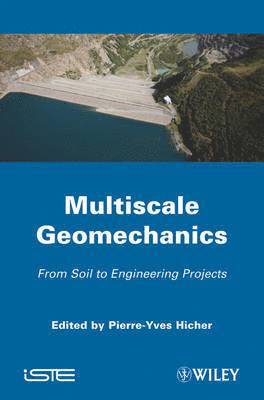
Multiscale Geomechanics
From Soil to Engineering Projects
Inbunden, Engelska, 2011
2 581 kr
Beställningsvara. Skickas inom 11-20 vardagar. Fri frakt över 249 kr.
Beskrivning
This book addresses the latest issues in multiscale geomechanics. Written by leading experts in the field as a tribute to Jean Biarez (1927-2006), it can be of great use and interest to researchers and engineers alike.A brief introduction describes how a major school of soil mechanics came into being through the exemplary teaching by one man. Biarez's life-long work consisted of explaining the elementary mechanisms governing soil constituents in order to enhance understanding of the underlying scientific laws which control the behavior of constructible sites and to incorporate these scientific advancements into engineering practices.He innovated a multiscale approach of passing from the discontinuous medium formed by individual grains to an equivalent continuous medium. The first part of the book examines the behavior of soils at the level of their different constituents and at the level of their interaction. Behavior is then treated at the scale of the soil sample.The second part deals with soil mechanics from the vantage point of the construction project. It highlights Biarez's insightful adoption of the Finite Element Codes and illustrates, through numerous construction examples, his methodology and approach based on the general framework he constructed for soil behavior, constantly enriched by comparing in situ measurements with calculated responses of geostructures.
Produktinformation
- Utgivningsdatum:2011-11-25
- Mått:165 x 241 x 28 mm
- Vikt:748 g
- Format:Inbunden
- Språk:Engelska
- Antal sidor:396
- Förlag:ISTE Ltd and John Wiley & Sons Inc
- ISBN:9781848212466
Utforska kategorier
Mer om författaren
Pierre-Yves Hicher is Professor of Civil Engineering at Ecole Centrale de Nantes in France, specializing in soil behavior and constitutive modeling. His publications are numerous and well-known, particularly an early work Elementary Mechanics of Soil Behaviour (1994) co-authored with Jean Biarez.
Innehållsförteckning
- Preface xi Acknowledgments xvChapter 1. Jean Biarez: His Life and Work 1Jean-Louis BORDES, Jean-Louis FAVRE and Daniel GRIMM1.1. Early years and arrival in Grenoble 11.2. From Grenoble to Paris 41.3. The major research interests of Jean Biarez 81.4. Research and teaching 91.5. Conclusion 13Chapter 2. From Particle to Material Behavior: the Paths Chartered by Jean Biarez 15Bernard CAMBOU and Cécile NOUGUIER-LEHON2.1. Introduction 152.2. The available tools, the variables analyzed and limits of the proposed analyses 162.3. Analysis of geometric anisotropy 182.4. Analysis of the distribution of contact forces in a granular material 212.5. Analysis of local arrays 242.6. Particle breakage 272.7. Conclusion 322.8. Bibliography 32Chapter 3. Granular Materials in Civil Engineering: Recent Advances in the Physics of Their Mechanical Behavior and Applications to Engineering Works 35Etienne FROSSARD3.1. Behavior resulting from energy dissipation by friction 373.1.1. Introduction 373.1.2. Fundamentals 383.1.3. Main practical consequences 433.1.4. Conclusions 523.2. Influence of grain breakage on the behavior of granular materials 533.2.1. Introduction to the grain breakage phenomenon 533.2.2. Scale effect in shear strength 563.3. Practical applications to construction design 633.3.1. A new method for rational assessment of rockfill shear strength envelope 633.3.2. Incidence of scale effect on rockfill slope stability 653.3.3. Scale effects on deformation features 703.4. Conclusions 783.5. Bibliography 79Chapter 4. Waste Rock Behavior at High Pressures: Dimensioning High Waste Rock Dumps 83Edgar BARD, María EUGENIA ANABALÓN and José CAMPAÑA4.1. Introduction 834.2. Development of new laboratory equipment for testing coarse materials 844.2.1. Triaxial and oedometric equipment at the IDIEM 854.3. Mining rock waste 864.3.1. In situ grain size distribution 864.3.2. Analyzed waste rock 874.4. Characterization of mechanical behavior of the waste rock 884.4.1. Oedometric tests 884.4.2. Triaxial tests 894.4.3. Oedometric test results 904.4.4. Triaxial test results 944.5. Evolution of density 1024.6. Stability analysis and design considerations 1044.7. Operation considerations 1064.7.1. Basal drainage system 1064.7.2. Water management 1074.7.3. Foundation conditions 1074.7.4. Effects of rain and snow 1084.7.5. Effects of in situ leaching on waste rock 1084.7.6. Designing for closure 1094.8. Conclusions 1094.9. Acknowledgements 1104.10. Bibliography 110Chapter 5. Models by Jean Biarez for the Behavior of Clean Sands and Remolded Clays at Large Strains 113Jean-Louis FAVRE and Mahdia HATTAB5.1. Introduction 1135.2. Biarez’s model for the oedometer test 1155.3. Perfect plasticity state and critical void ratio 1185.4. Normally and overconsolidated isotropic loading 1225.4.1. Analogy between sands and clays 1225.4.2. Normally consolidated state (ISL) 1235.4.3. Overconsolidated state (Cs) 1245.5. The drained triaxial path for sands and clays 1265.5.1. The reference behavior 1265.5.2. The mathematical model 1275.6. The undrained triaxial path for sands 1285.6.1. Simplified Roscoe formula for undrained consolidated soils 1295.6.2. Modeling of the maxima under the right M on the plan q – p' 1305.7. Standard behavior for undrained sands 1325.7.1. Normalization by the theoretical overconsolidation stress p'iC 1325.7.2. Perfect plasticity normalization of the curves in the (q – ε1) plane and pore pressure variation 1335.7.3. Initial stress p'0 normalization in the (q – p) plane 1335.8. The triaxial behavior of “lumpy” sands 1345.8.1. “Lump” sands 1345.8.2. The Roscoe model applied to lump sands 1355.8.3. Synthesis of several lump sand behaviors 1365.9. A new model to analyze the oedometer’s path 1385.9.1. Burland’s model 1385.9.2. Comparison of models and mixed model 1415.9.3. Burland’s model in (IL – logσ'v) Biarez’s space 1445.10. “Destructuration” of clayey sediments 1445.11. Conclusion 1455.12. Examples of manuscript notes 1475.13. Bibliography 149Chapter 6. The Concept of Effective Stress in Unsaturated Soils 153Said TAIBI, Jean-Marie FLEUREAU, Sigit HADIWARDOYO, Hanène SOULI and António GOMES CORREIA6.1. Introduction 1536.2. Microstructural model for unsaturated porous media 1606.3. Material and methods 1646.3.1. Material and preparation of samples 1646.3.2. Experimental devices and test procedures 1656.3.3. Normalization of data 1706.4. Experimental results 1716.4.1. Isotropic compression paths 1716.4.2. Deviatoric compression paths 726.4.3. Small strain behavior 1736.5. Interpretation of results using the effective stress concept 1746.5.1. Interpretation of large strain triaxial tests 1756.5.2. Interpretation of small strain modulus measurements 1766.6. Conclusions 1776.7. Acknowledgements 1786.8. Bibliography 178Chapter 7. A Microstructural Model for Soils and Granular Materials 183Pierre-Yves HICHER7.1. Introduction 1837.2. The micro-structural model 1857.2.1. Inter-particle behavior 1867.2.2. Stress−strain relationship 1897.2.3. Model parameters 1907.3. Results of numerical simulation on Hostun sand 1917.3.1. Drained triaxial tests 1917.3.2. Undrained triaxial tests 1957.4. Model extension to clayey materials 1967.4.1. Remolded clays 1987.4.2. Natural clays 2007.5. Unsaturated granular materials 2047.6. Summary and conclusion 2147.7. Bibliography 216Chapter 8. Modeling Landslides with a Material Instability Criterion 221Florent PRUNIER, Sylvain LIGNON, Farid LAOUAFA and Félix DARVE8.1. Introduction 2218.2. Study of the second-order work criterion 2238.2.1. Analytical study 2238.2.2. Physical interpretation 2278.3. Petacciato landslide modeling 2298.3.1. Site presentation 2298.3.2. Description of the model used 2318.3.3. Landslide computation 2348.4. Conclusion 2388.5. Bibliography 240Chapter 9. Numerical Modeling: An Efficient Tool for Analyzing the Behavior of Constructions 243Arezou MODARESSI-FARAHMAND-RAZAVI9.1. Notations 2439.2. Introduction 2479.3. Modeling soil behavior 2489.3.1. Main characteristics of the soil’s mechanical behavior 2489.3.2. Constitutive models used for computation 2539.3.3. Simplified model 2549.3.4. Generalizing the simplified model 2629.3.5. Mechanical behavior of non-saturated soil 2659.3.6. Loading/unloading definition in plasticity 2729.3.7. Multimechanism model 2749.4. Parameter identification strategy for the ECP model 2759.4.1. Classification and identification of the ECP model parameters 2769.4.2. Directly measurable parameters 2799.4.3. Parameters that are not directly measurable 2889.4.4. Parameters defining the initial state 2909.4.5. Application of parameter identification strategy 2939.5. Influence of constitutive behavior on structural response 2999.5.1. Retaining walls 2999.5.2. Vertically loaded piles 3049.5.3. Earth and rockfill dams 3129.6. Conclusions 3189.7. Acknowledgments 3199.8. Appendix 3199.9. Bibliography 323Chapter 10. Evaluating Seismic Stability of Embankment Dams 333Jean-Jacques FRY10.1. Introduction 33310.1.1. A tribute to Jean Biarez 33310.1.2. Definitions 33410.2. Observed seismic performance 33510.2.1. Earthquake performance of gravity dams 33510.2.2. Earthquake performance of buttress dams 33610.2.3. Earthquake performance of arch dams 33710.2.4. Earthquake performance of hydraulic fills 33810.2.5. Earthquake performance of tailing dams 33910.2.6. Earthquake performance of road embankments and levees 33910.2.7. Earthquake performance of river hydroelectric embankments 33910.2.8. Earthquake performance of small earth dams 34010.2.9. Earthquake performance of large earth dams 34210.2.10. Earthquake performance of large zoned dams with rockfill 34410.2.11. Earthquake performance of concrete face rockfill dams 34410.2.12. Dynamic performance of physical models 34510.2.13. Assessment of seismic damage on dams 34510.2.14. Major seismic damage of large concrete dams 34610.2.15. Seismic damage of large embankment dams 34710.2.16. Delayed or indirect consequences of an earthquake 34710.3. Method for analyzing seismic risk 34810.3.1. Seismic classification of dams in France 34810.4. Evaluation of seismic hazard 35010.4.1. Scenarios for dimensioning a particular situation 35010.4.2. Choice of seismic levels 35010.4.3. Choice of the seismic characteristics 35110.4.4. Choice of accelerographs 35210.5. Re-evaluation of seismic stability 35510.5.1. Maximum risk associated with seismic loading: liquefaction 35510.5.2. A recommended step-by-step methodology 35710.5.3. Identification 35710.5.4. Pseudo-static analysis of stability 35810.5.5. Pseudo-static analysis of displacement 35810.5.6. Analysis of the liquefaction risk 36210.5.7. Coupled non-linear analysis 36510.5.8. Analysis of post-seismic stability 36710.5.9. Assessment 36710.6. Semi-coupled modeling of liquefaction 36810.6.1. Objectives 36810.6.2. Constitutive model 36810.6.3. Failure criterion 36910.6.4. Shear strain law 37010.6.5. Volumetric strain law: liquefaction 37210.6.6. Model implementation 37310.6.7. Model qualification in the case of the San Fernando Dam failure 37310.6.8. Model application to fluvial dikes 38010.7. Bibliography 387List of Authors 393Index 395
Hoppa över listan


Du kanske också är intresserad av
Practice of Constitutive Modelling for Saturated Soils
Zhen-Yu Yin, Pierre-Yves Hicher, Yin-Fu Jin
Häftad
1 064 kr
Practice of Constitutive Modelling for Saturated Soils
Zhen-Yu Yin, Pierre-Yves Hicher, Yin-Fu Jin
Inbunden
1 064 kr
- Nyhet
- Signerad!
- -30%
- Nyhet
- -22%
Del 1
- Signerad!
Del 3
- Nyhet