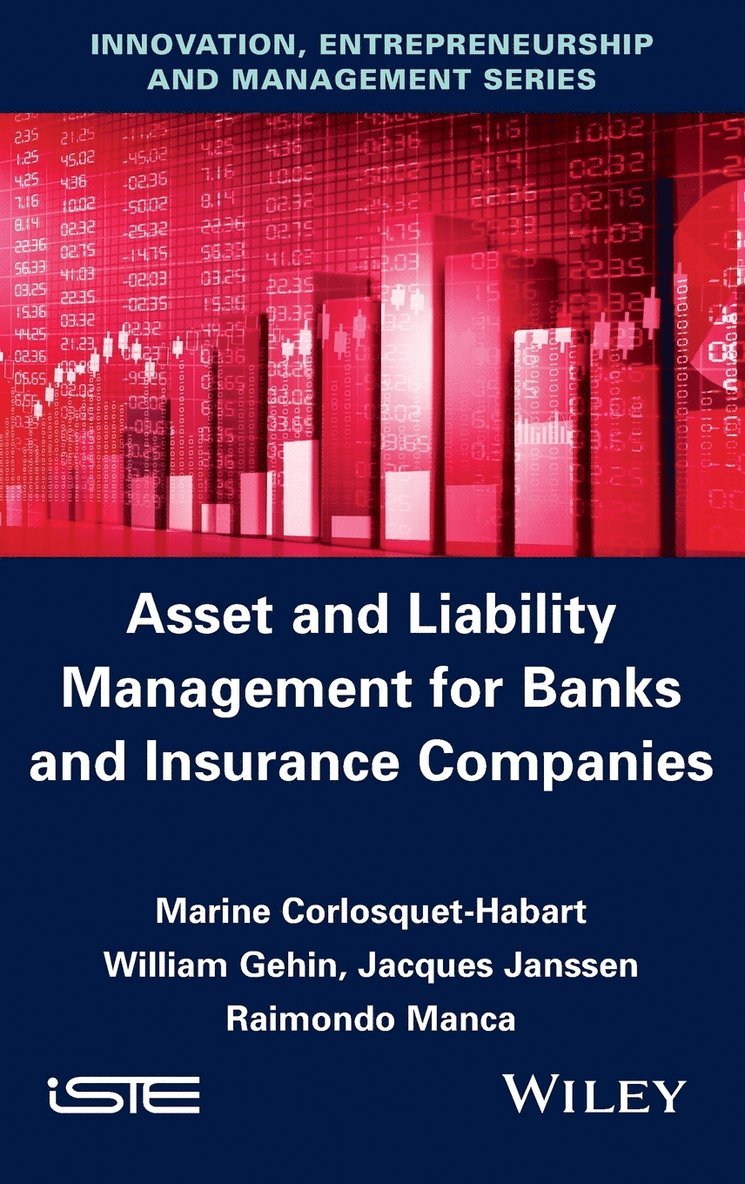
Asset and Liability Management for Banks and Insurance Companies
AvMarine Corlosquet-Habart,William Gehin
1 465 kr
Beställningsvara. Skickas inom 7-10 vardagar. Fri frakt över 249 kr.
Beskrivning
Produktinformation
- Utgivningsdatum:2015-08-04
- Mått:163 x 239 x 15 mm
- Vikt:431 g
- Format:Inbunden
- Språk:Engelska
- Antal sidor:176
- Förlag:ISTE Ltd and John Wiley & Sons Inc
- ISBN:9781848218833
Utforska kategorier
Mer om författaren
Marine Corlosquet-Habart is a certified actuary and co-director of EURIA (Euro-Institut d’Actuariat, University of West Brittany, Brest, France). She teaches at EURIA, Telecom Bretagne and Ecole Centrale Paris (France). Her main research interests are pandemics, Solvency II internal models and ALM issues for insurance companies.William Gehin is a graduate engineer and actuary with risk management experience in both banking (Rothschild, HSBC) and insurance (BNP Paribas Cardif). His actuary dissertation concerned the management of extreme financial risks and received two international prizes (FFSA and AFGAP-PRMIA prize).Jacques Janssen is Honorary Professor at the Solvay Business School (ULB) in Brussels, Belgium, having previously taught at EURIA (Euro-Institut d’Actuariat, University of West Brittany, Brest, France) and Telecom Bretagne (Brest, France) as well as being a director of Jacan Insurance and Finance Services, a consultancy and training company.Raimondo Manca is Professor of mathematical methods applied to economics, finance and actuarial science at the University of Rome in Italy. His main research interests are multidimensional linear algebra, computational probability, the application of stochastic processes to economics, finance and insurance and simulation models.
Innehållsförteckning
- INTRODUCTION ixCHAPTER 1. DEFINITION OF ALM IN THE BANKING AND INSURANCE AREAS 11.1. Introduction 11.2. Brief history of ALM for banks and insurance companies 21.3. Missions of the ALM department 31.3.1. Missions of the ALM department for banks 31.3.2. Missions of the ALM department for insurance companies 51.4. Conclusion 8CHAPTER 2. RISKS STUDIED IN ALM 92.1. Introduction 92.2. Risks studied in a bank in the framework of Basel II and III 92.2.1. Main risks for banks 92.2.2. From Basel I to Basel III 112.3. Stress tests 152.3.1. What is a stress test? 152.3.2. The stress tests of 2014 162.4. Risks studied in an insurance company in the framework of Solvency II 172.4.1. Solvency II in a nutshell 172.4.2. Focus on the risks 202.5. Commonalities and differences between banks and insurance companies’ problems 252.5.1. Commonalities 252.5.2. Differences 252.6. Conclusion 26CHAPTER 3. DURATIONS (REVISITED) AND SCENARIOS FOR ALM 273.1. Introduction 273.2. Duration and convexity risk indicators 283.3. Scenario on the cash amounts of the flow 323.4. Scenario on the time maturities of the flow 343.5. Matching asset and liability 363.6. Matching with flow scenarios 403.7. ALM with the yield curve 433.7.1. Yield curve 433.7.2. ALM with the equivalent constant rate 443.8. Matching with two rates 463.9. Equity sensitivity 473.9.1. Presentation of the problem 473.9.2. Formalization of the problem 483.9.3. Time dynamic of asset and liability flows 493.9.4. Sensitivity of equities and VaR indicator 513.9.5. Duration of equities 523.9.6. Special case of the aggregated balance sheet 523.9.7. A VaR approach 543.10. ALM and management of the bank 583.10.1. Basic principles 583.10.2. ALM and shares 583.10.3. Stochastic duration 663.11. Duration of a portfolio 703.12. Conclusion 71CHAPTER 4. BUILDING AND USE OF AN ALM INTERNAL MODEL IN INSURANCE COMPANIES 734.1. Introduction 734.2. Asset model 744.2.1. Equity portfolio 744.2.2. Bond portfolio 764.2.3. Real estate 824.2.4. Central scenario and simulated scenarios 834.3. Liability model 844.3.1. Model points 854.3.2. Mathematical reserves and annual policyholder benefits 874.3.3. Annual policyholder benefits and crediting rate 874.3.4. Profit sharing 904.3.5. Policyholder demography and behavior 914.3.6. Other reserves 944.3.7. Future new business 964.3.8. Fees and business costs 974.4. Structure of an ALM study 994.4.1. Determinist study 994.4.2. Stochastic study 1034.5. Case study 1054.5.1. Goal of the study 1054.5.2. Business plan and other liability inputs 1054.5.3. Central scenario and other asset inputs 1064.5.4. Fee and cost hypotheses 1074.5.5. Step-by-step model 1074.5.6. The ALM study 1094.6. Conclusion 114CHAPTER 5. BUILDING AND USE OF ALM INTERNAL MODELS IN BANKS 1155.1. Introduction 1155.2. Case 1: Reduction of gaps 1155.2.1. Basic numerical data 1155.2.2. Basic ALM indicators 1185.2.3. Scenario for loss reduction 1195.3. Case 2: A stochastic internal model 1215.3.1. Probability of bankruptcy 1215.3.2. Presentation of the first model (Model I) 1225.3.3. Presentation of the model with correlations (Model Ibis) 1245.3.4. Presentation of the model with correlations and non-negative values for assets and liabilities (Model II)1265.3.5. Consequences for ALM 1315.4. Calibration of the models 1355.4.1. Historical method 1355.4.2. Scenario generator 1395.5. Example 1395.5.1. Model Ibis 1395.5.2. ALM II 1425.6. Key points for building internal models 1465.6.1. How to present an internal model? 1465.6.2. Validation of the model 1475.6.3. Partial and global internal models 1475.7. Conclusion 148CONCLUSION 149BIBLIOGRAPHY 151INDEX 153
Du kanske också är intresserad av
Semi-Markov Migration Models for Credit Risk
Guglielmo D'Amico, Giuseppe Di Biase, Jacques Janssen, Raimondo Manca
1 749 kr
Semi-Markov Risk Models for Finance, Insurance and Reliability
Jacques Janssen, Raimondo Manca
1 062 kr
VaR Methodology for Non-Gaussian Finance
Marine Habart-Corlosquet, Jacques Janssen, Raimondo Manca
1 947 kr
Semi-Markov Risk Models for Finance, Insurance and Reliability
Jacques Janssen, Raimondo Manca
1 062 kr
Applied Diffusion Processes from Engineering to Finance
Jacques Janssen, Oronzio Manca, Raimondo Manca
2 121 kr
Stochastic Methods for Pension Funds
Pierre Devolder, Jacques Janssen, Raimondo Manca
2 192 kr