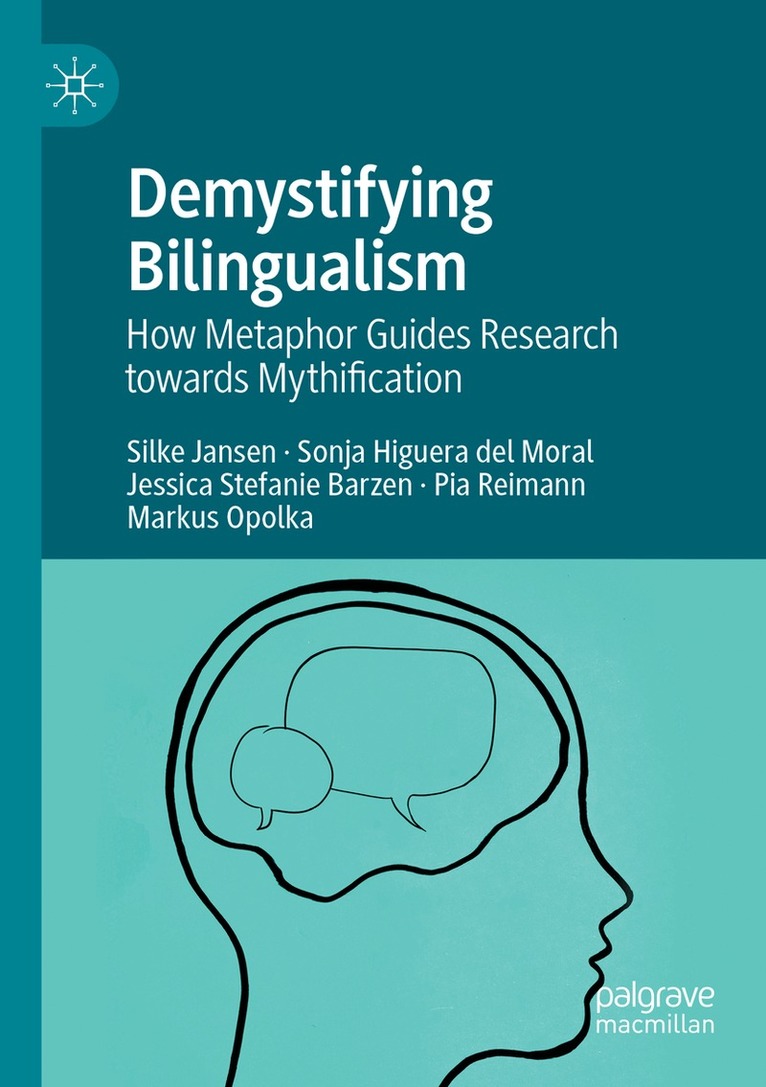
This book analyses changing views on bilingualism in Cognitive Psychology and explores their socio-cultural embeddedness. This book will be of interest to students and scholars of Cognitive Psychology, Psycholinguistics, Multilingualism and Applied Linguistics, Cognitive andComputational Linguistics, and Critical Metaphor Analysis.
Silke Jansen is Professor and Chair of Romance Philology (especially Linguistics) at Friedrich-Alexander Universität Erlangen-Nürnberg, Germany. She specializes in sociolinguistics, language contact, and linguistic ideologies, with a focus on Latin America and the Caribbean. Sonja Higuera del Moral is a PhD student at Friedrich-Alexander Universität Erlangen-Nürnberg, Germany. She is currently working on her PhD thesis on multilingual repertoires and language management skills of Hispanic migrants in Germany.Jessica Stefanie Barzen is a Research Assistant at Mannheim University, Germany. She graduated from Friedrich-Alexander Universität Erlangen-Nürnberg with a Doctor’s degree in linguistics, focusing on language contact and multilingualism. She has engaged in international research, study, and instruction in the US, Cuba, the Dominican Republic, and Haiti.Pia Reimann graduated from Friedrich-Alexander Universität Erlangen-Nürnberg, Germany with a Master's degree in linguistics, focusing on language acquisition and multilingualism. As a visiting scholar at the Pennsylvania State University, USA, she gained further experience by studying experimental psycholinguistic approaches.Markus Opolka is a software developer and system administrator with more than 10 years of professional experience in open-source technology. He has studied Computational Linguistics and Romance Philology at Friedrich-Alexander Universität Erlangen-Nürnberg, Germany.
Innehållsförteckning
Chapter 1: Introduction.- Chapter 2: Historical development and state of the art in research on the bilingual advantage.- Chapter 3: Unravelling language myths in academic discourse: Methodological considerations.- Chapter 4: Languages as objects, substances, and containers: The ontological foundations of language myths.- Chapter 5: National narratives as language myths: The metonymic conflation of languages, speakers and nations.- Chapter 6: Mind and language between the organic and the anorganic.- Chapter 7: The survival of the fittest: contention as the leading metaphor in understanding bilingualism.- Chapter 8: Deconstructing the "bilingual advantage": The fallacies of metaphorical thinking in science.- Chapter 9: Conclusion.