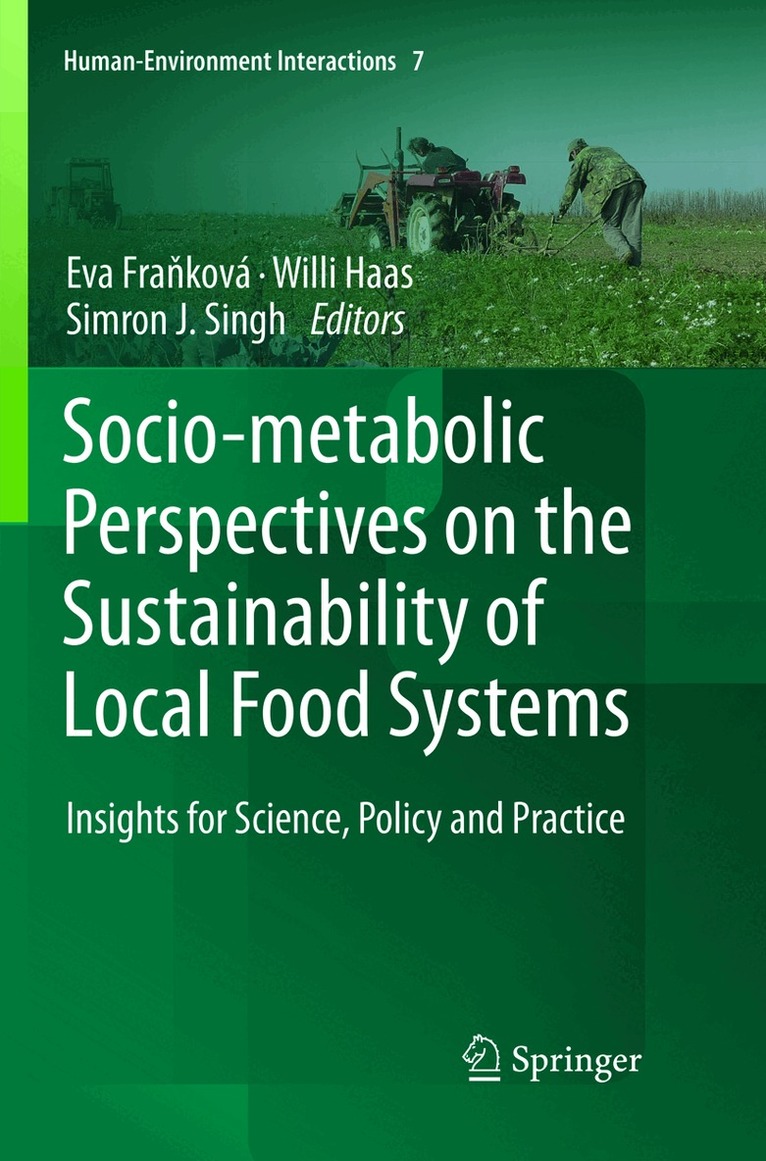
Socio-Metabolic Perspectives on the Sustainability of Local Food Systems (inbunden)
Fler böcker inom
Format
Inbunden (Hardback)
Språk
Engelska
Serie
Human-Environment Interactions (del 7)
Antal sidor
364
Utgivningsdatum
2018-01-25
Upplaga
18001
Förlag
Springer International Publishing AG
Dimensioner
241 x 167 x 26 mm
Vikt
781 g
ISBN
9783319692357

Socio-Metabolic Perspectives on the Sustainability of Local Food Systems

Insights for Science, Policy and Practice

Inbunden,  Engelska, 2018-01-25
1588
  • Skickas från oss inom 10-15 vardagar.
  • Fri frakt över 249 kr för privatkunder i Sverige.
Finns även som
Visa alla 1 format & utgåvor
This book delves into diverse local food systems and critically assesses their ecological and societal benefits and trade-offs, their limits and opportunities for improving sustainability of food production, and framework conditions which either hinder or promote their development.
Visa hela texten

Passar bra ihop

  1. Socio-Metabolic Perspectives on the Sustainability of Local Food Systems
  2. +
  3. Sustainable Land Management in a European Context

De som köpt den här boken har ofta också köpt Sustainable Land Management in a European Context av Thomas Weith, Tim Barkmann, Nadin Gaasch, Sebastian Rogga, Christian Strauß (häftad).

Köp båda 2 för 2340 kr

Kundrecensioner

Har du läst boken? Sätt ditt betyg »

Övrig information

Eva Fra?ková works as an Assistant Professor at the Department of Environmental Studies, Faculty of Social Studies, Masaryk University in Brno, Czech Republic. Her long-term research interests and passions include the concept of eco-localisation, sustainable degrowth and various grass-root alternative economic practices including eco-social enterprises, local food initiatives etc. Recently she has been involved in the mapping of heterodox economic initiatives in the Czech Republic, and in research on the social metabolism of local food systems. She is also involved in several NGOs - the Association of Local Food Initiatives, the Society and Economy Trust, and NaZemi (OnEarth), a global education and Fair Trade organisation in the Czech Republic. Willi Haas is senior researcher and lecturer at the Institute of Social Ecology in Vienna, an institute of the Faculty of Interdisciplinary Studies at the Alpen Adria University. In the 90s, he became fascinated by social ecology, the study of society-nature relations across time and space. He is interested in the past transition from agrarian to industrial societies and the insights that can be drawn from these far-reaching changes for the next transition to a post- fossil society. In his view the question of how to overcome the system inertia and the unsustainable reproduction dynamics of the present fossil fuelled societies is crucial for fostering a sustainable future. He was chair of Greenpeace CEE for 9 years. Professionally, he was a public official at the Ministry of Social Affairs, director of the Institute of Applied Ecology (Vienna), acting director of the Environmental Monitoring Group (Cape Town) and researcher at the International Institute of Applied System Analysis (IIASA, based in Austria). At the Institute of Social Ecology he has headed numerous scientific projects and is the coordinator of the institute's team of thematic research coordinators. Simron Jit Singh is Associate Professor and Associate Dean (Graduate Studies) at the Faculty of Environment, University of Waterloo, Canada. Drawing on the concept of social metabolism, his research focuses on the systemic links between material and energy flows, time use and human wellbeing. His particular interest lies at the local and sub-national scales, as well as small islands. He has conducted social metabolism studies in the Nicobar Islands (India), and Samothraki (Greece), and supervised work on the biomass metabolism of Jamaica (as part of the Canadian project Hungry Cities), the Region of Waterloo as well as Canada. As work-package leader, he led work on biomass flows and social conflicts in an EU project (EJOLT).