Inbunden, Engelska, 2018
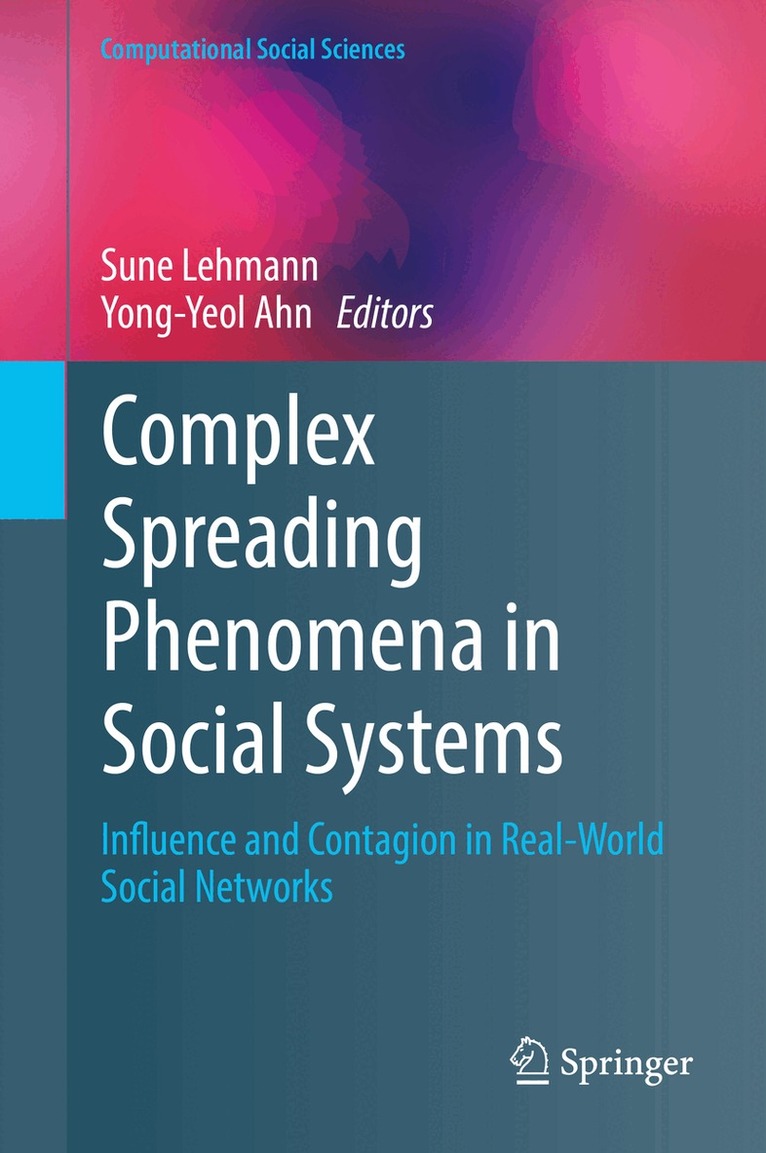
Complex Spreading Phenomena in Social Systems
Av Sune Lehmann, Yong-Yeol Ahn
1853 kr
Beställningsvara. Skickas inom 10-15 vardagar. Fri frakt över 249 kr.
Beskrivning
This text is about spreading of information and influence in complex networks. Although previously considered similar and modeled in parallel approaches, there is now experimental evidence that epidemic and social spreading work in subtly different ways. While previously explored through modeling, there is currently an explosion of work on revealing the mechanisms underlying complex contagion based on big data and data-driven approaches.This volume consists of four parts. Part 1 is an Introduction, providing an accessible summary of the state of the art. Part 2 provides an overview of the central theoretical developments in the field. Part 3 describes the empirical work on observing spreading processes in real-world networks. Finally, Part 4 goes into detail with recent and exciting new developments: dedicated studies designed to measure specific aspects of the spreading processes, often using randomized control trials to isolate the network effect from confounders, such as homophily. Each contribution is authored by leading experts in the field. This volume, though based on technical selections of the most important results on complex spreading, remains quite accessible to the newly interested. The main benefit to the reader is that the topics are carefully structured to take the novice to the level of expert on the topic of social spreading processes. This book will be of great importance to a wide field: from researchers in physics, computer science, and sociology to professionals in public policy and public health.
Produktinformation
- Utgivningsdatum: 2018-07-09
- Mått: 155 x 235 x 26 mm
- Vikt: 665 g
- Format: Inbunden
- Språk: Engelska
- Serie: Computational Social Sciences
- Antal sidor: 361
- Förlag: Springer International Publishing AG
- ISBN: 9783319773315
Utforska kategorier
Betyg & recensioner
0 recensioner
Inga recensioner tillgängliga.