• Fri frakt över 249 kr
  • •
  • Snabba leveranser
  • •
  • Billiga böcker
Kundservice

Du är på sajten för privatpersoner.

Företag, bibliotek eller offentlig verksamhet?

Du handlar på classic.bokus.com, där alla dina funktioner finns intakta.
Till classic.bokus.com
Bokus logotyp. Gå till startsidan.
  • Erbjudanden
  • Nyheter
  • Student
  • Topplistor
  • Barn & ungdom
  • Bokus Play
  • E-böcker
  • Pocketböcker
  • Spel & pussel

10% rabatt på allt med kod NYSTART10 →

Sidfot

Mina sidor

    Hjälp

    • Kundservice
    • Vanliga frågor och svar
    • Frakt och leverans
    • Retur vid ångerrätt
    • Reklamera vara
    • Betalning
    • Köpvillkor
    • Allmänna villkor
    • Information om webbplatsens tillgänglighet

    Om Bokus

    • Om oss
    • Pressrum
    • För studenter
    • För företag
    • För bibliotek och offentlig verksamhet
    • För leverantörer
    • Hållbarhet

    Populärt

    • Aktuella erbjudanden
    • Presentkort
    • Studentlitteratur
    • Nya böcker
    • Topplistor
    • Signerade böcker
    • Engelska böcker

    Inspiration

    • Boktips
    • BookTok
    • Populära bokserier
    • Barnbokskaraktärer
    • Populära författare
    Logotyp för Bokus
    Följ oss på Facebook (extern länk)Följ oss på Instagram (extern länk)Följ oss på YouTube (extern länk)Följ oss på TikTok (extern länk)
    bokus @ CookiesAnpassa cookiesIntegritetspolicyKöpvillkor
    Till Citymail hemsida (extern länk)Till Budbee hemsida (extern länk)Till Postnord hemsida (extern länk)Till Schenker hemsida (extern länk)Till Early Bird hemsida (extern länk)Till Walleys hemsida (extern länk)
    1. Naturvetenskap och teknik
    2. Geovetenskap
    3. Miljövetenskap och miljöpolitik

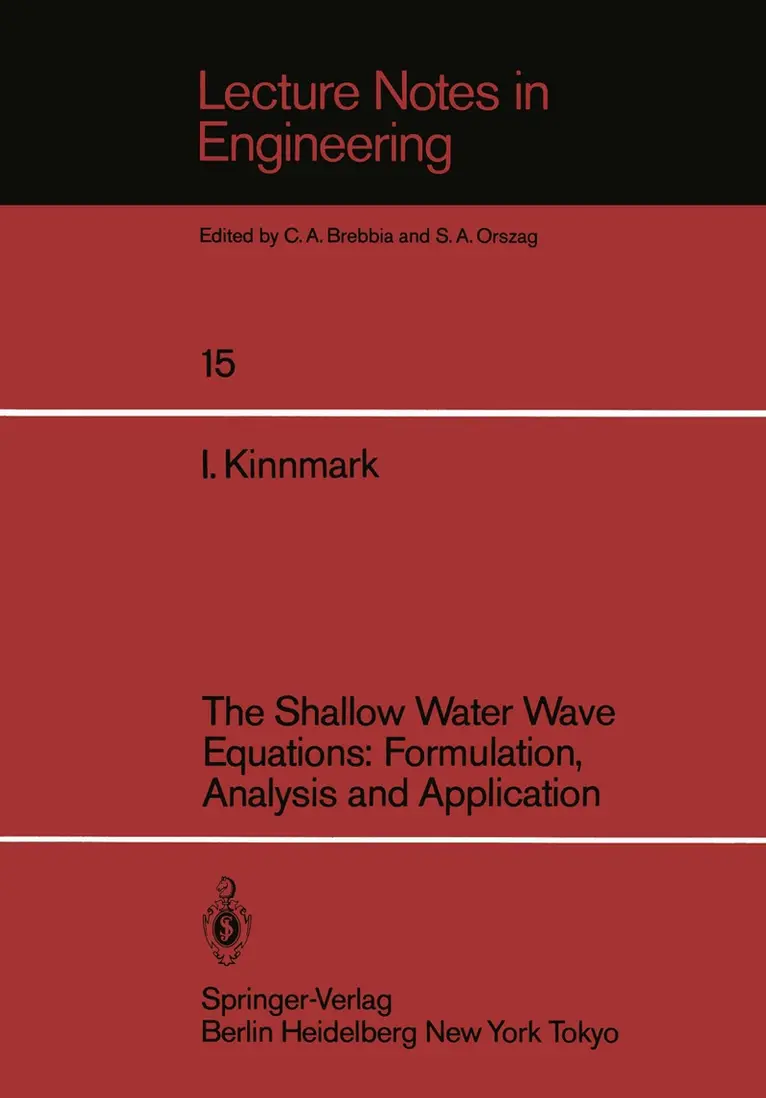
    Shallow Water Wave Equations: Formulation, Analysis and Application

    AvIngemar Kinnmark

    Häftad, Engelska, 1985

    Del 15 i serien Lecture Notes in Engineering

    1 085 kr

    Beställningsvara. Skickas inom 10-15 vardagar. Fri frakt över 249 kr.

    Fler format och utgåvor

    E-bok

    1 416 kr

    Beskrivning

    1. 1 AREAS OF APPLICATION FOR THE SHALLOW WATER EQUATIONS The shallow water equations describe conservation of mass and mo­ mentum in a fluid. They may be expressed in the primitive equation form Continuity Equation _ a, + V. (Hv) = 0 L(l;,v;h) at (1. 1) Non-Conservative Momentum Equations a M("vjt,f,g,h,A) = at(v) + (v. V)v + tv - fkxv + gV, - AIH = 0 (1. 2) 2 where is elevation above a datum (L) ~ h is bathymetry (L) H = h + C is total fluid depth (L) v is vertically averaged fluid velocity in eastward direction (x) and northward direction (y) (LIT) t is the non-linear friction coefficient (liT) f is the Coriolis parameter (liT) is acceleration due to gravity (L/T2) g A is atmospheric (wind) forcing in eastward direction (x) and northward direction (y) (L2/T2) v is the gradient operator (IlL) k is a unit vector in the vertical direction (1) x is positive eastward (L) is positive northward (L) Y t is time (T) These Non-Conservative Momentum Equations may be compared to the Conservative Momentum Equations (2. 4). The latter originate directly from a vertical integration of a momentum balance over a fluid ele­ ment. The former are obtained indirectly, through subtraction of the continuity equation from the latter. Equations (1. 1) and (1. 2) are valid under the following assumptions: 1. The fluid is well-mixed vertically with a hydrostatic pressure gradient. 2. The density of the fluid is constant.

    Produktinformation

    • Utgivningsdatum:1985-11-01
    • Mått:170 x 244 x 12 mm
    • Vikt:382 g
    • Format:Häftad
    • Språk:Engelska
    • Serie:Lecture Notes in Engineering
    • Antal sidor:188
    • Förlag:Springer-Verlag Berlin and Heidelberg GmbH & Co. KG
    • ISBN:9783540160311

    Utforska kategorier

    • Miljövetenskap och miljöpolitik inom Naturvetenskap och teknik
    • Byggnadsteknik inom Naturvetenskap och teknik

    Innehållsförteckning

    • I. Introduction.- Areas of Application for the Shallow Water Equations.- Finite Element Methods for Solution of the Shallow Water Equations.- Methods for Analyzing Spatial Oscillations in Numerical Schemes.- Methods for Analyzing Stability of Numerical Schemes.- II. Equation Formulation.- Primitive Equation Form.- Wave Equation Form.- Generalized Wave Equation Form.- Linearized Form of the Continuity and Momentum Equations.- III. Fourier Analysis Methods.- Fourier Analysis: An Accuracy Measure.- Amplitude of Propagation Factors Arising from Second Degree Polynomials.- IV. Stability.- General Concepts.- Routh-Hurwitz and Liénard-Chipart.- Routh-Hurwitz and Orlando.- Factorization of Higher Degree Polynomials into Lower Degree Polynomials.- Determination of Stability for a Product of Polynomials.- V. Explicit Methods Using Various Spatial Discretizations.- Equal Node Spacing and Constant Bathymetry in One Dimension.- Application to Unequal Node Spacing.- Applications with Even Node Spacing and Variable Bathymetry.- Application to a Rectangular Grid.- VI. Implicit Methods.- Reducing the Number of Time Dependent Terms in the Matrix for the Wave Equation.- Explicit Treatment of the Coriolis Term in an Implicit Wave Continuity Equation.- Repeated Back Substitutions Replacing Decompositions.- The Generalized Wave Continuity Equation.- VII. Spatial Oscillations.- N-Dimensional Uniform Rectangular Grid.- N-Dimensional Nonuniform Rectangular Grid with Multi-Information Nodes.- Leapfrog Scheme and Wave Equation Formulation on Linear Elements.- Leapfrog Scheme and Wave Equation Formulation on Quadratic Elements.- The Use of Dispersion Analysis in Evaluating Numerical Schemes.- The 2?x Test: Assessing the Ability to Suppress Node-to-Node Oscillations.- VIII. TemporalOscillations.- Numerical Artifacts.- A Different Three Time Level Approximation of the Momentum Equations.- A Two Time Level Approximation of the Momentum Equations.- IX. Applications.- Application to Quarter Circle Harbor.- Application to the Southern Part of the North Sea — I.- Application to the Southern Part of the North Sea — II.- X. Conclusions.- A. Equivalent Formulations of Conditions Which Guarantee Roots of Magnitude Less than Unity.