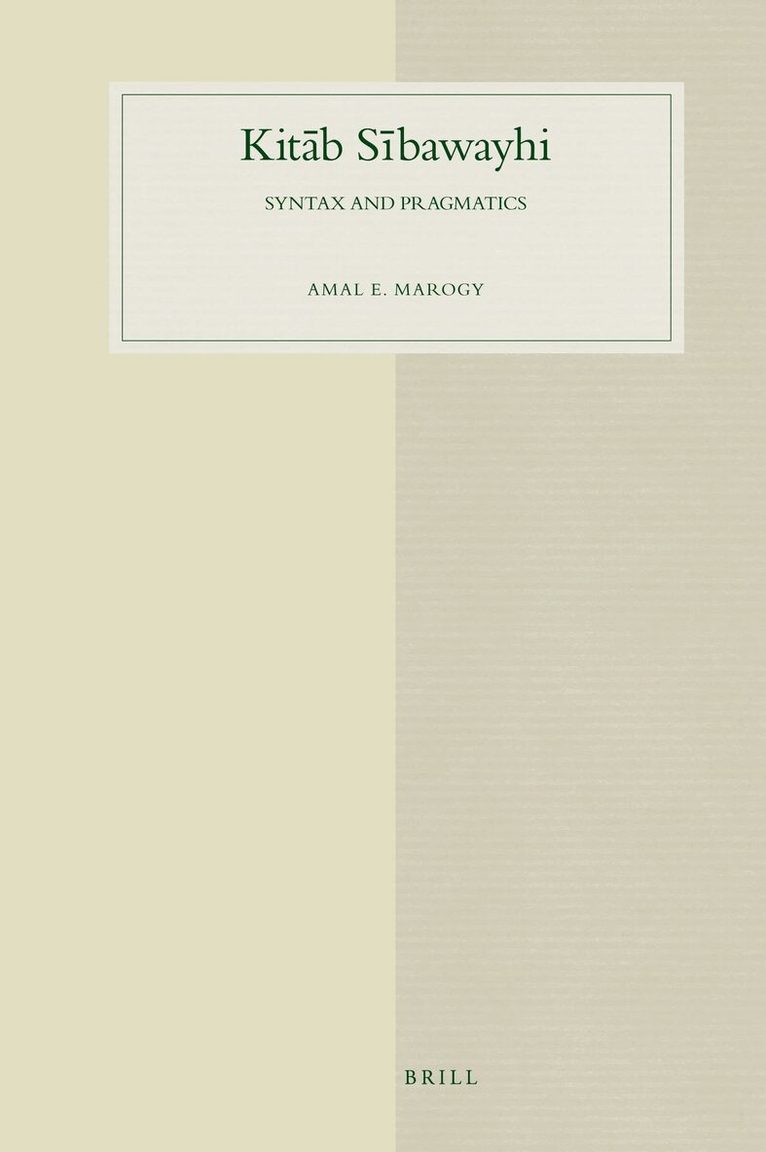
Del 56 i serien Studies in Semitic Languages and Linguistics
2 542 kr
Beställningsvara. Skickas inom 5-8 vardagar. Fri frakt över 249 kr.
Beskrivning
Produktinformation
- Utgivningsdatum:2009-12-08
- Mått:160 x 240 x 19 mm
- Vikt:584 g
- Format:Inbunden
- Språk:Engelska
- Serie:Studies in Semitic Languages and Linguistics
- Antal sidor:238
- Förlag:Brill
- ISBN:9789004178168
Utforska kategorier
Mer om författaren
Amal E. Marogy, Ph.D. (2007) in Oriental Languages and Cultures, is lector of Arabic at the University of Cambridge and a bilingual Arabic-Aramaic speaker.
Recensioner i media
"[L]a qualità...dell’opera che costituisce nel complesso un passo in avanti negli studi su Sībawayh e una lettura informativa e stimolante, non solo per gli studiosi interessati alla tradizione linguistica araba, ma anche per linguisti e storici della linguistica." - Antonella Ghersetti, Università Ca’ Foscari, Venezia, in: QSA no. 7 (2012), pp. 275-276
Innehållsförteckning
- CONTENTSAcknowledgements ............................................................................ ixPreface .................................................................................................. xiChapter One Historical Background ........................................... 11. Life .................................................................................................. 42. Cultural and Social Milieu .......................................................... 72.1. Al-Ḥīra: a Synoptic View .................................................... 72.2. Population ............................................................................. 112.3. Cultural history .................................................................... 152.4. Kūfa-Basṛ a Dichotomy ........................................................ 192.5. The Naḥwiyyūn .................................................................... 223. The Kitāb ....................................................................................... 273.1. Sources of the Kitāb ............................................................ 303.1.1. Qurʾān ......................................................................... 303.1.2. Ḥadīt ̠ (Prophetic Tradition) ................................... 333.1.3. Poetry ......................................................................... 343.2. Status of the Kitāb ................................................................ 353.2.1. Arab Grammarians .................................................. 373.2.1.1. az-Zajjājī (d. 337/949) ............................... 383.2.1.2. as-Sīrāfī (d. 368/979) ................................. 393.2.1.3. ar-Rummānī (d. 384/994) ......................... 393.2.1.4. Ibn Jinnī (d. 392/1002) ............................. 393.2.1.5. Ibn al-ʾAnbārī (d. 577/1181) .................... 403.2.1.6. Ibn Hišām (d. 761/1360) .......................... 403.2.2. Western Scholars ...................................................... 40Summary ............................................................................................. 44Chapter Two Complementarity .................................................... 471. Utterance Tuning Parameters ..................................................... 492. Complementarism ........................................................................ 552.1. Communication act as an event ........................................ 612.2. Istiqāma, Grammaticality and the Speaker’s Intention ... 742.3. Negotiability and Motivation ............................................. 792.3.1. Negotiability in Sībawayhi ...................................... 812.3.2. Motivated Use of Case Endings ............................. 822.3.3. Motivated Reduction ............................................... 842.4. Conventionality .................................................................... 882.4.1. Absolute Conventionality ....................................... 892.4.2. Motivated Conventionality ..................................... 91Summary ............................................................................................. 94Chapter Three Definiteness and Identifiability .......................... 951. Preliminary Observations ........................................................... 962. Definiteness in the Kitāb ............................................................. 992.1. Criteria of Adjectival Qualifiability .................................. 1042.2. Proper Nouns ....................................................................... 1082.3. Hierarchy of Definiteness ................................................... 1173. Definiteness and Non-Arbitrariness of Word Order .............. 1233.1. Word Order in Arabic Nominal Sentences ..................... 1253.1.1. Indefinite Nouns and the Initial Position ............ 1303.1.2. Kāna and its Sisters ‘Kāna wa ’Aḫawātuhā’ .......... 1363.2. Verbs and the Initial Position ............................................ 143Summary ............................................................................................. 148Chapter Four Mubtadaʾ, Topic and Theme ................................ 1511. Introductory Remarks ................................................................. 1522. Three Structural-Functional Theories ....................................... 1572.1. Dik’s Functional Grammar ................................................. 1572.2. Information Structure and Role and ReferenceGrammar ............................................................................... 1602.3. Systemic Functional Grammar .......................................... 1642.3.1. Downing’s view on Topic, Theme and the ‘Initial’Position ...................................................................... 1672.3.2. Participant’s Role in Identifying Topics ................ 1713. Mubtadaʾ and Ibtidāʾ: an Alternative Approach to an OldProblem .......................................................................................... 1783.1. Inverted Nominal Sentence and Types of Ḫabars .......... 1833.2. Reversibility of the Three Types of Ḫabars ..................... 1913.3. ʾInna and its Related Particles ........................................... 193Summary ............................................................................................. 200Chapter Five Conclusion ............................................................... 203Bibliography ........................................................................................ 217Index .................................................................................................... 229
Mer från samma serie
Corpus of Soqotri Oral Literature
Vitaly Naumkin, Leonid Kogan, Dmitry Cherkashin, Maria Bulakh, Ekaterina Vizirova
4 188 kr
Approaches to the History and Dialectology of Arabic in Honor of Pierre Larcher
Manuel Sartori, Manuela E.B. Giolfo, Philippe Cassuto
3 346 kr
Du kanske också är intresserad av
Approaches to the History and Dialectology of Arabic in Honor of Pierre Larcher
Manuel Sartori, Manuela E.B. Giolfo, Philippe Cassuto
3 346 kr
Corpus of Soqotri Oral Literature
Vitaly Naumkin, Leonid Kogan, Dmitry Cherkashin, Maria Bulakh, Ekaterina Vizirova
4 188 kr