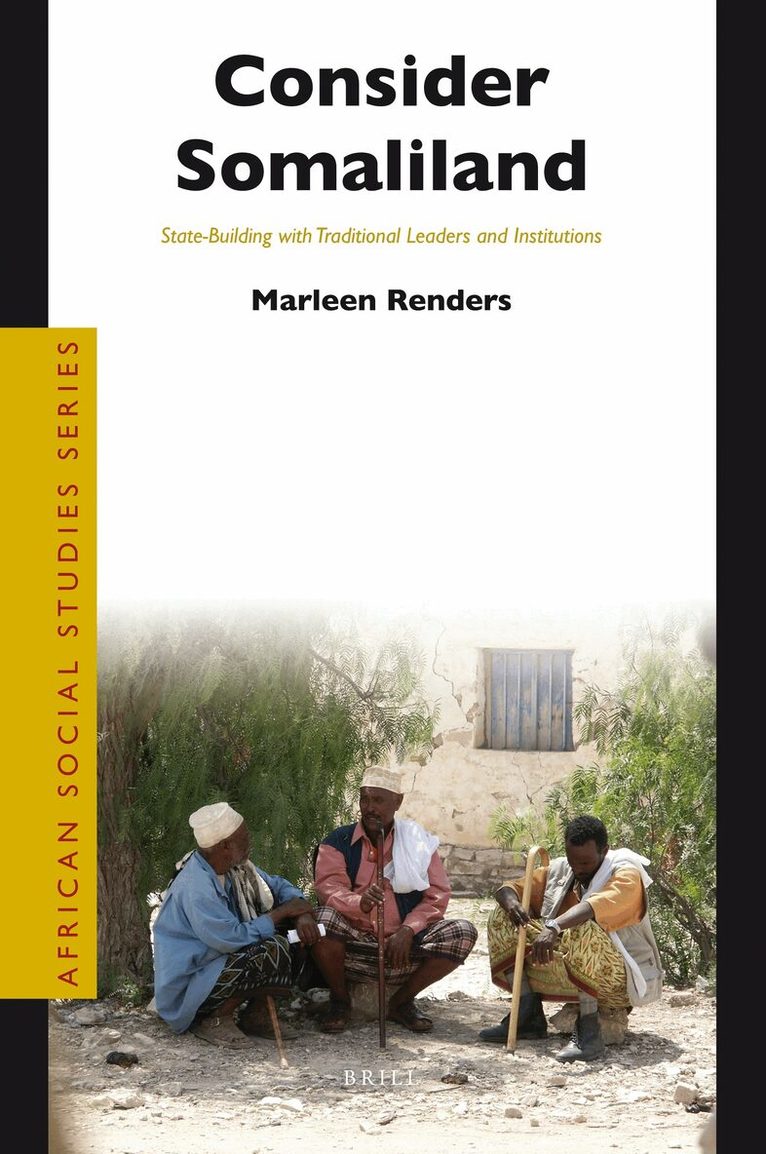
Consider Somaliland
State-Building with Traditional Leaders and Institutions
Del 26 i serien African Social Studies Series
1 217 kr
Beställningsvara. Skickas inom 5-8 vardagar. Fri frakt över 249 kr.
Beskrivning
Produktinformation
- Utgivningsdatum:2012-01-20
- Mått:160 x 240 x 18 mm
- Vikt:560 g
- Format:Häftad
- Språk:Engelska
- Serie:African Social Studies Series
- Antal sidor:290
- Förlag:Brill
- ISBN:9789004218482
Utforska kategorier
Mer om författaren
Marleen C.M. Renders, Ph.D. (2006) in Political Science, Ghent University, is a research associate at the Human Rights Centre of the same University. She was Fellow at the Somaliland Academy for Peace and Development in Hargeysa and has published several articles on state formation in Somaliland. She currently lives and works in Nairobi.
Recensioner i media
'Renders (Ghent Univ., Belgium) is as comfortable in explaining the (in) applicability of the Weberian theory of the state in this context as she is in elucidating the role of clan elders in the complex governance of the present state-like entity. She labels Somaliland a "hybrid political order (HPO)." Although densely argued, the book makes an important contribution to empirical political theory and comparative Afiican studies. Summing Up: Recommended. Graduate, research, and professional collections'.H. Glickman, emeritus, Haverford College, In: Choice, August 2012'This book is a timely contribution to the discourse on 'stateness' - the concept of becoming a state - in Somali Studies. Renders has produced an elegantly written book that adds fresh insight into statebuilding in fragile and failing states'. Mohamed Haji Ingiriis in 'Journal of the Anglo-Somali Society', Spring 2013, Issue 53, pp. 56-58
Innehållsförteckning
- CONTENTSList of Abbreviations ............................................................................................... xiList of Illustrations .................................................................................................xiiiAcknowledgements ................................................................................................ xvA Note on Somali Orthography and Transliteration ...................................xviiIntroduction: Places That Do Not Exist ............................................................... 1A. State-Making in Somaliland......................................................................2B. Data Collection .............................................................................................5C. Plan of the Book .......................................................................................... 9I Challenging Received Notions of Statehood, State Failure and State-Building ..... 13A. Defijining a State: Somaliland’s Claim to Statehood .......................... 15B. Failing What? .............................................................................................. 17C. Persistent Anachronisms ......................................................................... 21D. Anachronisms as Patches for State Failure ....................................... 22E. Invented Traditions and the Making of African States: A Two Way-Process ... 25F. State-Making Reconsidered: Bringing Politics Back in .................. 27G. Concluding Remarks: Concepts, Discourse and Politics ............... 29II The Failing State. What Has Clan Got to Do With It? ........................... 33A. The Somaliland Protectorate and the Introduction of the Modern Nation State ........... 35B. Colonial Administration and State Building ..................................... 42C. Clanship Mediated Politics in Cold War Somalia ............................ 45D. Concluding Remarks: Failed State Building? .................................... 57III The Emergence of the Somali National Movement as a Clan-Supported Opposition Force .... 59A. Growing Oppositions in the Northwest .............................................60B. Becoming Isaaq ......................................................................................... 72C. SNM Fighting in the Northwest ............................................................ 79D. Concluding Remarks ................................................................................ 85IV Clan Elders and the Forging of a Hybrid State ...................................... 87A. The Role of Clan Elders in the Undoing of the SNM .................... 87B. SNM Heartland: Clan Elders’ Negotiating Power over State Resources ....96C. Peace, Governance and State Outside the Isaaq Heartland ......104D. Conclusion ...............................................................................................115V “At the Centre of Peace and War”: Pragmatic State Building Under the Egal Government, 1993–1997 .....117A. Somaliland and UNOSOM II ...............................................................117B. The Airport War ....................................................................................126C. Regime Consolidation Via War … and ‘Traditional’ Peace Making ....140D. Concluding Remarks ............................................................................150VI Looking Like a Proper State .......................................................................153A. The Hargeysa ‘Clan Conference’ and the End of Clan-Based Representation ......154B. Undoing Local Governance Arrangements While Outsourcing Security and Public Order. .................159C. Centralising Symbolic and Material Resources ............................168D. Concluding Remarks ............................................................................174VII Claiming the Eastern Borderlands ..........................................................177A. The Dhulbahante and Somaliland ...................................................178B. Competing State Claims ...................................................................... 181C. Shifting Sands and Loose Ends ..........................................................190D. Concluding Remarks ............................................................................194VIII Egal’s Political and Institutional Tailpiece ............................................197A. The Referendum on the Draft Constitution and the Introduction of the Multi-Party System ....198B. The Opposition Sultaans....................................................................204C. Toward the First Election ....................................................................211D. Conclusion ..............................................................................................221IX Somaliland as a Model for Building Proper States? ........................... 225A. Transitioning into the Post-Egal Era ............................................... 228B. The Elections: Clan Politics Through the Back Door .................236C. Somaliland after the First Round of Elections under the Multi-party System ........ 255D. Conclusion .............................................................................................263Bibliography ...........................................................................................................267Index......................................................................................................................... 283
Du kanske också är intresserad av
Colonial Survey and Native Landscapes in Rural South Africa, 1850 - 1913
Lindsay F. Braun
1 253 kr
Elasticity in Domesticity: White Women in Rhodesian Zimbabwe, 1890-1979
Ushehwedu Kufakurinani
1 087 kr