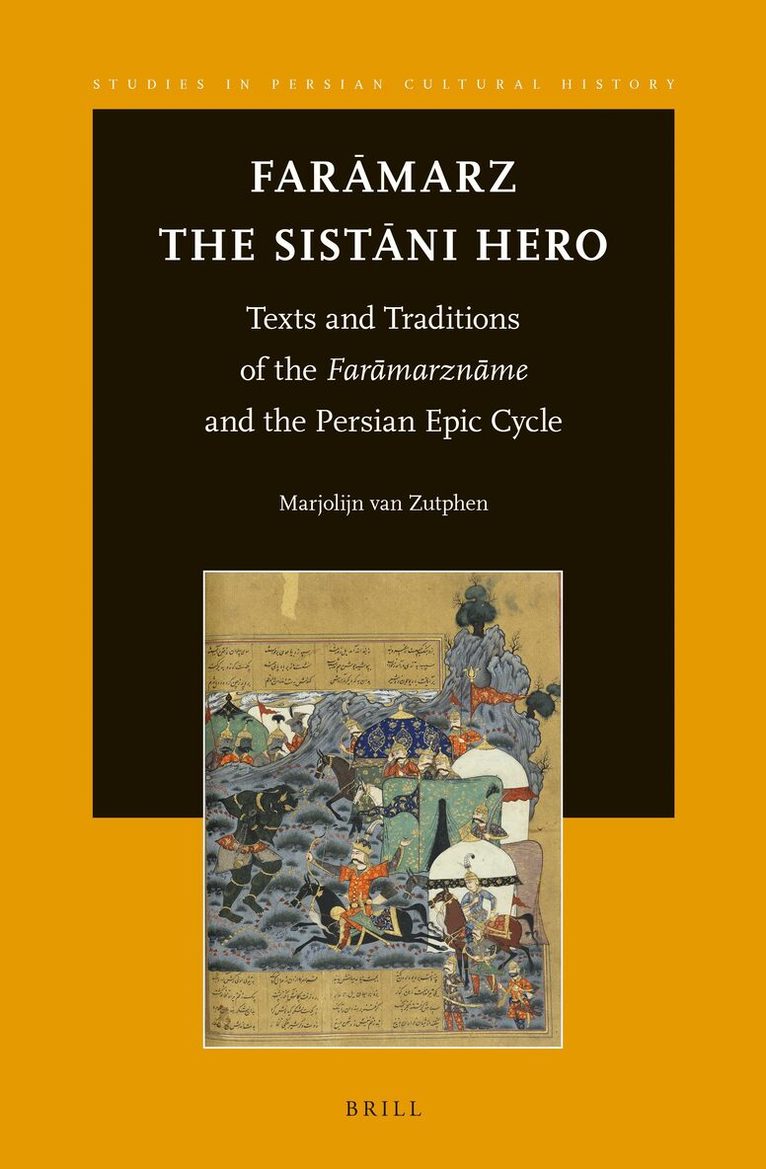
Farāmarz, the Sistāni Hero
Texts and Traditions of the Farāmarznāme and the Persian Epic Cycle
Inbunden, Engelska, 2014
Del 6 i serien Studies in Persian Cultural History
5 339 kr
Beställningsvara. Skickas inom 3-6 vardagar. Fri frakt över 249 kr.
Beskrivning
In Farāmarz, the Sistāni Hero Marjolijn van Zutphen discusses the manuscripts, storylines and main themes of the shorter and the longer Farāmarznāme (c. 1100), in relation to Ferdowsi’s Shāhnāme and several other later maṡnawis about the warriors from Sistān (the Persian Epic Cycle). Farāmarz, a secondary figure of the Shāhnāme, gained importance in later epic traditions and as the invincible protagonist of both Farāmarznāmes reached a status that equalled, if not surpassed, that of his famous father Rostam. Van Zutphen further shows how Farāmarz displays parallels to the fictional figures of Garshāsp (his ancestor) and Eskandar and argues that some story elements of Farāmarz’s Indian conquest may be rooted in historical events from both the Parthian and the Ghaznawid period.
Produktinformation
- Utgivningsdatum:2014-09-29
- Mått:155 x 235 x 50 mm
- Vikt:1 331 g
- Format:Inbunden
- Språk:Engelska
- Serie:Studies in Persian Cultural History
- Antal sidor:772
- Förlag:Brill
- ISBN:9789004268265
Utforska kategorier
Mer om författaren
Marjolijn van Zutphen earned her doctorate at Leiden University (December 2011). She is currently researching the Persian traditions surrounding Eskandar, within the project Beyond the European Myth. In Search of the Afro-Asiatic Alexander Cycle at the Amsterdam Free University (VU).
Innehållsförteckning
- ContentsPrefaceNotes on transcription, dates, quotations and bibliographical citationsChronological tableMap of greater Iran and northern IndiaList of tables and figuresIntroductionPART I.FERDOWSI’S SHĀHNĀME AND THE PERSIAN EPIC CYCLE: TEXTS AND ORIGINSChapter 1. The history of the kings, the Sistāni cycle and the manuscript tradition1. Ferdowsi’s Shāhnāme, its origins and supposed sources1.1 Pre-Islamic origins1.2 Other versions of the ‘Book of Kings’ in the Islamic period1.3 Possible sources of the legends of Sistān1.3.1 The narrations of Āzādsarw2. Parthian origins of the Sistāni cycle: tentative links to historical events2.1 The geo-political entity of Sistān2.2 The Sakas, the Suren and the Sistāni legends2.2.1 Rostam and the hero of Carrhae2.2.2 Farāmarz and the Indo-Parthian empire of Gondophares3. Shāhnāme manuscripts and editions: reconstructions and reinterpretations3.1 The culmination of a tradition of interpolating: London, British Library, MSS Or. 2926 and Or. 2976 (BL)3.2 Editions of the Shāhnāme: establishing a codified textChapter 2. The Persian epic cycle1. The later epics as a genre1.1 Epic romances: a description2. The poems making up the Persian epic cycle2.1 A tentative classification2.2 A descriptive overview3. Origins and roles of the Sistāni warriors3.1 Possible origins of the later epics3.2 Roles of the Sistāni warriors in the Persian epic cyclePART II. FARĀMARZ AND THE SISTĀNI DYNASTY: IN THE SHĀHNĀME, LATER EPICS AND HISTORIESChapter 3. The Sistāni dynasty in Ferdowsi’s Shāhnāme1. The older generations, Rostam, Zāl, Zawāre and Sām1.1 Roles in the Shāhnāme1.2 Rulers of Sistān, Zābolestān and India2. The confusing situation of Garshāsp3. Bizhan, the son of Bānu Goshasp: the union of two noble houses4. Farāmarz’s appearances in the Shāhnāme4.1 The revenge of Siyāwakhsh: Farāmarz’s debut as a warrior in the Iranian army4.2 Key Khosrow sends Farāmarz on campaign to India4.3 The remainder of the reign of Key Khosrow: Farāmarz in the background4.4 The story of Rostam and Esfandiyār: Farāmarz and Zawāre propel the action4.5 Farāmarz avenges Rostam’s death4.6 Farāmarz’s end4.7 ConclusionChapter 4. Farāmarz’s role in six later epics1. The Bānu Goshaspnāme: Farāmarz’s youth2. The Shabrangnāme: Farāmarz’s first test of war3. The Jahāngirnāme: Farāmarz saves Jahāngir’s life4. The Borzunāme4.1 The shorter Borzunāme: Farāmarz replaces his father4.2 The longer Borzunāme: Farāmarz as a minor Sistāni warrior5. The Shahriyārnāme: Farāmarz returns from India6. The Bahmannāme6.1 Part 1 of the Bahmannāme: Rostam’s role6.2 Parts 2-4: the battles between Bahman and the Sistāni armies7. ConclusionChapter 5. Farāmarz and the Sistāni dynasty in six histories and an encyclopaedia1. Ṭabari’s universal history: Farāmarz added to the history of the kings2. Balʿami: the Persian version of Ṭabari’s History2.1 Additions to Balʿami’s original text about Garshāsp, Rostam and Farāmarz3. Ṡaʿālebi’s Arabic history of the Persian kings3.1 Ṡaʿālebi on the Sistāni rulership3.2 Ṡaʿālebi on Farāmarz3.3 Sources: Ṡaʿālebi versus Ferdowsi4. The Mojmal al-tawārikh wa’l- qeṣaṣ: a source on Persian epic traditions4.1 Focus on the Sistāni warriors: accounts from the Persian epic cycle4.2 Farāmarz in the Mojmal al-tawārikh5. Shahmardān b. Abi’l-Kheyr’s Nozhatnāme-ye ʿalā’i: Farāmarz’s Indian campaign6. Malek Shāh Sistāni’s Eḥyā’ al-moluk and its example, the Tārikh-e Sistān6.1 The anonymous Persian Tārikh-e Sistān: a source on the Sistāni dynasty6.2 The Eḥyā’ al-moluk: stories from the Persian epic cycle6.2.1 The older generations of Sistāni warriors: the Tārikh-e Sistān combined with the Shāhnāme and the Persian epic cycle6.2.2 Farāmarz and the younger Sistāni generations: the Bahmannāme and beyond7. ConclusionPART III. THE SHORTER AND THE LONGER FARĀMARZNĀME: MANUSCRIPTS AND CONTENTSChapter 6. Texts of the Farāmarznāme1. The shorter Farāmarznāme1.1 The separate epic, placed in the context of Farāmarz’s family1.1.1 Oxford (MS Pers. e. 13) and London (MS Or. 2946), two near-identical copies1.1.2 Paris (MS Suppl. persan 498), from the collection of Anquetil Duperron1.2 A sequel to the Shabrangnāme, in Leiden (MS Acad. 150), BL (MS Or. 2926), and IO (MS IO Islamic 3263)1.2.1 The interpolated Shabrangnāme and shorter Farāmarznāme of Mashhad (MS 4248)1.3 A prequel to the longer Farāmarznāme, in the lithographed book (L)1.4 The seven versions compared1.5 Sarmadi’s edition2. The longer Farāmarznāme: the separate poem2.1 RSPA (MS RSPA 176), the longer Farāmarznāme as a separate book2.1.1 Comparison with the lay-out of the other two texts (IO and L)2.2 IO (MS IO Islamic 3263), a mix of three stories dealing with Farāmarz2.3 The lithographed Farāmarznāme (L), the story of Farāmarz’s life2.3.1 Contents of the book3. The interpolated longer Farāmarznāme in four Shāhnāme manuscripts4. The Indian manuscripts: two shorter and four longer Farāmarznāmes5. ConclusionChapter 7. The shorter Farāmarznāme1. Previous research1.1 The fame of Farāmarz1.2 The poet, the period and possible origins2. The story2.1 The beginning; Nowshād asks for assistance against five foes (S, vss 1–189)2.2 Farāmarz defeats Kannās Diw (S, vss 190–376)2.3 Bizhan and Gorg-e guyā (S, vss 377–554)2.4 Farāmarz deals with Mār-e jushā and with the rhinoceroses (S, vss 555–731)2.5 The battle against Keyd (S, vss 732–1053)2.6 Farāmarz journeys onwards in pursuit of Keyd: the lands of Niknur and Saranj (S, vss 1054–1246)2.7 Farāmarz’s conversation with a Brahman (S, vss 1247–1348)2.8 Farāmarz makes peace with Keyd and discusses with another Brahman (S, vss 1349–1595)2542.9 Variant readings: notable additions and omissions2.9.1 The situation of Ṭahmur and Arwand Shah22.9.2 Leiden’s missing conversations with the Brahmans3. Analysis3.1 In imitation of Ferdowsi – and of Asadi3.1.1 The poem’s beginning and development3.1.2 The fight against the dragon3.1.3 A complaint of old age3.2 Andarz: words of wisdom in an epic setting3.2.1 Counsel in the form of a testament3.2.2 Farāmarz and the Brahmans: counsel and riddles3.2.3 The dual nature of the poem: fighting vs. reasoning3.3 Exaggeration and heroics3.3.1 Fighting fantastic creatures3.3.2 Easily defeated enemies: the heroics of Farāmarz and Bizhan3.4 Names and places: Farāmarz’s Indian conquest as an incentive for the Ghaznawids3.4.1 Destination Delhi: geographical inconsistencies in the journey to Keyd’s country3.4.2 Familiar names: Keyd and Cheypāl3.5 An incomplete poem4. ConclusionChapter 8. The longer Farāmarznāme1. Speculations on the poem’s date and sources2. THE INTRODUCTORY SECTION – TWO DIFFERENT VERSIONS2.1. The manuscript version of the introduction (RSPA and IO), a paraphrase of a Shāhnāme episode2.1.1 A spurious introduction2.1.2 Returning the focus to Farāmarz2.2 The lithographed introduction (L)3. The main story – part one: Farāmarz’s campaign on the Indian mainland3.1 Farāmarz arrives in Khargāh and opposes Ṭoworg (RSPA, ff. 9v–27v)3.2 Farāmarz and the Raja of India (RSPA, ff. 28r–59r)3.2.1 Farāmarz and the Raja: comparison with the Nozhatnāme-ye ʿalā’i3.3 The confrontation with Mahārak, governor of Kashmir (RSPA, ff. 59v–76r)4. The interpolated longer Farāmarznāme: a retelling of the epic’s first part4.1 Illustrations of the interpolated longer Farāmarznāme: Farāmarz in the limelight5. The main story – part two: Farāmarz’s travels to the Indian islands5.1 The islands of Farāsang and Kahilā: a battle and a brief romance (RSPA, ff. 77r–90v)5.2 The islands of the Dawālpāyān, the Filgushān, and the Brahmans: pugnacious peoples and a wise conversation (RSPA, ff. 91r–104v)5.3 Farāmarz goes up against a bird, a dragon, and the Zangiyān (RSPA, ff. 104v–111r)5.4 In Qeyrawān: Garshāsp’s testament and the defeat of the dragon, the lions, and the rhinoceroses (RSPA, ff. 111v–129r)5.5 Farāmarz receives help from the Simorgh and finds the tomb of king Hushang (RSPA, ff. 129v–138v)5.6 King Farghān, Mount Qāf, and the demons of Kalānkuh (RSPA, ff. 138v–149v)5.7 Farāmarz falls in love: his encounters with Siyah Diw and his letter to king Farṭurtush (RSPA, ff. 149v–168r)5.8 Farāmarz’s haft khān (RSPA, ff. 168r–179v)5.9 Farāmarz becomes Farṭurtush’s son-in-law, goes back to Iran, and thereafter returns to rule India (RSPA, ff. 179v–193v)6. Analysis6.1 Links to the Shāhnāme: further evidence of a former interpolation6.2 Resemblances to certain Shāhnāme stories6.2.1 Farāmarz’s nightly adventure with the princess: in imitation of Rostam6.2.2 Similarities between Farāmarz and Zāl: Simorgh and the love story6.2.3 Farāmarz’s haft khān, compared with Rostam’s and Esfandiyār’s6.2.4 Andarz: Buzorjmehr’s words put in the Brahman’s mouth6.3 Reminders of traditions about Eskandar6.3.1 Acting as his own messenger6.3.2 Peoples with strange features: the Dawālpāyān and the Filgushān6.3.3 The land of the Zangiyān and the demons of Kalānkuh6.4 Farāmarz in love with the fairy princess: a comparison with the Sāmnāme6.5. Parallels to the Garshāspnāme6.5.1 Dealings with rebellious Indian rulers: Mahārak and Bahu6.5.2 Travels around the islands: marvels or just a set of adventures?6.5.3 In the footsteps of the Sistāni ancestors6.6 Inconsistencies within the rubrics and the storyline6.7 Farāmarz as ruler of India6.7.1 The two parts of the poem connected: the Sistāni rule of India6.7.2 Farāmarz’s conquest and historical reality: a connection to the Ghaznawids7. ConclusionConclusion. Farāmarz, the hero1. Farāmarz, the historical conqueror1.1 Farāmarz and the Indo-Parthians1.2 Farāmarz and the Ghaznawids1.3 Farāmarz, a historical hero?2. Farāmarz, the epic warrior and the folktale hero3. Farāmarz, hero of the later Shāhnāme manuscriptsAppendix 1. Manuscripts and lithographs of the Shāhnāme and the later epics1. Manuscripts2. Lithographed editionsAppendix 2. Rubrics of the shorter Farāmarznāme1. The rubrics of London (and Oxford) and Paris compared2. The rubrics of L, BL, IO and Leiden comparedAppendix 3. Comparison of the verses of the texts of the shorter FarāmarznāmeAppendix 4. Rubrics of the longer FarāmarznāmeAppendix 5. Comparison of the verses of the texts of the longer FarāmarznāmeAppendix 6. Rubrics of the interpolated longer FarāmarznāmeBibliography1. Primary sources1.1 Manuscripts1.2 Lithographed books1.3 Printed editions2. Secondary sourcesIndex
Hoppa över listan


Du kanske också är intresserad av
Del 12
Introduction to Business Statistics (with Premium Website Printed Access Card)
Ronald Weiers
Inbunden
5 339 kr
Del 20
Persian Miniatures Collection of the Rijksmuseum, A Hidden Treasure Trove
Forough Sajadi
Inbunden
1 644 kr
Del 19
Del 10
Del 9
Del 5
Del 7
Del 21
Del 11