• Fri frakt över 249 kr
  • •
  • Snabba leveranser
  • •
  • Billiga böcker
Kundservice

Du är på sajten för privatpersoner.

Företag, bibliotek eller offentlig verksamhet?

Du handlar på classic.bokus.com, där alla dina funktioner finns intakta.
Till classic.bokus.com
Bokus logotyp. Gå till startsidan.
  • Erbjudanden
  • Nyheter
  • Student
  • Topplistor
  • Barn & ungdom
  • Bokus Play
  • E-böcker
  • Pocketböcker
  • Spel & pussel

10% rabatt på allt med kod NYSTART10 →

Sidfot

Mina sidor

    Hjälp

    • Kundservice
    • Vanliga frågor och svar
    • Frakt och leverans
    • Retur vid ångerrätt
    • Reklamera vara
    • Betalning
    • Köpvillkor
    • Allmänna villkor
    • Information om webbplatsens tillgänglighet

    Om Bokus

    • Om oss
    • Pressrum
    • För studenter
    • För företag
    • För bibliotek och offentlig verksamhet
    • För leverantörer
    • Hållbarhet

    Populärt

    • Aktuella erbjudanden
    • Presentkort
    • Studentlitteratur
    • Nya böcker
    • Topplistor
    • Signerade böcker
    • Engelska böcker

    Inspiration

    • Boktips
    • BookTok
    • Populära bokserier
    • Barnbokskaraktärer
    • Populära författare
    Logotyp för Bokus
    Följ oss på Facebook (extern länk)Följ oss på Instagram (extern länk)Följ oss på YouTube (extern länk)Följ oss på TikTok (extern länk)
    bokus @ CookiesAnpassa cookiesIntegritetspolicyKöpvillkor
    Till Citymail hemsida (extern länk)Till Budbee hemsida (extern länk)Till Postnord hemsida (extern länk)Till Schenker hemsida (extern länk)Till Early Bird hemsida (extern länk)Till Walleys hemsida (extern länk)
    1. Samhälle och politik
    2. Samhälle och kultur
    3. Kultur och medier
    4. Referensverk och tvärvetenskap

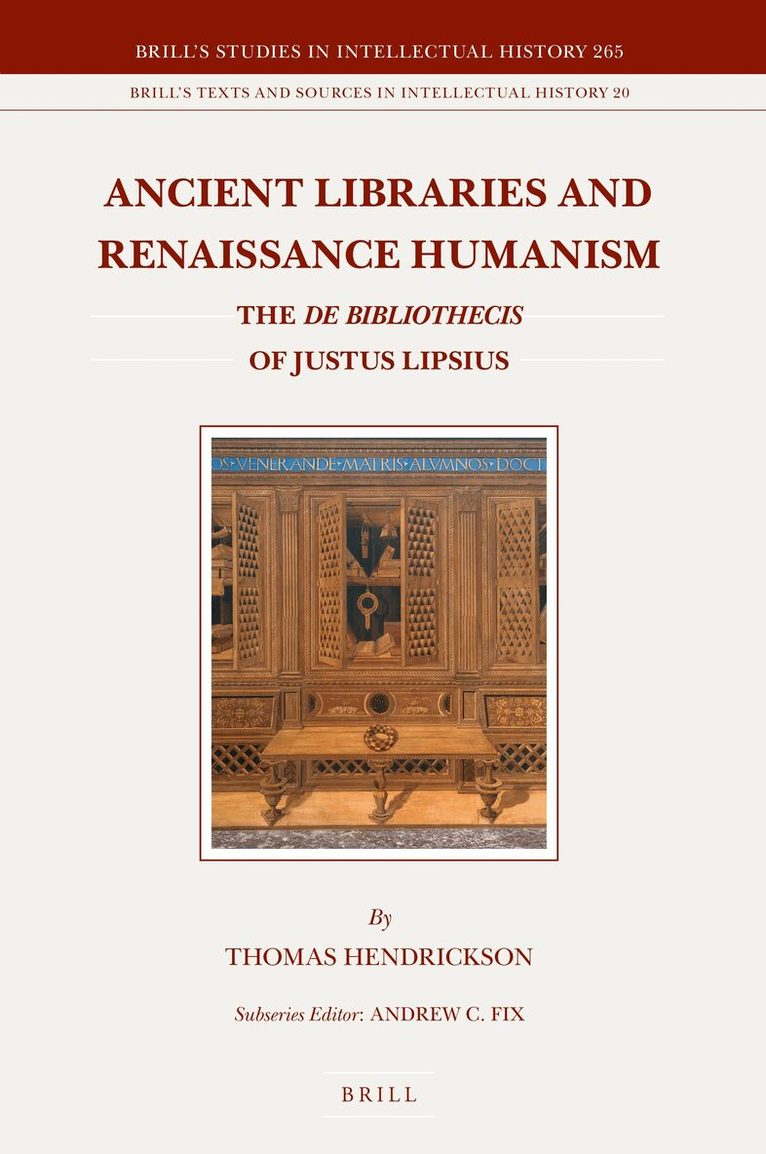
    Ancient Libraries and Renaissance Humanism

    The De bibliothecis of Justus Lipsius

    AvThomas Hendrickson

    Inbunden, Engelska, 2017

    Del i serien Brill's Texts and Sources in Intellectual History

    2 498 kr

    Beställningsvara. Skickas inom 5-8 vardagar. Fri frakt över 249 kr.

    Beskrivning

    Winner of the 2018 Josef IJsewijn Prize for Best Book on a Neo-Latin TopicAlthough many humanists, from Petrarch to Fulvio Orsini, had written briefly about library history, the De bibliothecis of Justus Lipsius was the first self-contained monograph on the topic. The De bibliothecis proved to be a seminal achievement, both in redefining the scope of library history and in articulating a vision of a public, secular, research institution for the humanities. It was repeatedly reprinted and translated, plagiarized and epitomized. Through the end of the nineteenth century, scholars turned to it as the ultimate foundation for any discussion of library history. In Ancient Libraries and Renaissance Humanism, Hendrickson presents a critical edition of Lipsius’s work with introductory studies, a Latin text, English translation, and a substantial historical commentary.

    Produktinformation

    • Utgivningsdatum:2017-02-16
    • Mått:155 x 235 x 26 mm
    • Vikt:672 g
    • Format:Inbunden
    • Språk:Engelska
    • Serie:Brill's Texts and Sources in Intellectual History
    • Antal sidor:338
    • Förlag:Brill
    • ISBN:9789004338166

    Utforska kategorier

    • Referensverk och tvärvetenskap inom Samhälle och politik
    • Historia: särskilda händelser och ämnen inom Historia och arkeologi

    Mer om författaren

    Thomas Hendrickson, Ph.D. (2013), UC Berkeley, is a Rome-Prize winner and teaches at Stanford Online High School. He has published on ancient libraries, ancient biography, and the reception of both in the Renaissance world.

    Recensioner i media

    “This is a supremely useful book.” - Earle Havens, Johns Hopkins University, in: Renaissance Quarterly, 72:1 (Spring 2019), pp. 253-255“The translation is lively, faithful to Lipsius’s much discussed, and difficult to characterize, style.” - Kathleen M. Comerford, Georgia Southern University, in: Journal of Jesuit Studies, 5:4 (November 2018), pp. 699-701“The most important and innovative part of this volume is the generous commentary, which not only provides the reader with abundant material on the ancient libraries discussed by Lipsius, but also on ancient and modern authors who have contributed to the subject.” - in: Neo-Latin News 2017, pp 139-141“This edition, with a detailed introduction, translation on facing pages, and commentary, is very welcome. The notes are full and well informed. The standard of production is high and the book is well illustrated” - Nigel Wilson, Lincoln College, Oxford, in: Library & Information History, 33:3 (2017), pp. 220-221“Hendrickson’s translation of De Bibliothecis is judicious and eloquent; his analysis of its sources, Lipsius’s writing style, and the context of its production are excellent. This books offers a perfect model for the reissuing of Renaissance texts and making them available to a wider audience.” - Arthur der Weduwen, University of St Andrews, in: Sixteenth Century Journal, 49:4 (Winter 2018), pp. 1168-1170“Thomas Hendrickson’s critical and annotated edition of Lipsius’s De bibliothecis syntagma is a work of great erudition and shows the editor’s affinity with both classical and more recent Latin on the one hand, and his familiarity with the history of the book on the other.” - Jeanine De Landtsheer, Leuven University, in: Quaerendo, 49:1 (March 2019), pp. 79-82“a handsome volume, which provides us with the text in Latin and an English translation of the Renaissance work on libraries of the scholar Justus Lipsius that should be of considerable interest to scholars working in earlier book cultures [...]. Overall, Hendrickson has provided a great service to scholars interested in (ancient) libraries. This is a work that may, and probably will, prompt further study of the ancient materials about book collections and also of the Renaissance context in which book collections were subsequently found. Hendrickson’s volume thus rightly deserves a place in the scholar’s library!” - Yun Lee Too, Cambridge University, in: Bryn Mawr Classical Review 2017.10.25

    Innehållsförteckning

    • IntroductionList of ImagesAbbreviations1 The De bibliothecis of Justus Lipsius1.1 The significance of the De bibliothecis1.2 The Need for a New Edition of Lipsius’s De bibliothecis2 Lipsius Proteus: The Career of a Scholar in an Age of Strife3 Library Historiography before Lipsius3.1 Manuals and Legends: Library Historiography in the Ancient World 3.2 Isidore of Seville: Literary Materiality and Literary Tradition in the Monastic World3.3 Library Historiography and the Humanists3.3.1 Francesco Petrarch3.3.2 Michael Neander3.3.3 Fulvio Orsini and Melchior Guilandinus3.3.4 Library Historiography and Religious Authority3.4 Library Historiography and Vatican Frescoes: Rocca and Lipsius4 The De bibliothecis: Title, Structure, and Purpose4.1 A Note on the Title of the De bibliothecis4.2 Structure and Purpose of the De bibliothecisTable 4.2: Chapter Outline of the De bibliothecis5 Lipsius and his Sources5.1 Ancient SourcesTable 5.1: Ancient Sources5.2 Contemporary Sources6 Print History6.1 Latin Editions of the De bibliothecisTable 6.1: List of Latin Editions of the De bibliothecis6.2 Translations of the De bibliothecisTable 6.2: List of Translations of the De bibliothecis7 Editorial Principles7.1 The Text7.2 Orthography7.3 Accents and Punctuation in Lipsius’s Latin8 A Note on the CommentaryDe bibliothecis: Text and TranslationDe bibliothecis: CommentaryWorks Cited by Author and DateIndex List of ImagesFigure 1: Title Page of the (1602) First Edition of the DB (digitized by Google Books)Figure 2: Relationships between the DB editions Figure 3: Ozymandias Fresco from the Vatican Library (photo: author)Figure 4: The Serapeum in the Roman Period (McKenzie 2007, figure 350; courtesy of Judith McKenzie)Figure 5: Hadrian’s Library in Athens (Sisson 1929, plate 21)Figure 6: Rooms Traditionally Identified as Pergamene Royal Library (Bohn 1885, table 3)Figure 7: Octavia’s Portico (courtesy of Wikimedia Commons: https://commons.wikimedia.org/wiki/File:Plan_portique_octavie.png (last access 30.7.16))Figure 8: The Library of Palatine Apollo in the Augustan Era (Iacopi and Tedone 2005/6, table 8; courtesy of the Soprintendenza Speciale per i Beni Archeologici di Roma)Figure 9: Twin Halls of the Post-Domitianic Palatine Apollo Library (De Gregori 1937, figure 5)Figure 10: Inscription of Antiochus, a bibliotheca latina Apollinis, from Orsini’s Imagines (digitized by Google Books)Figure 11: Inscription of Julius Falyx, a bibliotheca graeca palat., from Orsini’s Imagines (digitized by Google Books)Figure 12: Map of Libraries in Ancient Rome (adapted from Wikimedia Commons)Figure 13: Temple of Peace (Meneghini and Valenzani 2007, figure 65; courtesy of Roberto Meneghini)Figure 14: Trajan’s Forum (Meneghini 2002, figure 151; courtesy of Roberto Meneghini)Figure 15: The Sanctuary of Hercules Victor at Tivoli (Giuliani 2004, table 14; courtesy of Cairoli Fulvio Giuliani)Figure 16: Pluteus from the Biblioteca Laurenziana (Clark 1901, figure 102)