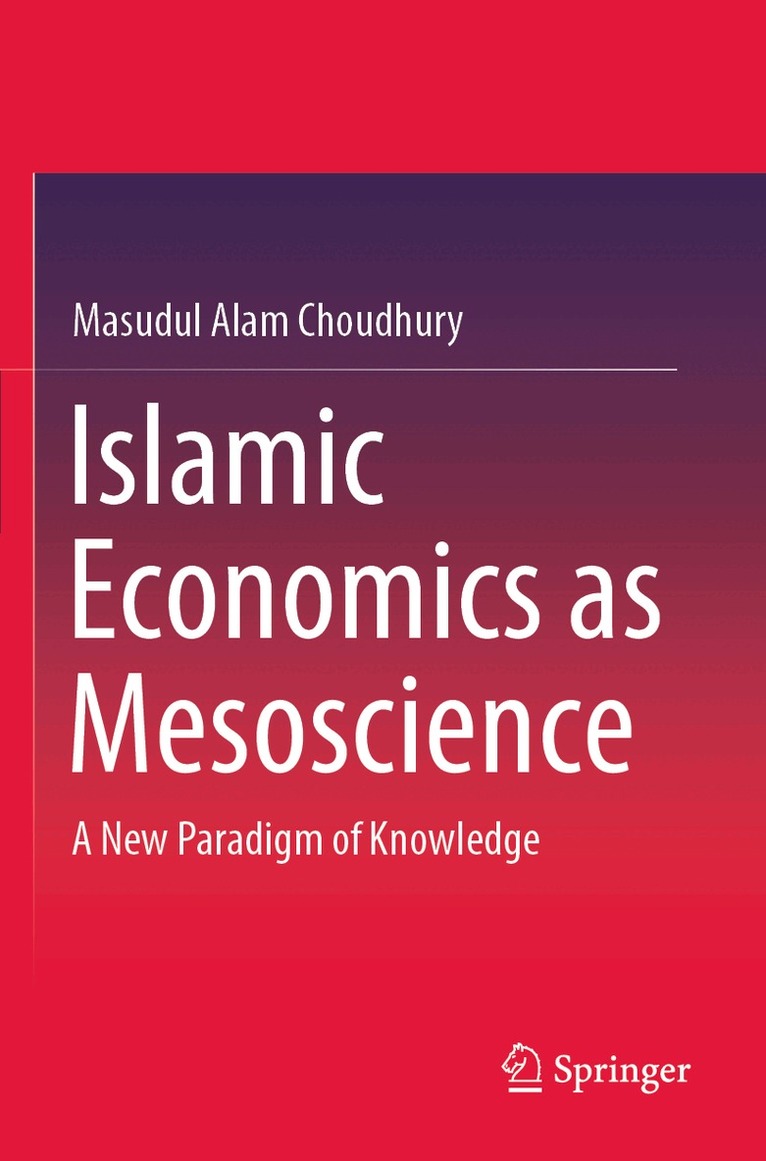
This book presents the building blocks of Islamic economics as meso-science, offering an in-depth study of the Qur’anic worldview of the monotheistic unity of knowledge, which is the universal and unique message of Tawhid in the Qur’an.
Professor Masudul Alam Choudhury is one of a handful of academic scholars in the field of Islamic studies with a focus on Islamic economics and finance. His work has been highly recognised in both Western and Muslim academic circles. Professor Choudhury obtained his Ph.D. in the field of Human Capital Theory and Economic Growth from the University of Toronto. He is the first academic in his field to address the original methodology of Tawhid as ontological law in the development of a Theory of Meta-Science. Professor Choudhury is the International Chair in the Postgraduate Program in Islamic Economics and Finance at Trisakti University in Jakarta, Indonesia. He teaches and supervises doctoral students, and researches and publishes in the areas of Islamic socio-scientific methodology, shari’ah and economics, and policy-theoretic applications using these foundational areas of Islamic studies. He is a regular Summer Visiting Professor in the Social Economy Center of the Ontario Institutefor Studies in Education, University of Toronto.
Innehållsförteckning
Chapter 1: Epistemic and Economics.-Chapter 2: Ontological Foundation Of The Theory of Econometrics In Unity Of Knowledge By Inter-Causality.-Chapter 3: Profit-Sharing versus Interest Avoidance, a Critical Inquiry.-Chapter 4: Content Approach To Analytics Of Islamic Banks By Meso-Economics Of Inter-Causality.-Chapter 5: Objective Functions Of Islamic Bank Bangladesh, A Critique Of Islamic Economics.-Chapter 6: The Meso-Economics Of The Wellbeing Criterion.- Chapter 7: Imaging The Imaginary Events In Evolutionary Learning Trajectories Of Wellbeing.- Chapter 8: Meso-economic framework of decision-making.-Chapter 9: Endogenous monetary transmission model by meso-economics, by Masudul A. Choudhury & Nirdukita Ratnawaty.- Chapter 10: Money, debt, interest, and real economy.- Chapter 11: Spatial Domain Analysis as an evaluation method of meso-economic model, by Mohammad Shahadat Hossain (contribution).