Alan Charles Kors - Böcker
Visar alla böcker från författaren Alan Charles Kors. Handla med fri frakt och snabb leverans.
11 produkter
11 produkter
251 kr
Skickas inom 3-6 vardagar
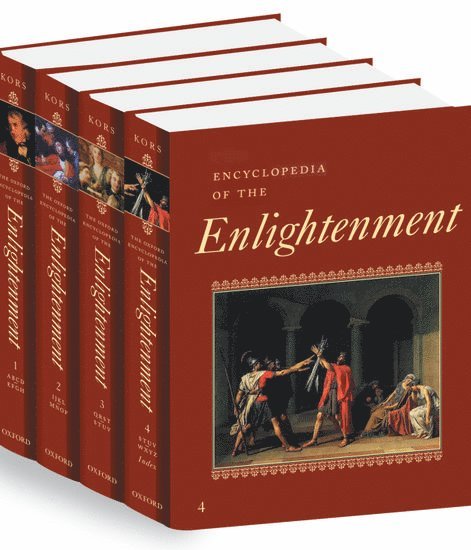
Encyclopedia of the Enlightenment
4 volumes: print and e-reference editions available
Inbunden, Engelska, 2003
9 537 kr
Skickas inom 7-10 vardagar
Comprising more than seven hundred articles totalling more than one million words, the Encyclopedia of the Enlightenment is a unique and comprehensive reference work on the entire range of philosophic and social changes wrought by the Enlightenment. It is available in both print and as an e-reference text from Oxford's Digital Reference Shelf. The Enlightenment is here defined as the 'long eighteenth century', from the rise of Descarte's disciples in 1670 to the Restoration of the Bourbon monarchy in France in 1815, including themes central to the ongoing history of Europe and the United States. These include increasing secularisation and a critical attitude toward inherited authority, the extension of scientific method beyond the physical sciences to law and economics, a broadened commitment to the ethical criterion of utility, an expansion of the dimensions of human life deemed subject to reform and human control, a disdain for sectarian religious strife and for its diversely perceived causes, and an elevation of the theme of 'toleration' among the concerns of the Western conscience. The four volumes draw together the resources of a select group of editors, advisers, and contributors and provides fresh perspectives on recent scholarship in such areas as gender history and the history of popular culture. Clearly written and well balanced this reference work offers students, scholars, and other readers an up-to-date reference tool that, for the first time, places the entire range of Enlightenment studies into an authoritative encyclopedic format. This work brings together the people and places that played a role in the Enlightenment, explains the movement's concepts and themes, and describes its impact on areas as diverse as politics, religion, science, philosophy, society, and art. This definitive work presents and assesses the subject in many thematic and geographical areas, including:BLTransnational communication, including such topics as the diffusion of texts, the Republic of Letters, languages and translation, censorship and press freedom, and the Grand Tour.BLThe Enlightenment in Iberian, Ibero-American, Scandinavian, Jewish, Russian, and Eastern European culture.BLMaterial culture, especially the 'history of the book', and the resonance of the Enlightenment in more popular culture.BLThe impact of world exploration and contact on eighteenth-century life and letters.BL'Secondary' and 'provincial' centres of intellectual and cultural activity, such as Milan, Saint Petersburg, and Philadelphia.BLThe history of Enlightenment studies, including recent theoretical and methodological approaches, and the scope of current interpretations and debates.These dramatic developments inform the more than one hundred articles that comprise the encyclopedia and are reflected in the work's synoptic outline, which covers such conceptual categories as biographies, cities, concepts, education, major schools of thought, and nations and states. Intended for the non-specialist as well as the specialist, with both wide-ranging and up-to-date coverage, the encyclopedia will prove a powerful reference tool for undergraduates, graduate students, advanced scholars, and general readers alike. An extensive system of cross-references, a synoptic outline of contents, and a comprehensive topical index provide easy access to networks of related articles. Each entry is signed by the contributor and the work is illustrated with photographs, line drawings, and maps. Authoritative, comprehensive, and accessible, the Encyclopedia of the Enlightenment is an invaluable and indispensable addition to personal, public, academic, and research libraries.
581 kr
Skickas inom 7-10 vardagar
Although most historians have sought the roots of atheism in the history of "free thought," Alan Charles Kors contends that attacks on the existence of God were generated above all by the vitality and controversies of orthodox theistic culture itself. In this first volume of a planned two-volume inquiry into the sources and nature of atheism, he shows that orthodox teachers and apologists in seventeenth-century France were obliged by the logic of their philosophical and pedagogical systems to create many models of speculative atheism for heuristic purposes. Unusual in its broad sampling of the religious literature of the early-modern learned world, this book reveals that the "great fratricide" among bitterly competing schools of Aristotelian, Cartesian, and Malebranchist Christian thought encouraged theologians to refute each other's proofs of God and to depict the ideas of their theological opponents as atheistic. Such "fratricide" was not new in the history of Christendom, but Kors demonstrates that its influence was dramatically amplified by the expanding literacy of the seventeenth century.Capturing the attention of the reading public, theological debate provided intellectual grounds for the disbelief of the first generation of atheistic thinkers. Originally published in 1990. The Princeton Legacy Library uses the latest print-on-demand technology to again make available previously out-of-print books from the distinguished backlist of Princeton University Press. These editions preserve the original texts of these important books while presenting them in durable paperback and hardcover editions. The goal of the Princeton Legacy Library is to vastly increase access to the rich scholarly heritage found in the thousands of books published by Princeton University Press since its founding in 1905.
503 kr
Skickas inom 7-10 vardagar
Students of the Enlightenment have long assumed that the major movement towards atheism in the Ancien Regime was centered in the circle of intellectuals who met at the home of Baron d'Holbach during the last half of the eighteenth century. This major critical study shows, contrary to the accepted views, that in fact, atheism was not the common bond of a majority of the members and that, far from being alienated figures, most of the members were privileged and publicly successful citizens devoted to peaceful and gradual reform. Alan Charles Kors determines the coterie's membership and discovers it to have been a diverse assemblage of philosophes, men of letters, and scientists. Analyzing the thought and behavior of those members who lived past 1789, the author argues that the hostility to the Revolution expressed by the coterie's survivors was fully consistent with their world view. Originally published in 1976. The Princeton Legacy Library uses the latest print-on-demand technology to again make available previously out-of-print books from the distinguished backlist of Princeton University Press.These editions preserve the original texts of these important books while presenting them in durable paperback and hardcover editions. The goal of the Princeton Legacy Library is to vastly increase access to the rich scholarly heritage found in the thousands of books published by Princeton University Press since its founding in 1905.
2 720 kr
Skickas inom 3-6 vardagar
Although most historians have sought the roots of atheism in the history of "free thought," Alan Charles Kors contends that attacks on the existence of God were generated above all by the vitality and controversies of orthodox theistic culture itself. In this first volume of a planned two-volume inquiry into the sources and nature of atheism, he shows that orthodox teachers and apologists in seventeenth-century France were obliged by the logic of their philosophical and pedagogical systems to create many models of speculative atheism for heuristic purposes. Unusual in its broad sampling of the religious literature of the early-modern learned world, this book reveals that the "great fratricide" among bitterly competing schools of Aristotelian, Cartesian, and Malebranchist Christian thought encouraged theologians to refute each other's proofs of God and to depict the ideas of their theological opponents as atheistic. Such "fratricide" was not new in the history of Christendom, but Kors demonstrates that its influence was dramatically amplified by the expanding literacy of the seventeenth century.Capturing the attention of the reading public, theological debate provided intellectual grounds for the disbelief of the first generation of atheistic thinkers. Originally published in 1990. The Princeton Legacy Library uses the latest print-on-demand technology to again make available previously out-of-print books from the distinguished backlist of Princeton University Press. These editions preserve the original texts of these important books while presenting them in durable paperback and hardcover editions. The goal of the Princeton Legacy Library is to vastly increase access to the rich scholarly heritage found in the thousands of books published by Princeton University Press since its founding in 1905.
2 511 kr
Skickas inom 3-6 vardagar
Students of the Enlightenment have long assumed that the major movement towards atheism in the Ancien Regime was centered in the circle of intellectuals who met at the home of Baron d'Holbach during the last half of the eighteenth century. This major critical study shows, contrary to the accepted views, that in fact, atheism was not the common bond of a majority of the members and that, far from being alienated figures, most of the members were privileged and publicly successful citizens devoted to peaceful and gradual reform. Alan Charles Kors determines the coterie's membership and discovers it to have been a diverse assemblage of philosophes, men of letters, and scientists. Analyzing the thought and behavior of those members who lived past 1789, the author argues that the hostility to the Revolution expressed by the coterie's survivors was fully consistent with their world view. Originally published in 1976. The Princeton Legacy Library uses the latest print-on-demand technology to again make available previously out-of-print books from the distinguished backlist of Princeton University Press.These editions preserve the original texts of these important books while presenting them in durable paperback and hardcover editions. The goal of the Princeton Legacy Library is to vastly increase access to the rich scholarly heritage found in the thousands of books published by Princeton University Press since its founding in 1905.
420 kr
Skickas inom 10-15 vardagar
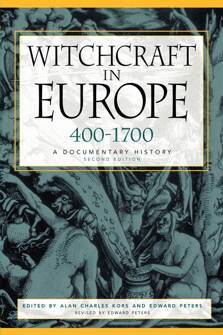
Selected by Choice magazine as an Outstanding Academic Book for 2001The highly-acclaimed first edition of this book chronicled the rise and fall of witchcraft in Europe between the twelfth and the end of the seventeenth centuries. Now greatly expanded, the classic anthology of contemporary texts reexamines the phenomenon of witchcraft, taking into account the remarkable scholarship since the book's publication almost thirty years ago.Spanning the period from 400 to 1700, the second edition of Witchcraft in Europe assembles nearly twice as many primary documents as the first, many newly translated, along with new illustrations that trace the development of witch-beliefs from late Mediterranean antiquity through the Enlightenment. Trial records, inquisitors' reports, eyewitness statements, and witches' confessions, along with striking contemporary illustrations depicting the career of the Devil and his works, testify to the hundreds of years of terror that enslaved an entire continent.Thomas Aquinas, Martin Luther, Thomas Hobbes, and other thinkers are quoted at length in order to determine the intellectual, perceptual, and legal processes by which "folklore" was transformed into systematic demonology and persecution. Together with explanatory notes, introductory essays-which have been revised to reflect current research-and a new bibliography, the documents gathered in Witchcraft in Europe vividly illumine the dark side of the European mind.
1 192 kr
Skickas inom 7-10 vardagar
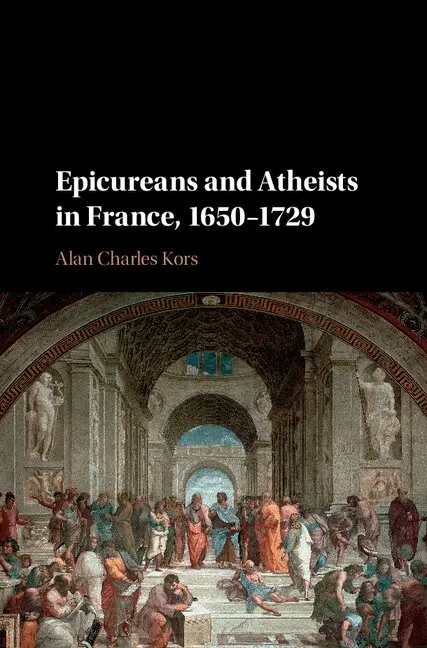
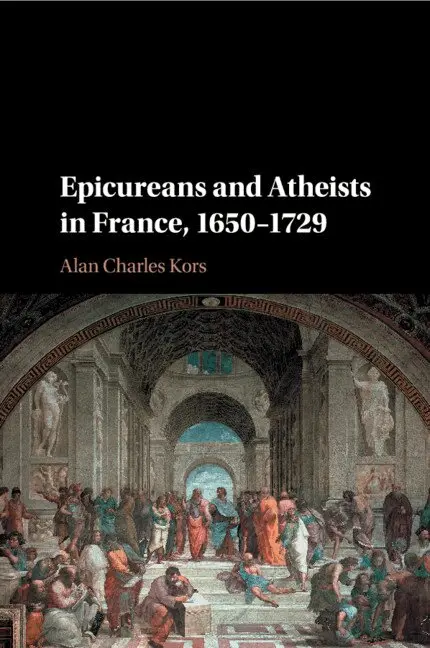
Atheism was the most fundamental challenge to early-modern French certainties. Leading educators, theologians and philosophers labelled such atheism as manifestly absurd, confident that neither the fact nor behaviour of nature was explicable without reference to God. The alternative was a categorical naturalism. This book demonstrates that the Christian learned world had always contained the naturalistic 'atheist' as an interlocutor and a polemical foil, and its early-modern engagement and use of the hypothetical atheist were major parts of its intellectual life. In the considerations and polemics of an increasingly fractious orthodox culture, the early-modern French learned world gave real voice and eventually life to that atheistic presence. Without understanding the actual context and convergence of the inheritance, scholarship, fierce disputes, and polemical modes of orthodox culture, the early-modern generation and dissemination of absolute naturalism are inexplicable. This book brings to life that Christian learned culture, its dilemmas, and its unintended consequences.
1 245 kr
Skickas inom 7-10 vardagar
Atheism was the most foundational challenge to early-modern French certainties. Theologians and philosophers labelled such atheism as absurd, confident that neither the fact nor behaviour of nature was explicable without reference to God. The alternative was a categorical naturalism, whose most extreme form was Epicureanism. The dynamics of the Christian learned world, however, which this book explains, allowed the wide dissemination of the Epicurean argument. By the end of the seventeenth century, atheism achieved real voice and life. This book examines the Epicurean inheritance and explains what constituted actual atheistic thinking in early-modern France, distinguishing such categorical unbelief from other challenges to orthodox beliefs. Without understanding the actual context and convergence of the inheritance, scholarship, protocols, and polemical modes of orthodox culture, the early-modern generation and dissemination of atheism are inexplicable. This book brings to life both early-modern French Christian learned culture and the atheists who emerged from its intellectual vitality.
428 kr
Skickas inom 7-10 vardagar
Atheism was the most fundamental challenge to early-modern French certainties. Leading educators, theologians and philosophers labelled such atheism as manifestly absurd, confident that neither the fact nor behaviour of nature was explicable without reference to God. The alternative was a categorical naturalism. This book demonstrates that the Christian learned world had always contained the naturalistic 'atheist' as an interlocutor and a polemical foil, and its early-modern engagement and use of the hypothetical atheist were major parts of its intellectual life. In the considerations and polemics of an increasingly fractious orthodox culture, the early-modern French learned world gave real voice and eventually life to that atheistic presence. Without understanding the actual context and convergence of the inheritance, scholarship, fierce disputes, and polemical modes of orthodox culture, the early-modern generation and dissemination of absolute naturalism are inexplicable. This book brings to life that Christian learned culture, its dilemmas, and its unintended consequences.
428 kr
Skickas inom 7-10 vardagar
Atheism was the most foundational challenge to early-modern French certainties. Theologians and philosophers labelled such atheism as absurd, confident that neither the fact nor behaviour of nature was explicable without reference to God. The alternative was a categorical naturalism, whose most extreme form was Epicureanism. The dynamics of the Christian learned world, however, which this book explains, allowed the wide dissemination of the Epicurean argument. By the end of the seventeenth century, atheism achieved real voice and life. This book examines the Epicurean inheritance and explains what constituted actual atheistic thinking in early-modern France, distinguishing such categorical unbelief from other challenges to orthodox beliefs. Without understanding the actual context and convergence of the inheritance, scholarship, protocols, and polemical modes of orthodox culture, the early-modern generation and dissemination of atheism are inexplicable. This book brings to life both early-modern French Christian learned culture and the atheists who emerged from its intellectual vitality.