Ann Blair - Böcker
Visar alla böcker från författaren Ann Blair. Handla med fri frakt och snabb leverans.
8 produkter
8 produkter
527 kr
Skickas inom 7-10 vardagar
A landmark history that traces the creation, management, and sharing of information through six centuriesThanks to modern technological advances, we now enjoy seemingly unlimited access to information. Yet how did information become so central to our everyday lives, and how did its processing and storage make our data-driven era possible? This volume is the first to consider these questions in comprehensive detail, tracing the global emergence of information practices, technologies, and more, from the premodern era to the present. With entries spanning archivists to algorithms and scribes to surveilling, this is the ultimate reference on how information has shaped and been shaped by societies.Written by an international team of experts, the book's inspired and original long- and short-form contributions reconstruct the rise of human approaches to creating, managing, and sharing facts and knowledge. Thirteen full-length chapters discuss the role of information in pivotal epochs and regions, with chief emphasis on Europe and North America, but also substantive treatment of other parts of the world as well as current global interconnections. More than 100 alphabetical entries follow, focusing on specific tools, methods, and concepts—from ancient coins to the office memo, and censorship to plagiarism. The result is a wide-ranging, deeply immersive collection that will appeal to anyone drawn to the story behind our modern mania for an informed existence.Tells the story of information’s rise from 1450 through to todayCovers a range of eras and regions, including the medieval Islamic world, late imperial East Asia, early modern and modern Europe, and modern North AmericaIncludes 100 concise articles on wide-ranging topics:Concepts: data, intellectual property, privacyFormats and genres: books, databases, maps, newspapers, scrolls and rolls, social mediaPeople: archivists, diplomats and spies, readers, secretaries, teachersPractices: censorship, forecasting, learning, political reporting, translatingProcesses: digitization, quantification, storage and searchSystems: bureaucracy, platforms, telecommunicationsTechnologies: cameras, computers, lithographyProvides an informative glossary, suggested further reading (a short bibliography accompanies each entry), and a detailed indexWritten by an international team of notable contributors, including Jeremy Adelman, Lorraine Daston, Devin Fitzgerald, John-Paul Ghobrial, Lisa Gitelman, Earle Havens, Randolph C. Head, Niv Horesh, Sarah Igo, Richard R. John, Lauren Kassell, Pamela Long, Erin McGuirl, David McKitterick, Elias Muhanna, Thomas S. Mullaney, Carla Nappi, Craig Robertson, Daniel Rosenberg, Neil Safier, Haun Saussy, Will Slauter, Jacob Soll, Heidi Tworek, Siva Vaidhyanathan, Alexandra Walsham, and many more.
207 kr
Skickas inom 7-10 vardagar
An essential guide to the ways information has shaped and been shaped by societiesThanks to recent advances, we now enjoy seemingly unlimited access to information. How did information become so central to our everyday lives? This book traces the global emergence of information practices and technologies across pivotal epochs and regions, providing invaluable historical perspectives on the ways information has shaped and been shaped by societies. Featuring the core articles from the ultimate reference book Information: A Historical Companion, this short history will appeal to anyone seeking to understand our modern mania for an informed existence. The book:Tells the story of information’s rise from the premodern era to today, exploring how diverse cultures have created, managed, and shared facts and knowledgeTakes readers from the medieval Islamic world to late imperial East Asia, and from early modern and modern Europe to contemporary North AmericaCovers a broad range of topics, such as networks, bureaucracy, publicity, propaganda, censorship, privacy, intellectual property, digitization, telecommunications, storage and search, and much moreIncludes a new introduction, suggested further readings, and a glossary of key termsBrings together an international team of experts, including Jeremy Adelman, Devin Fitzgerald, John-Paul Ghobrial, Lisa Gitelman, Randolph C. Head, Richard R. John, Elias Muhanna, Thomas S. Mullaney, Carla Nappi, Craig Robertson, Daniel Rosenberg, Will Slauter, and Heidi Tworek
382 kr
Kommande
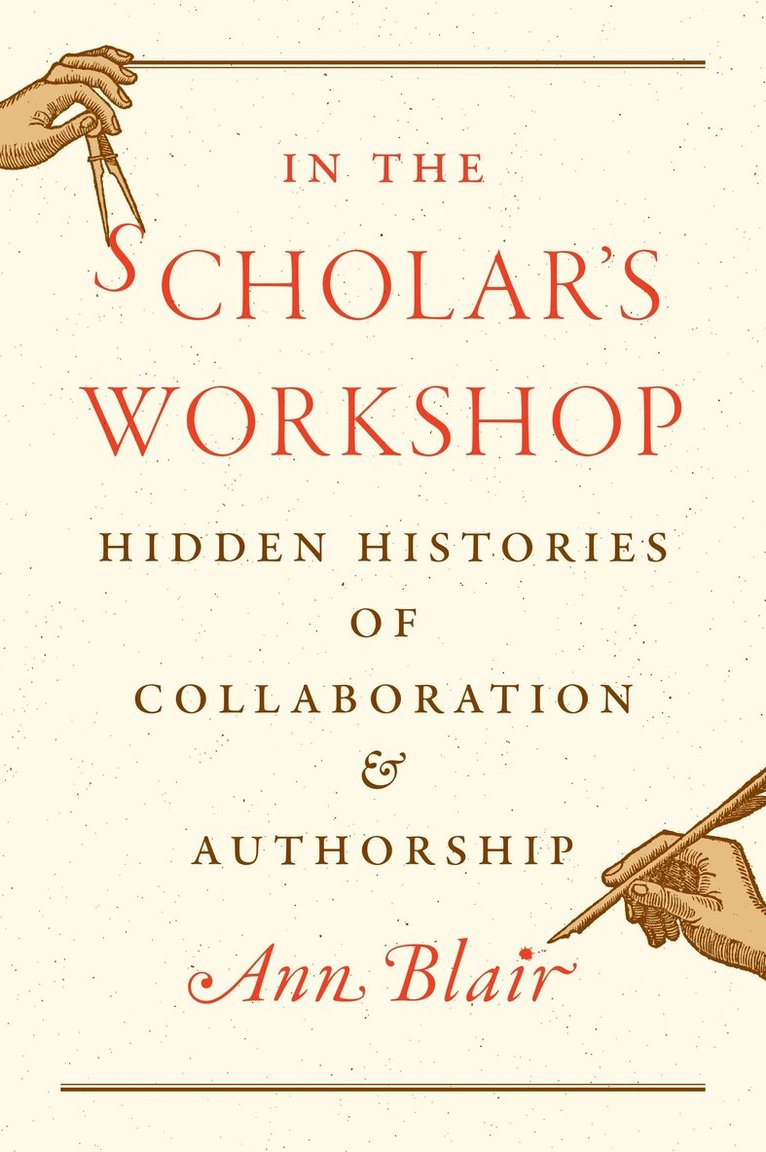
The hidden hands behind history’s great scholarly worksFor centuries, many of the world’s most influential thinkers routinely relied on helpers who performed tasks such as taking dictation, correcting, indexing, composing, and endless copying. In the Scholar’s Workshop introduces readers to these unsung scribes, assistants, and collaborators, showing how the scholarly enterprise is rarely as solitary as we tend to think.Ann Blair traces how the learned have relied on helpers since antiquity, discussing how and when these amanuenses became visible in manuscript and occasionally in print and explaining why they were uniquely positioned to shape the posthumous legacy of their principal. Taking an in-depth look at the later Renaissance, she reconstructs the private lives and academic pursuits of leading figures from the period such as the renowned humanist Erasmus, the reformer Martin Bucer, and Paris professors Adrien Turnèbe and Petrus Ramus. Blair paints multifaceted portraits of the servants, students, and family members who assisted in their work, drawing on sources ranging from scholarly texts in both draft and published forms to correspondence, annotations, biographical accounts, and household rules. Turning to the modern age, she identifies new kinds of digital amanuenses with the rise of chatbots and other powerful software tools.Panoramic in scope, In the Scholar’s Workshop challenges conventional views about authorship and attribution while affirming the enduring importance of collaboration in scholarly work today.
541 kr
Skickas inom 7-10 vardagar
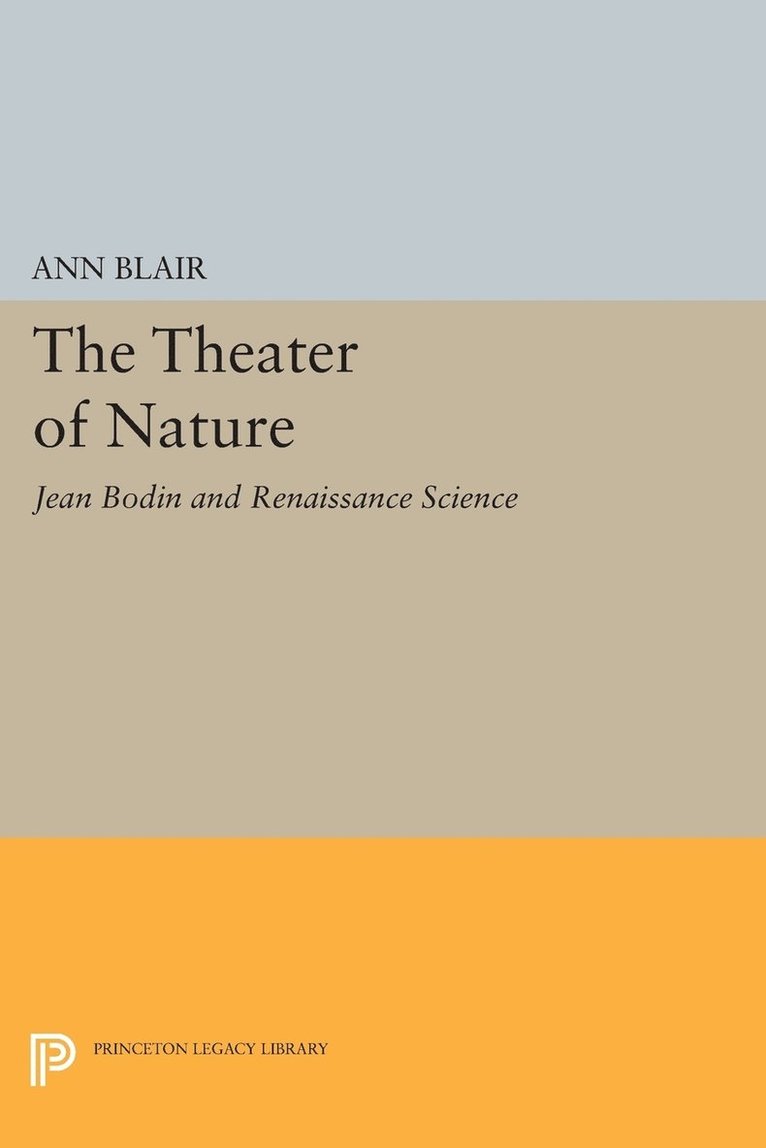
The Theater of Nature is histoire totale of the last work of the political philosopher Jean Bodin, his Universae naturae theatrum (1596). Through Bodin's work, Ann Blair explores the fascinating and previously little known world of late Renaissance natural philosophy. A study of the text, of its context (through comparisons with different genres of natural philosophy and works entitled "Theater"), and of its reception in the seventeenth century highlights above all the religious motivations, encyclopedic ambitions, and bookish methods characterizing much of late Renaissance science. Amid the religious crisis and the explosion of knowledge in the late sixteenth century, natural philosophy offered grounds for consensus across religious divides and a vast collection of useful and pleasant information, admired for both its order and its variety. The commonplace book provided a versatile tool for gathering and sorting bits of natural knowledge garnered from a wide array of bookish sources and "experience," fueling a vigorous cycle of text-based science at least through the mid-seventeenth century.The miscellaneous genre of the problemata into which Bodin's text was adapted attracted more popular audiences until even later. To place the Theatrum in its cultural context is also to reveal more clearly the peculiarities of Bodin's philosophical project in this, its final expression. He combined arguments from reason, experience, and authority to undermine traditional Aristotelian conclusions and proposed instead a natural philosophy based on pious, often biblical, solutions. Originally published in 1997. The Princeton Legacy Library uses the latest print-on-demand technology to again make available previously out-of-print books from the distinguished backlist of Princeton University Press. These editions preserve the original texts of these important books while presenting them in durable paperback and hardcover editions. The goal of the Princeton Legacy Library is to vastly increase access to the rich scholarly heritage found in the thousands of books published by Princeton University Press since its founding in 1905.
2 636 kr
Skickas inom 3-6 vardagar
The Theater of Nature is histoire totale of the last work of the political philosopher Jean Bodin, his Universae naturae theatrum (1596). Through Bodin's work, Ann Blair explores the fascinating and previously little known world of late Renaissance natural philosophy. A study of the text, of its context (through comparisons with different genres of natural philosophy and works entitled "Theater"), and of its reception in the seventeenth century highlights above all the religious motivations, encyclopedic ambitions, and bookish methods characterizing much of late Renaissance science. Amid the religious crisis and the explosion of knowledge in the late sixteenth century, natural philosophy offered grounds for consensus across religious divides and a vast collection of useful and pleasant information, admired for both its order and its variety. The commonplace book provided a versatile tool for gathering and sorting bits of natural knowledge garnered from a wide array of bookish sources and "experience," fueling a vigorous cycle of text-based science at least through the mid-seventeenth century.The miscellaneous genre of the problemata into which Bodin's text was adapted attracted more popular audiences until even later. To place the Theatrum in its cultural context is also to reveal more clearly the peculiarities of Bodin's philosophical project in this, its final expression. He combined arguments from reason, experience, and authority to undermine traditional Aristotelian conclusions and proposed instead a natural philosophy based on pious, often biblical, solutions. Originally published in 1997. The Princeton Legacy Library uses the latest print-on-demand technology to again make available previously out-of-print books from the distinguished backlist of Princeton University Press. These editions preserve the original texts of these important books while presenting them in durable paperback and hardcover editions. The goal of the Princeton Legacy Library is to vastly increase access to the rich scholarly heritage found in the thousands of books published by Princeton University Press since its founding in 1905.
381 kr
Skickas inom 10-15 vardagar
The Transmission of Culture in Early Modern Europe focuses on the ways in which culture is moved from one generation or group to another, not by exact replication but by accretion or revision. The contributors to the volume each consider how the passing of historical information is an organic process that allows for the transformation of previously accepted truth.The volume covers a broad and fascinating scope of subjects presented by leading scholars. Anthony Grafton's contribution on the fifteenth-century forger Annius of Viterbo emphasizes the role of imagination in the classical revival; Lisa Jardine demonstrates the way in which Erasmus helped turn a technical and rebarbative book by Rudolph Agricola into a sixteenth-century success story; Alan Charles Kors finds the roots of Enlightenment atheism in the works of French Catholic theologians; Donald R. Kelley follows the legal idea of "custom" from its formulation by the ancients to its assimilation into the modern social sciences; and Lawrence Stone shows how changes in legal action against female adultery between 1670 and 1857 reflect basic shifts in English moral values.
625 kr
Skickas inom 7-10 vardagar
This first book-length study of physico-theology questions the widespread notion of a steadily advancing early modern separation of religion and science.Beginning around 1650, the emergence of a number of new scientific concepts, methods, and instruments challenged existing syntheses of science and religion. Physico-theology, which embraced the values of personal, empirical observation, was an international movement of the early Enlightenment that focused on the new science to make arguments about divine creation and providence. By reconciling the new science with Christianity across many denominations, physico-theology played a crucial role in diffusing new scientific ideas, assumptions, and interest in the study of nature to a broad public. In this book, sixteen leading scholars contribute a rich array of essays on the terms and scope of the movement, its scientific and religious arguments, and its aesthetic sensibilities.Contributors: Ann Blair, Simona Boscani Leoni, John Hedley Brooke, Nicolas Brucker, Katherine Calloway, Kathleen Crowther, Brendan Dooley, Peter Harrison, Barbara Hunfeld, Eric Jorink, Scott Mandelbrote, Brian W. Ogilvie, Martine Pécharman, Jonathan Sheehan, Anne-Charlott Trepp, Rienk Vermij, Kaspar von Greyerz
647 kr
Skickas inom 11-20 vardagar
An illuminating exploration of the new frontiers—and unsettled geographical, temporal, and thematic borders—of early modern European history.The study of early modern Europe has long been the source of some of the most creative and influential movements in historical scholarship. New Horizons for Early Modern European Scholarship explores recent developments in historiography both to exhibit the field's continuing vibrancy and to highlight emerging challenges to long-assumed truths. Essays examine • how key ideas and intellectual practices arose, circulated through scholarly culture, and gave way to subsequent forms • Europe's transforming relationship with Asia, the Americas, Africa, and the rest of the world• how overlooked evidence illuminates vital but obscured people, practices, and objects • connections between disciplines, types of sources, time periods, and placesOpening up emerging possibilities, this book demonstrates that early modern European scholarship remains a source for groundbreaking historical insights and methodologies that would benefit the study of any time and place. Contributors: Alexander Bevilacqua, Ann Blair, Daniela Bleichmar, William J. Bulman, Frederic Clark, Anthony Grafton, Jill Kraye, Yuen-Gen Liang, Elizabeth McCahill, Nicholas Popper, Amanda Wunder