Anna Angelini - Böcker
Visar alla böcker från författaren Anna Angelini. Handla med fri frakt och snabb leverans.
5 produkter
5 produkter
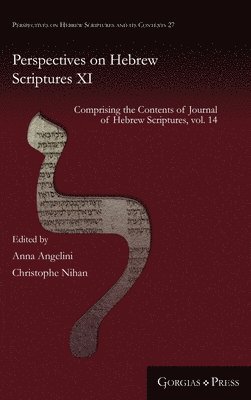
Perspectives on Hebrew Scriptures XI
Comprising the Contents of Journal of Hebrew Scriptures, vol. 14
Inbunden, Engelska, 2017
2 872 kr
Skickas inom 5-8 vardagar
This volume incorporates all the articles and reviews published in volume 14 (2014) of the Journal of Hebrew Scriptures.
1 618 kr
Skickas inom 5-8 vardagar
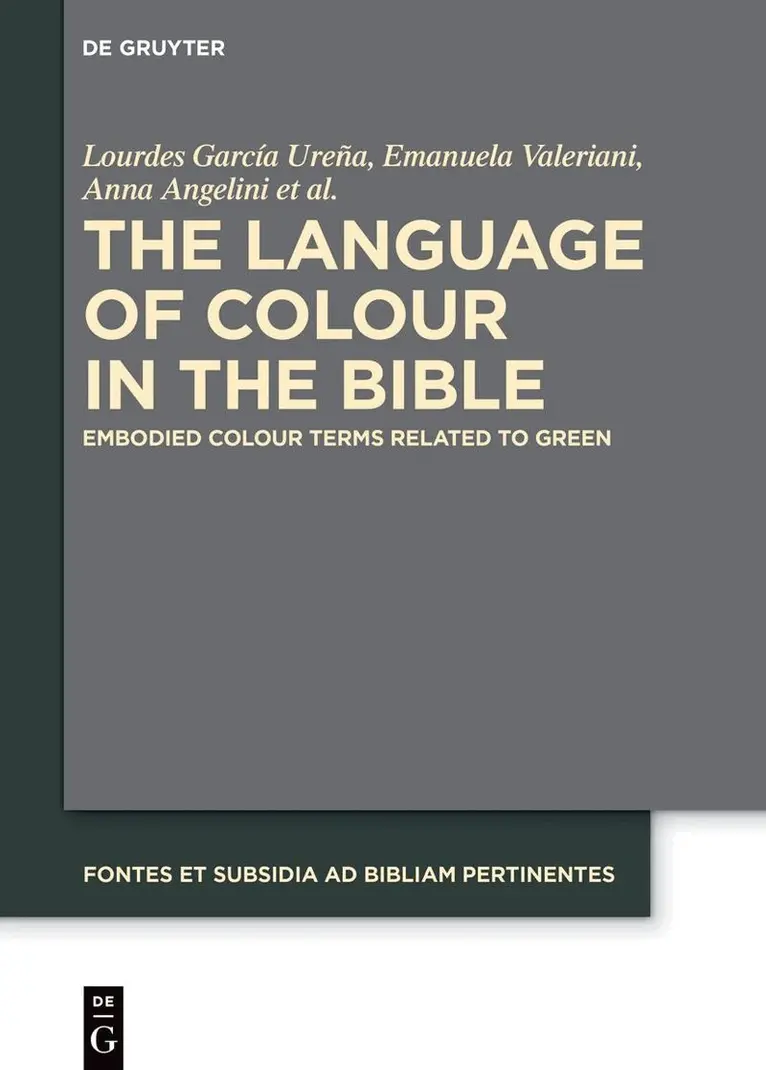
The Bible is one of the books that has aroused the most interest throughout history to the present day. However, there is one topic that has mostly been neglected and which today constitutes one of the most emblematic elements of the visual culture in which we live immersed: the language of colour. Colour is present in the biblical text from its beginning to its end, but it has hardly been studied, and we appear to have forgotten that the detailed study of the colour terms in the Bible is essential to understanding the use and symbolism that the language of colour has acquired in the literature that has forged European culture and art. The objective of the present study is to provide the modern reader with the meaning of colour terms of the lexical families related to the green tonality in order to determine whether they denote only color and, if so, what is the coloration expressed, or whether, together with the chromatic denotation, another reality inseparable from colour underlies/along with the chromatic denotation, there is another underlying reality that is inseparable from colour. We will study the symbolism that/which underpins some of these colour terms, and which European culture has inherited. This lexicographical study requires a methodology that allows us to approach colour not in accordance with our modern and abstract concept of colour, but with the concept of the ancient civilations. This is why the concept of colour that emerges from each of the versions of the Bible is studied and compared with that found in theoretical reflection in both Greek and Latin. Colour thus emerges as a concrete reality, visible on the surface of objects, reflecting in many cases, not an intrinsic quality, but their state. This concept has a reflection in the biblical languages, since the terms of colour always describe an entity (in this sense one can say that they are embodied) and include within them a wide chromatic spectrum, that is, they are mostly polysemic. Structuralism through the componential analysis, although providing interesting contributions, had at the same time serious shortcomings when it came to the study of colour. These were addressed through the theoretical framework provided by cognitive linguistics and some of its tools such as: cognitive domains, metonymy and metaphor. Our study, then, is one of the first to apply some of the contributions of cognitive linguistics to lexicography in general, and particularly with reference to the Hebrew, Greek and Latin versions of the Bible.A further novel contribution of this research is that the meaning is expressed through a definition and not through a list of possible colour terms as happens in dictionaries or in studies referring to colour in antiquity. The definition allows us to delve deeper and discover new nuances that enrich the understanding of colour in the three great civilizations involved in our study: Israel, Greece and Rome.
Del 2 - Archaeology and Bible
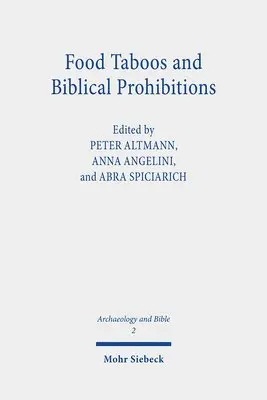
Food Taboos and Biblical Prohibitions
Reassessing Archaeological and Literary Perspectives
Häftad, Engelska, 2020
1 166 kr
Skickas inom 5-8 vardagar
Der vorliegende Band untersucht biblische Speiseverbote in Bezug auf ihre Materialität, ihre Eigenschaft als vergleichbare kulturelle Objekte und ihren anthropologischen Charakter, indem er Beiträge aus archäologischer, anthropologischer und textueller Perspektive vereint, ebenso wie der der Altorientalistik.
Del 9 - Archaeology and Bible
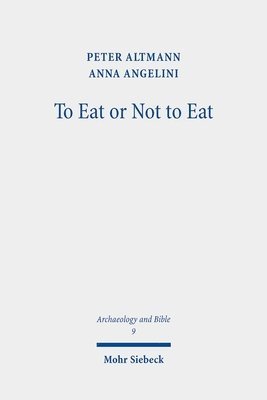
To Eat or Not to Eat
Studies on the Biblical Dietary Prohibitions
Häftad, Engelska, 2024
1 683 kr
Skickas inom 5-8 vardagar
Anna Angelini und Peter Altmann befassen sich mit zentralen Fragen zu den biblischen Speisegeboten und ihrer Bedeutung als Praktiken und Texte durch philologische, zooarchäologische, ikonografische und vergleichende altorientalische und griechisch-römische Perspektiven. Dabei untersuchen sie theoretische Rahmen, die in der modernen Auslegung verwendet werden, mögliche Ursprünge in Bezug auf die altisraelitische Religion und Gesellschaft, sowie die Verortung in Bezug auf die priesterliche Terminologie und die deuteronomische Tradition. Sie weiten den Untersuchungsbogen auf die Rezeption der Verbote des Zweiten Tempels sowohl in den Schriftrollen vom Toten Meer als auch in den griechisch-römischen Diskursen der ersten Jahrhunderte nach Christus aus. Mit ihren grundlegenden Studien liefern sie eine Annäherung an die Speisegebote, die den Weg für die Rekonstruktion ihres Entwicklungsweges in ihre heutigen Kontexte öffnet.
Del 197 - Supplements to the Journal for the Study of Judaism
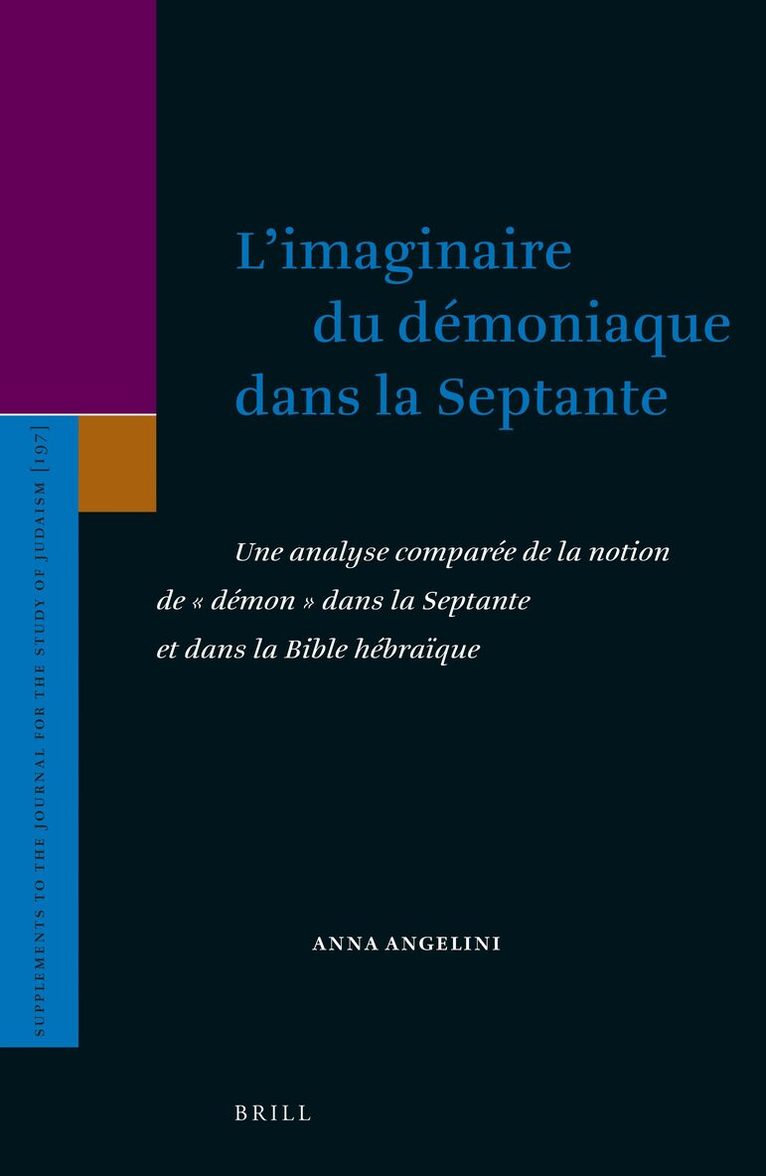
L’imaginaire du démoniaque dans la Septante
Une analyse comparée de la notion de “démon” dans la Septante et dans la Bible Hébraïque
Inbunden, Engelska, 2021
2 357 kr
Skickas inom 5-8 vardagar
This book offers a thorough analysis of demons in the Hebrew Bible and Septuagint in the wider context of the ancient Near East and the Greek world. Taking a fresh and innovative angle of enquiry, Anna Angelini investigates continuities and changes in the representation of divine powers in Hellenistic Judaism, thereby revealing the role of the Greek translation of the Bible in shaping ancient demonology, angelology, and pneumatology. Combining philological and semantic analyses with a historical approach and anthropological insights, the author both develops a new method for analyzing religious categories within biblical traditions and sheds new light on the importance of the Septuagint for the history of ancient Judaism.Le livre propose une analyse approfondie des démons dans la Bible Hébraïque et la Septante, à la lumière du Proche Orient Ancien et du contexte grec. Par un nouvel angle d’approche, Anna Angelini met en lumière dynamiques de continuité et de changement dans les représentations des puissances divines à l’époque hellénistique, en soulignant l’importance de la traduction grecque de la Bible pour la compréhension de la démonologie, de l’angélologie et de la pneumatologie antiques. En intégrant l’analyse philologique et sémantique avec une approche historique et des méthodes anthropologiques, l’autrice développe une nouvelle méthodologie pour analyser des catégories religieuses à l’intérieur des traditions bibliques et affirme la valeur de la Septante pour l’histoire du judaïsme antique.