Anthony Hunter - Böcker
Visar alla böcker från författaren Anthony Hunter. Handla med fri frakt och snabb leverans.
5 produkter
5 produkter
92 kr
Tillfälligt slut
554 kr
Skickas inom 10-15 vardagar
Inconsistency arises in many areas in advanced computing. Often inconsistency is unwanted, for example in the specification for a plan or in sensor fusion in robotics; however, sometimes inconsistency is useful. Whether inconsistency is unwanted or useful, there is a need to develop tolerance to inconsistency in application technologies such as databases, knowledge bases, and software systems. To address this situation, inconsistency tolerance is being built on foundational technologies for identifying and analyzing inconsistency in information, for representing and reasoning with inconsistent information, for resolving inconsistent information, and for merging inconsistent information.The idea for this book arose out of a Dagstuhl Seminar on the topic held in summer 2003. The nine chapters in this first book devoted to the subject of inconsistency tolerance were carefully invited and anonymously reviewed. The book provides an exciting introduction to this new field.
554 kr
Skickas inom 10-15 vardagar
An introductory review of uncertainty formalisms by the volume editors begins the volume. The first main part of the book introduces some of the general problems dealt with in research. The second part is devoted to case studies; each presentation in this category has a well-delineated application problem and an analyzed solution based on an uncertainty formalism. The final part reports on developments of uncertainty formalisms and supporting technology, such as automated reasoning systems, that are vital to making these formalisms applicable. The book ends with a useful subject index. There is considerable synergy between the papers presented. The representative collection of case studies and associated techniques make the volume a particularly coherent and valuable resource. It will be indispensable reading for researchers and professionals interested in the application of uncertainty formalisms as well as for newcomers to the topic.
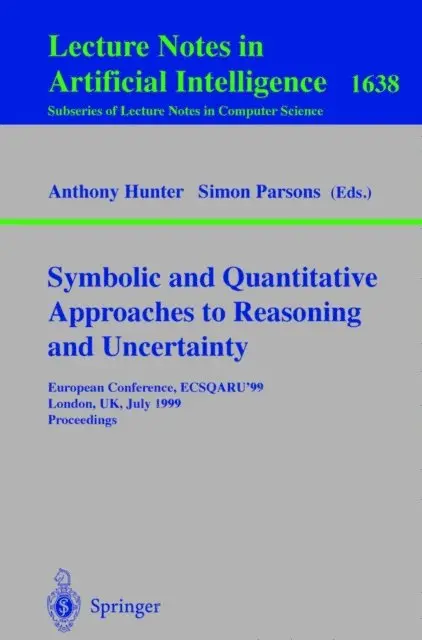
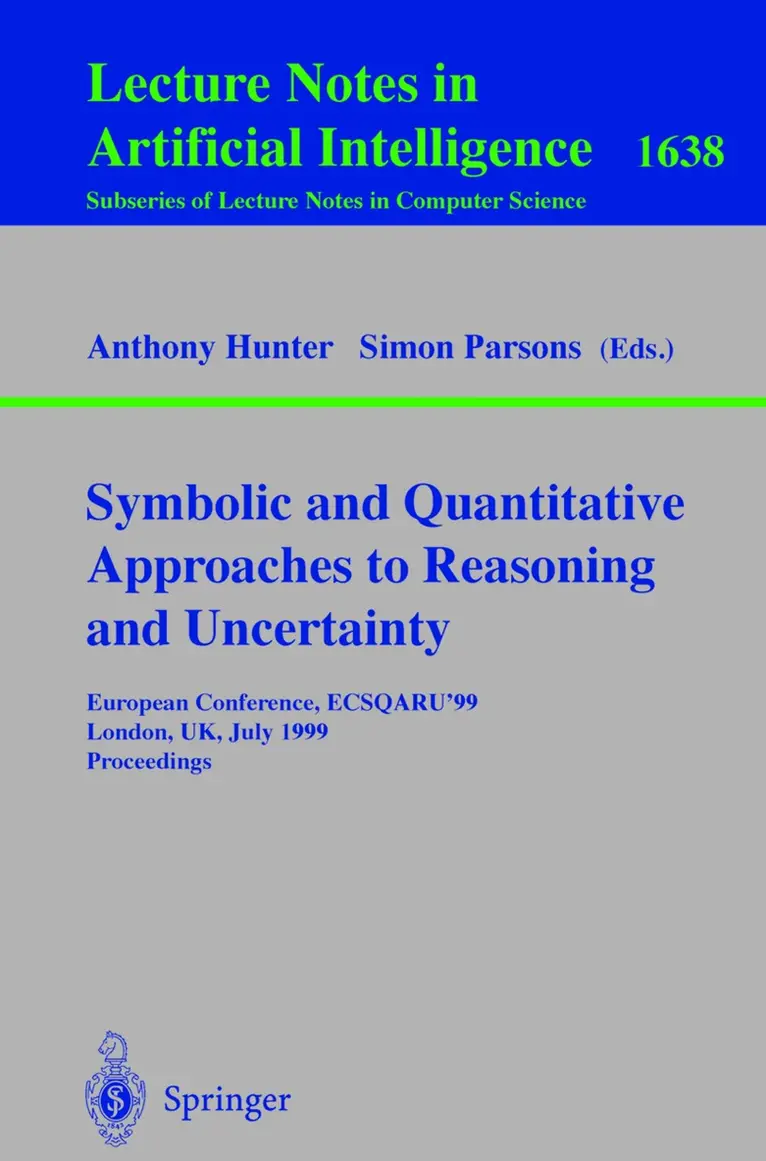
Symbolic and Quantitative Approaches to Reasoning and Uncertainty
European Conference, ECSQARU'99, London, UK, July 5-9, 1999, Proceedings
Häftad, Engelska, 1999
554 kr
Skickas inom 10-15 vardagar
Uncertaintyisanincreasinglyimportantresearchtopicinmanyareasofc- puterscience. Manyformalismsarebeingdeveloped,withmuchinterestatthe theoryleveldirectedatdevelopingabetterunderstandingoftheformalismsand identifyingrelationshipsbetweenformalisms,andatthetechnologyleveldirected atdevelopingsoftwaretoolsforformalismsandapplicationsofformalisms. ThemainEuropeanforumforthesubjectistheEuropeanConferenceon SymbolicandQuantitativeApproachestoReasoningandUncertainty(EC- SQARU). FollowingthesuccessofthepreviousECSQARUconferences,heldin Marseilles(1991),Granada(1993),Fribourg(1995),andBonn(1997),the?fth conferenceintheserieswasheldatUniversityCollegeLondoninJuly1999. ThisvolumecontainspapersacceptedforpresentationatECSQARU'99. In additiontothemainconference,twoworkshopswereheld. The?rstwason DecisionTheoreticandGameTheoreticAgents,chairedbySimonParsonsand MikeWooldridge,andthesecondwasonLogicalandUncertaintyModelsfor InformationSystems,chairedbyFabioCrestaniandMouniaLalmas. Selected papersfromtheworkshopsarealsoincludedintheseproceedings. Weareindebitedtotheprogrammmecommitteefortheire?ortinorganising theprogramme,totheinvitedspeakers,andtothepresentersofthetutorials.Furthermore,wegratefullyacknowledgethecontributionofthemanyreferees whowereinvolvedinthereviewingprocess. Finallywewouldliketothankthe DepartmentofComputerScienceatUniversityCollegeLondonforadminist- tivesupport. ProgrammeCommittee TheprogrammecommitteewaschairedbyAnthonyHunter(UniversityCollege London),andcomprisedDovGabbay(King'sCollegeLondon),FinnJensen (AalborgUniversity),RudolfKruse(UniversityofMagdeburg),SimonParsons (QueenMary,UniversityofLondon)HenriPrade(IRIT,Toulouse),Torsten Schaub(UniversityofPotsdam),andPhilippeSmets(ULB,Bruxelles). Reviewers Theprogrammecommitteeisverygratefulforallthehardworkcontributed bythereviewers. Hopefully,wehavenotmissedanyonefromthefollowing list:BruceD'Ambrosio,FlorenceBannay,SalemBenferhat,PhilippeBesnard, HuguesBersini,ChristianBorgelt,RachelBourne,StefanBrass,LaurenceCholvy, RogerCooke,AdnanDarwiche,YannisDimopoulos,JurgenDix,DidierDubois, UweEgly,LindavanderGaag,JoergGebhardt,SiegfriedGottwald,RolfHaenni, Jean-YvesJa?ray,RadimJirousek,RuthKempson,U?eKjaerulf,FrankK- wonn,AljoschaKlose,JuergKohlas,PaulKrause,GerhardLakemeyer,Mounia Lalmas,JeromeLang,KimG. Larsen,NorbertLehmann,T. Y. Lin,Thomas Linke,KhalidMellouli,JeromeMengin,J. -J. Ch.Meyer,SanjayModgil,Yves Moinard,Sera?nMoral,DetlefNauck,AnnNicholson,PascalNicolas,Dennis VI Preface Nilsson,KristianG. Olesen,RainerPalm,ZdzislawPawlak,VincentRisch,Regis Sabbadin,CamillaSchwind,PrakashP. Shenoy,MilanStudeny,HeikoTimm, HansTompits,MarcoValtorta,andCeesWitteven. April1999 AnthonyHunterandSimonParsons TableofContents Onthedynamicsofdefaultreasoning GrigorisAntoniou...1 Non-monotonicandparaconsistentreasoning:Frombasicentailmentsto plausiblerelations OferArieliandArnonAvron ...11 AcomparisonofsystematicandlocalsearchalgorithmsforregularCNF formulas Ram'onB'ejarandFelipMany'a...22 Query-answeringinprioritizeddefaultlogic FaridBenhammadi,PascalNicolasandTorstenSchaub...32 Updatingdirectedbeliefnetworks BoutheinaBenYaghlaneandKhaledMellouli...43 Inferringcausalexplanations PhilippeBesnardandMarie-OdileCordier...55 Acritiqueofinductivecausation ChristianBorgeltandRudolfKruse...68 Connectinglexicographicwithmaximumentropyentailment RachelA. BourneandSimonParsons...80 Avoidingnon-groundvariables StefanBruning .. andTorstenSchaub...92 Anchoringsymbolstovisiondatabyfuzzylogic SilviaCoradeschiandAlessandroSa?otti...104 Filteringvsrevisionandupdate:Letusdebate!CorineCossartandCatherineTessier...116 Irrelevanceandindependenceaxiomsinquasi-Bayesiantheory FabioG. Cozman...128 Assessingthevalueofacandidate:Aqualitativepossibilisticapproach DidierDubois,MichelGrabischandHenriPrade...137 VIII TableofContents Learningdefaulttheories B'eatriceDuvalandPascalNicolas...148 Knowledgerepresentationforinductivelearning PeterA. Flach...160 Handling inconsistency e?ciently in the incremental construction of strati?ed beliefbases EricGr'egoire...168 Roughknowledgediscoveryandapplications J. W. GuanandD. A. Bell...179 GradientdescenttrainingofBayesiannetworks FinnV. Jensen...190 Opendefaulttheoriesovercloseddomains:Anextendedabstract MichaelKaminski...201 Shopboteconomics Je?reyO. KephartandAmyR. Greenwald...208 OptimizedalgorithmforlearningBayesiannetworkfromdata F'ediaKhalfallahandKhaledMellouli...221 Mergingwithintegrityconstraints S'ebastienKoniecznyandRam'onPinoP'erez...233 Boolean-likeinterpretationofSugenointegral IvanKramosil...245 AnalternativetooutwardpropagationforDempster-Shaferbelieffunctions NorbertLehmannandRolfHaenni...256 Onbottom-uppre-processingtechniquesforautomateddefaultreasoning ThomasLinkeandTorstenSchaub...268 Probabilisitclogicprogrammingundermaximumentropy ThomasLukasiewiczandGabrieleKern-Isberner...279 Lazypropagationandindependenceofcausalin?uence AndersL. MadsenandBruceD'Ambrosio...293 TableofContents IX AMonteCarloalgorithmforcombiningDempster-Shaferbeliefbasedon approximatepre-computation Seraf'?nMoralandAntonioSalmer'on...305 Anextensionofalinguisticnegationmodelallowingustodenynuanced propertycombinations DanielPacholczyk...316 Argumentationandqualitativedecisionmaking SimonParsonsandShawGreen...328 Handling di?erent forms of uncertainty in regression analysis: A fuzzy belief structureapproach SimonPetit-RenaudandThierryDenoeux...340 State recognition in discrete dynamical systems using Petri nets and evidence theory Mich'eleRombaut,ImanJarkassandThierryDenoeux...352 Robotnavigationandmapbuildingwiththeeventcalculus MurrayShanahanandMarkWitkowski...362 Informationfusioninthecontextofstockindexprediction StefanSiekmann,J..orgGebhardtandRudolfKruse...363 Defeasiblegoals LeendertvanderTorre...374 Logicaldeductionusingthelocalcomputationframework NicWilsonandJ'eromeMengin...386 AuthorIndex...397 OntheDynamicsofDefaultReasoning Grigoris Antoniou Gri?thUniversity,QLD4111,Australia UniversityofMacedonia,Thessaloniki,Greece ga@cit.gu. edu. au Abstract. Defaultlogicisaprominentrigorousmethodforreasoning withincompleteinformationbasedonassumptions. Itisastaticreas- ingapproach,inthesensethatitdoesn'treasonaboutchangesandtheir consequences. Ontheotherhand,itsnonmonotonicbehaviourappears whenchangestoadefaulttheoryaremade.
Scalable Uncertainty Management
4th International Conference, SUM 2010, Toulouse, France, September 27-29, 2010, Proceedings
Häftad, Engelska, 2010
554 kr
Skickas inom 10-15 vardagar
Managing uncertainty and inconsistency has been extensively explored in - ti?cial Intelligence over a number of years. Now with the advent of massive amounts of data and knowledge from distributed heterogeneous,and potentially con?icting, sources, there is interest in developing and applying formalisms for uncertainty andinconsistency widelyin systems that need to better managethis data and knowledge. The annual International Conference on Scalable Uncertainty Management (SUM) has grown out of this wide-ranging interest in managing uncertainty and inconsistency in databases, the Web, the Semantic Web, and AI. It aims at bringing together all those interested in the management of large volumes of uncertainty and inconsistency, irrespective of whether they are in databases,the Web, the Semantic Web, or in AI, as well as in other areas such as information retrieval, risk analysis, and computer vision, where signi?cant computational - forts are needed. After a promising First International Conference on Scalable Uncertainty Management was held in Washington DC, USA in 2007, the c- ference series has been successfully held in Napoli, Italy, in 2008, and again in Washington DC, USA, in 2009.