A.P. Coudert – författare
Visar alla böcker från författaren A.P. Coudert. Handla med fri frakt och snabb leverans.
9 produkter
9 produkter
Inbunden, Engelska, 1995
1 834 kr
Skickas inom 10-15 vardagar
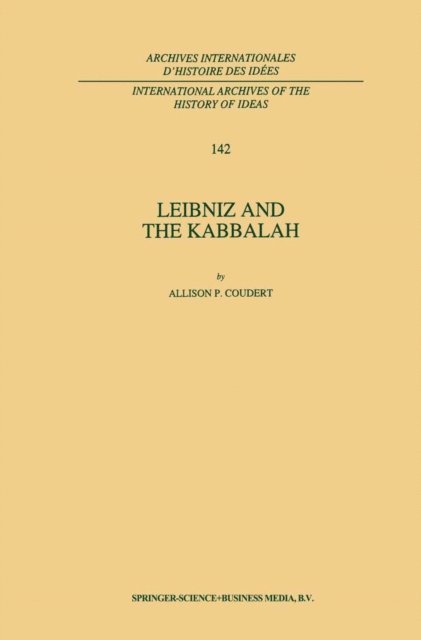
The general view of scholars is that the Kabbalah had no appreciable influence on the philosophy of Gottfried Wilhelm Leibniz. But on the basis of new evidence, Professor Coudert argues that this conclusion is mistaken. Leibniz was neither the foolish optimist Voltaire made him out to be in "Candide" nor the supreme rationalist described by so many subsequent scholars. He was a radical gnostic, whose philosophy was profoundly influenced by the Lurianic Kabbalah. Once this somewhat startling fact is understood, key areas of his philosophy, such as his concept of monads, defence of free will, and theodicy, can be seen in entirely new ways, which solve many of the problems that have perplexed scholars. This book is for all levels of readers, from those with a general interest in intellectual history to specialists in philosophy, the history of science, theology, and Jewish studies.
Inbunden, Engelska, 1998
1 621 kr
Skickas inom 10-15 vardagar
This collection of essays aims to change readers' perceptions of Leibniz and of the 17th century. Dealing with such subjects as Leibniz's occult sources, his interest in mysticism, Kabbalah, and Chinese philosophy, and his attitude towards enthusiasm, this text provides insights into Leibniz's thought and the cultural context in which he lived. The individual essays bring forward new primary material, while at the same time conserving the valuable aspects of older commentators on Leibniz (Baruzi, Meyer, Loemker). The authors frequently disagree which should provoke discussion and debate.
Inbunden, Engelska, 1999
1 083 kr
Skickas inom 10-15 vardagar
MURIEL MCCARTHY This volume originated from a seminar organised by Richard H. Popkin in Marsh's Library on July 7-8, 1994. It was one of the most stimulating events held in the Library in recent years. Although we have hosted many special seminars on such subjects as rare books, the Huguenots, and Irish church history, this was the first time that a seminar was held which was specifically related to the books in our own collection. It seems surprising that this type of seminar has never been held before although the reason is obvious. Since there is no printed catalogue of the Library scholars are not aware of its contents. In fact the collection of books by late seventeenth and early eighteenth century European authors on, for example, such subjects as biblical criticism, political and religious controversy, is one of the richest parts of the Library's collections. Some years ago we were informed that of the 25,000 books in Marsh's at least 5,000 English books or books printed in England were printed between 1640 and 1700.
Häftad, Engelska, 2010
1 834 kr
Skickas inom 10-15 vardagar
The general view of scholars is that the Kabbalah had no appreciable influence on the philosophy of Gottfried Wilhelm Leibniz. But on the basis of new evidence, Professor Coudert argues that this conclusion is mistaken. Leibniz was neither the foolish optimist Voltaire made him out to be in Candide nor the supreme rationalist described by so many subsequent scholars. He was a radical gnostic, whose philosophy was profoundly influenced by the Lurianic Kabbalah. Once this somewhat startling fact is understood, key areas of his philosophy, such as his concept of monads, defense of free will, and theodicy, can be seen in entirely new ways, which solve many of the problems that have perplexed scholars. This book is for all levels of readers, from those with a general interest in intellectual history to specialists in philosophy, the history of science, theology, and Jewish studies.
Häftad, Engelska, 2010
1 619 kr
Skickas inom 10-15 vardagar
This important, well-researched collection of essays will change many readers' perceptions of Leibniz and of the seventeenth century. Dealing with such subjects as Leibniz's occult sources, his interest in mysticism, Kabbalah, and Chinese philosophy, and his attitude towards enthusiasm, the authors provide new insights into Leibniz's thought and the cultural context in which he lived. The individual essays bring forward much in the way of new primary material, while at the same time conserving the valuable aspects of older commentators on Leibniz (Baruzi, Meyer, Loemker). The fact that the authors frequently disagree makes this an exciting collection that is bound to provoke discussion and debate. While this book will especially appeal to Leibniz scholars, it has much to recommend it to readers interested in the philosophy, theology, and science of early modern Europe.
Häftad, Engelska, 2012
1 073 kr
Skickas inom 10-15 vardagar
MURIEL MCCARTHY This volume originated from a seminar organised by Richard H. Popkin in Marsh's Library on July 7-8, 1994. It was one of the most stimulating events held in the Library in recent years. Although we have hosted many special seminars on such subjects as rare books, the Huguenots, and Irish church history, this was the first time that a seminar was held which was specifically related to the books in our own collection. It seems surprising that this type of seminar has never been held before although the reason is obvious. Since there is no printed catalogue of the Library scholars are not aware of its contents. In fact the collection of books by late seventeenth and early eighteenth century European authors on, for example, such subjects as biblical criticism, political and religious controversy, is one of the richest parts of the Library's collections. Some years ago we were informed that of the 25,000 books in Marsh's at least 5,000 English books or books printed in England were printed between 1640 and 1700.
E-bok
PDF, Engelska, 20131 408 kr
Läs direkt efter köp
MURIEL MCCARTHY This volume originated from a seminar organised by Richard H. Popkin in Marsh''s Library on July 7-8, 1994. It was one of the most stimulating events held in the Library in recent years. Although we have hosted many special seminars on such subjects as rare books, the Huguenots, and Irish church history, this was the first time that a seminar was held which was specifically related to the books in our own collection. It seems surprising that this type of seminar has never been held before although the reason is obvious. Since there is no printed catalogue of the Library scholars are not aware of its contents. In fact the collection of books by late seventeenth and early eighteenth century European authors on, for example, such subjects as biblical criticism, political and religious controversy, is one of the richest parts of the Library''s collections. Some years ago we were informed that of the 25,000 books in Marsh''s at least 5,000 English books or books printed in England were printed between 1640 and 1700.
E-bok
PDF, Engelska, 20131 977 kr
Läs direkt efter köp
Some scholars in the history of ideas have had a growing interest in examining Leibniz''s many discussions ofvarious aspects of religion, Christian, Jewish and far eastern. Leibniz, with his voracious interest and concern for so many aspects of human intellectual and spiritual life, read a wide variety of books on the various religions of mankind. He also was in personal contact with many of those who espoused orthodox and non-orthodox views. He annotated his copies of many books on religious subjects. And he was working on schemes for reuniting the various Catholic and Protestant churches in Europe. Studies on Leibniz''s views on Judaism, on the Kabbalah, on Chinese thought have been appearing over the last decades. It was decided by some of us that since there has been a growing interest in this side of Leibniz''s thought it would be a good idea to bring together a group of scholars working on different aspects of Leibniz''s views on religion, mysticism and spiritualism, in order to h~ve them present papers on their current researches, and to have the opportunity for lengthy discussion, formal and informal, in the most pleasant academic ambiance of the William Andrews Clark Library in Los Angeles. Under the sponsorship of the UCLA Center for Seventeenth and Eighteenth Century Studies, a workshop conference was held November 18-19, 1994.
E-bok
PDF, Engelska, 20132 275 kr
Läs direkt efter köp
The general view of scholars is that the Kabbalah had no meaningful influence on Leibniz''s thought. } But on the basis of new evidence I am convinced that the question must be reopened. The Kabbalah did influence Leibniz, and a recognition of this will lead to both a better understanding of the supposed "quirkiness,,2 of Leibniz''s philosophy and an appreciation ofthe Kabbalah as an integral but hitherto ignored factor in the emergence of the modem secular and scientifically oriented world. During the past twenty years there has been increasing willingness to recognize the important ways in which mystical and occult thinking contributed to the development of science and the emergence 3 of toleration. However, the Kabbalah, particularly the Lurianic Kabbalah with its monistic vitalism and optimistic philosophy of perfectionism and universal salvation, has not yet been integrated into the new historiography, although it richly deserves to be. On the basis of manuscripts in libraries at Hanover and Wolfenbiittel, it is clear that Leibniz''s relationship with Francis Mercury van Helmont (1614- 1698) and Christian Knorr von Rosenroth (1636-1689), the two leading Christian Kabbalists of the period, was much closer than previously imagined and that his direct knowledge of their writings, especially the collection of 4 kabbalistic texts they published in the Kabbala Denudata, was far more detailed than most scholars have realized. During 1688 Leibniz spent more than a month at Sulzbach with von Rosenroth.