Arnold R. Hirsch - Böcker
Visar alla böcker från författaren Arnold R. Hirsch. Handla med fri frakt och snabb leverans.
4 produkter
4 produkter
197 kr
Skickas inom 7-10 vardagar
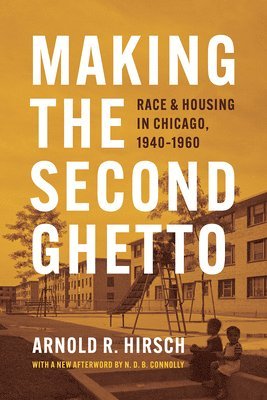
First published in 1983 and praised by the likes of Ta-Nehisi Coates and Thomas Sugrue, Arnold R. Hirsch’s Making the Second Ghetto is the rare book that has only become more piercingly prescient over the years.Hirsch’s classic and groundbreaking work of urban history is a revelatory look at Chicago in the decades after the Great Depression, a period when the city dealt with its rapidly growing Black population not by working to abolish its stark segregation but by expanding and solidifying it. Even as the civil rights movement rose to prominence, Chicago exploited a variety of methods of segregation—including riots, redevelopment, and a host of new legal frameworks—that provided a national playbook for the emergence of a new kind of entrenched inequality. Hirsch’s chronicle of the strategies employed by ethnic, political, and business interests in reaction to the Great Migration of Southern Blacks in the mid-twentieth century makes startingly clear how the violent reactions of an emergent white population found common ground with policy makers to segregate first a city and then the nation.This enlarged edition of Making the Second Ghetto features a visionary afterword by historian N. D. B. Connolly, explaining why Hirsch’s book still crackles with “blistering relevance” for contemporary readers.
1 383 kr
Kommande
Collects critical essays by the author of Making the Second Ghetto. Arnold R. Hirsch (1949–2018) was one of the preeminent urban historians of his generation, a reputation cemented by his landmark book, Making the Second Ghetto. With compelling clarity, Hirsch demonstrated that segregation is not the inevitable result of individual choices, natural tendencies, or cultural traits—it is a structural phenomenon, reinforced on every level by state power. Segregating Cities collects the author’s key essays, some previously unpublished, to reveal a more complete picture of a remarkable scholar and his exploration of race, place, politics, and policy in the twentieth-century American city. Together, these essays can help us see segregation for what it is, so that we can then begin to truly work to overcome it.
456 kr
Kommande
Collects critical essays by the author of Making the Second Ghetto. Arnold R. Hirsch (1949–2018) was one of the preeminent urban historians of his generation, a reputation cemented by his landmark book, Making the Second Ghetto. With compelling clarity, Hirsch demonstrated that segregation is not the inevitable result of individual choices, natural tendencies, or cultural traits—it is a structural phenomenon, reinforced on every level by state power. Segregating Cities collects the author’s key essays, some previously unpublished, to reveal a more complete picture of a remarkable scholar and his exploration of race, place, politics, and policy in the twentieth-century American city. Together, these essays can help us see segregation for what it is, so that we can then begin to truly work to overcome it.
381 kr
Skickas inom 10-15 vardagar
This collection of six original essays explores the peculiar ethnic composition and history of New Orleans, which the authors persuasively argue is unique among American cities. The focus of Creole New Orleans is on the development of a colonial Franco-African culture in the city, the ways that culture was influenced by the arrival of later immigrants, and the processes that led to the eventual dominance of the Anglo-American community.Essays in the book's first section focus not only on the formation of the curiously blended Franco-African culture but also on how that culture, once established, resisted change and allowed New Orleans to develop along French and African creole lines until the early nineteenth century. Jerah Johnson explores the motives and objectives of Louisiana's French founders, giving that issue the most searching analysis it has yet received. Gwendolyn Midlo Hall, in her account of the origins of New Orleans' free black population, offers a new approach to the early history of Africans in colonial Louisiana.The second part of the book focuses on the challenge of incorporating New Orleans into the United States. As Paul F. LaChance points out, the French immigrants who arrived after the Louisiana Purchase slowed the Americanization process by preserving the city's creole culture. Joesph Tregle then presents a clear, concise account of the clash that occurred between white creoles and the many white Americans who during the 1800s migrated to the city. His analysis demonstrates how race finally brought an accommodation between the white creole and American leaders.The third section centers on the evolution of the city's race relations during the nineteenth and twentieth centuries. Joseph Logsdon and Caryn Cossé Bell begin by tracing the ethno-cultural fault line that divided black Americans and creole through Reconstruction and the emergence of Jim Crow. Arnold R. Hirsch pursues the themes discerned by Logsdon and Bell from the turn of the century to the 1980s, examining the transformation of the city's racial politics.Collectively, these essays fill a major void in Louisiana history while making a significant contribution to the history of urbanization, ethnicity, and race relations. The book will serve as a cornerstone for future study of the history of New Orleans.