Barry Edmonston - Böcker
Visar alla böcker från författaren Barry Edmonston. Handla med fri frakt och snabb leverans.
7 produkter
7 produkter
762 kr
Tillfälligt slut
The U.S. census, conducted every 10 years since 1790, faces dramatic new challenges as the country begins its third century. Critics of the 1990 census cited problems of increasingly high costs, continued racial differences in counting the population, and declining public confidence. This volume provides a major review of the traditional U.S. census. Starting from the most basic questions of how data are used and whether they are needed, the volume examines the data that future censuses should provide. It evaluates several radical proposals that have been made for changing the census, as well as other proposals for redesigning the year 2000 census. The book also considers in detail the much-criticized long form, the role of race and ethnic data, and the need for and ways to obtain small-area data between censuses.
385 kr
Tillfälligt slut
The growing importance of immigration in the United States today prompted this examination of the adequacy of U.S. immigration data. This volume summarizes data needs in four areas: immigration trends, assimilation and impacts, labor force issues, and family and social networks. It includes recommendations on additional sources for the data needed for program and research purposes, and new questions and refinements of questions within existing data sources to improve the understanding of immigration and immigrant trends.
251 kr
Tillfälligt slut
The recent level of illegal immigration to the United States has increased debates about the effect of these immigrants on the cost of public services, and states have begun to enact policies that limit the public services available to illegal immigrants. The central issues are how many illegal immigrants reside in particular local areas and states and their effect on public expenditures and revenues and the economy in general. The Local Fiscal Effects of Illegal Immigration workshop selected six studies for analysis. The six case studies focused on one specific aspect of the complex question of the demographic, economic, and social effects of immigration: the net public services costs of illegal immigrants to selected geographical regions.
Immigration Debate
Studies on the Economic, Demographic, and Fiscal Effects of Immigration
Häftad, Engelska, 1998
980 kr
Tillfälligt slut
The New Americans (NRC 1997) presents an analysis of the economic gains and losses from immigration--for the nation, states, and local areas--providing a scientific foundation for public discussion and policymaking. This companion book of systematic research presents nine original and synthesis papers with detailed data and analysis that support and extend the work in the first book and point the way for future work. The Immigration Debate includes case studies of the fiscal effects of immigration in New Jersey and California, studies of the impact of immigration on population redistribution and on crime in the United States, and much more.
975 kr
Skickas inom 3-6 vardagar
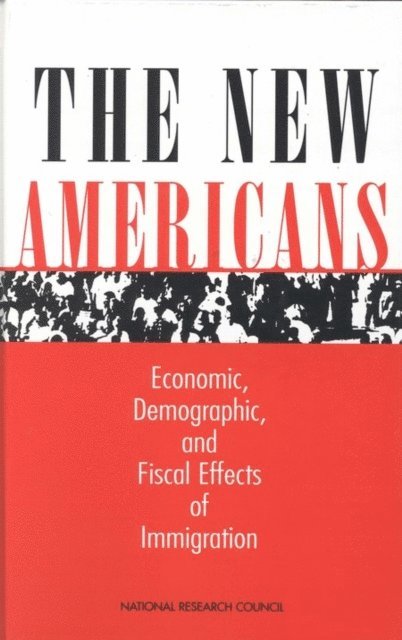
This book sheds light on one of the most controversial issues of the decade. It identifies the economic gains and losses from immigration--for the nation, states, and local areas--and provides a foundation for public discussion and policymaking. Three key questions are explored: * What is the influence of immigration on the overall economy, especially national and regional labor markets? * What are the overall effects of immigration on federal, state, and local government budgets? * What effects will immigration have on the future size and makeup of the nation's population over the next 50 years? The New Americans examines what immigrants gain by coming to the United States and what they contribute to the country, the skills of immigrants and those of native-born Americans, the experiences of immigrant women and other groups, and much more. It offers examples of how to measure the impact of immigration on government revenues and expenditures--estimating one year's fiscal impact in California, New Jersey, and the United States and projecting the long-run fiscal effects on government revenues and expenditures.Also included is background information on immigration policies and practices and data on where immigrants come from, what they do in America, and how they will change the nation's social fabric in the decades to come.
326 kr
Skickas inom 5-8 vardagar
534 kr
Skickas inom 10-15 vardagar
Dr. Albert Schmid President of the Federal Office for Migration and Refugees According to the United Nations, about 200 million people of the estimated world population of 6.8 billion are international migrants – that corresponds to about three per cent of the total world population. The proportion of international migrants in the global population has increased only marginally in the last 40 years. But, as a result of global population growth, the absolute number of migrants has increased, and their structure and spatial distribution has changed considerably. A structural shift has taken place primarily in the industrialised countries, where less than 20 per cent of the global workers are now living, but where more than 60 per cent of all migrants worldwide reside. Since 1990, more than 16 million people have moved to Germany, while about 11 million have left the country in the same period. Altogether, 15 million people of international migration origin are living in Germany, comprising almost 19 per cent of Germany’s current population of 82 million. At the end of 2006, about 64 million people out of Europe’s population of 732 million, or nine per cent, lived in a European country they were not born in. But why does anybody migrate at all? People decide to leave because, in general, they expect to find better conditions and opportunities in other countries or regions.