Beverly Lyon Clark - Böcker
Visar alla böcker från författaren Beverly Lyon Clark. Handla med fri frakt och snabb leverans.
8 produkter
8 produkter
111 kr
Tillfälligt slut
“Backgrounds and Contexts” provides students with the standard source materials often cited by critics—Twain’s stories of Good and Bad Boys, his Boy’s Manuscript, his correspondence with William Dean Howells, and his 1870 letter to Will Bowen. This section also includes lesser-known but valuable contextual materials, among them Twain’s journalistic description of school exercise and the discussion of Perry Davis’ Pain Killer and other nineteenth-century nostrums. “Criticism” includes interpretations by William Dean Howells, Hamlin L. Hill, Judith Fetterley, Alan Gribben, Glenn Hendler, Carter Revard, and Susan R. Gannon. A Chronology and Selected Bibliography are also included.
1 205 kr
Skickas inom 10-15 vardagar
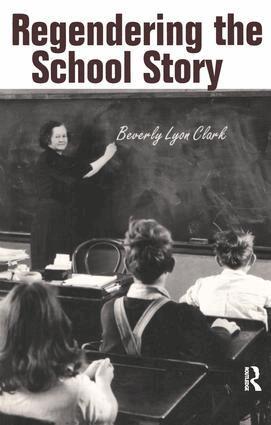
In 18th through 20th-century British and American literature, school stories always play out the power relationships between adult and child. They also play out gender relationships, especially when females are excluded, although most histories of the genre ignore the unusual novels that probe the gendering of school stories. When the occasional man wrote about girls schools-as Charles Lamb and H. G. Wells did-he sometimes empowered his female characters, granting them freedoms that he had experienced at school.Women who wrote about boys' schools often gave unusual emphasis to families, and at times, revealed the contradictions in the schoolyard code against telling tales or presented competing versions of masculinity, such as the Christian gentleman versus the self-made man. Sometimes these middle-class white women projected their sense of estrangement onto working class and minority women. Sometimes they wrote school stories that were in dialog with other genres, as when Mrs. Henry Wood wrote a sensation story or, like Louisa May Alcott, they domesticated the boys school story, giving prominence to a female viewpoint.
453 kr
Skickas inom 7-10 vardagar
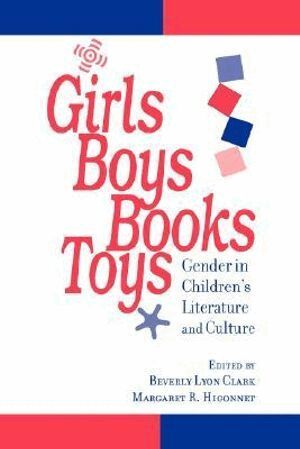
Beverly Lyon Clark and Margaret R. Higonnet bring together twenty-two scholars to look closely at the complexities of children's culture. Girls, Boys, Books, Toys asks questions about how the gender symbolism of children's culture is constructed and resisted. What happens when women rewrite (or illustrate) nursery rhymes, adventure stories, and fairy tales told by men? How do the socially scripted plots for boys and girls change through time and across cultures? Have critics been blind to what women write about "masculine" topics? Can animal tales or doll stories displace tired commonplaces about gender, race, and class? Can different critical approaches-new historicism, narratology, or postcolonialism-enable us to gain leverage on the different implications of gender, age, race, and class in our readings of children's books and children's culture?
405 kr
Skickas inom 7-10 vardagar
The popularity of the Harry Potter books among adults and the critical acclaim these young adult fantasies have received may seem like a novel literary phenomenon. In the nineteenth century, however, readers considered both Tom Sawyer and Huckleberry Finn as works of literature equally for children and adults; only later was the former relegated to the category of "boys' books" while the latter, even as it was canonized, came frequently to be regarded as unsuitable for young readers. Adults-women and men-wept over Little Women. And America's most prestigious literary journals regularly reviewed books written for both children and their parents. This egalitarian approach to children's literature changed with the emergence of literary studies as a scholarly discipline at the turn of the twentieth century. Academics considered children's books an inferior literature and beneath serious consideration. In Kiddie Lit, Beverly Lyon Clark explores the marginalization of children's literature in America-and its recent possible reintegration-both within the academy and by the mainstream critical establishment.Tracing the reception of works by Mark Twain, Louisa May Alcott, Lewis Carroll, Frances Hodgson Burnett, L. Frank Baum, Walt Disney, and J. K. Rowling, Clark reveals fundamental shifts in the assessment of the literary worth of books beloved by both children and adults, whether written for boys or girls. While uncovering the institutional underpinnings of this transition, Clark also attributes it to changing American attitudes toward childhood itself, a cultural resistance to the intrinsic value of childhood expressed through sentimentality, condescension, and moralizing. Clark's engaging and enlightening study of the critical disregard for children's books since the end of the nineteenth century-which draws on recent scholarship in gender, cultural, and literary studies- offers provocative new insights into the history of both children's literature and American literature in general, and forcefully argues that the books our children read and love demand greater respect.
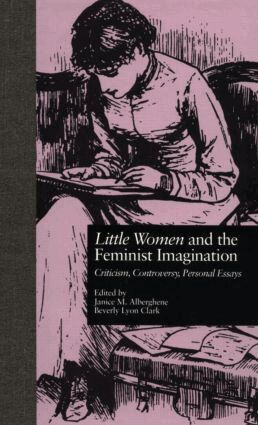
LITTLE WOMEN and THE FEMINIST IMAGINATION
Criticism, Controversy, Personal Essays
Inbunden, Engelska, 1998
2 263 kr
Skickas inom 10-15 vardagar
Raising key questions about race, class, sexuality, age, material culture, intellectual history, pedagogy, and gender, this book explores the myriad relationships between feminist thinking and Little Women, a novel that has touched many women's lives. A critical introduction traces 130 years of popular and critical response, and the collection presents 11 new essays, two new bibliographies, and reprints of six classic essays.The contributors examine the history of illustrating Little Women; Alcott's use of domestic architecture as codes of female self-expression; the tradition of utopian writing by women; relationship to works by British and African American writers; recent thinking about feminist pedagogy; the significance of the novel for women writers, and its implications from the vantage points of middle-aged scholar, parent, and resisting male reader.
2 419 kr
Skickas inom 10-15 vardagar
In 18th through 20th-century British and American literature, school stories always play out the power relationships between adult and child. They also play out gender relationships, especially when females are excluded, although most histories of the genre ignore the unusual novels that probe the gendering of school stories. When the occasional man wrote about girls schools-as Charles Lamb and H. G. Wells did-he sometimes empowered his female characters, granting them freedoms that he had experienced at school.Women who wrote about boys' schools often gave unusual emphasis to families, and at times, revealed the contradictions in the schoolyard code against telling tales or presented competing versions of masculinity, such as the Christian gentleman versus the self-made man. Sometimes these middle-class white women projected their sense of estrangement onto working class and minority women. Sometimes they wrote school stories that were in dialog with other genres, as when Mrs. Henry Wood wrote a sensation story or, like Louisa May Alcott, they domesticated the boys school story, giving prominence to a female viewpoint.
LITTLE WOMEN and THE FEMINIST IMAGINATION
Criticism, Controversy, Personal Essays
Häftad, Engelska, 2014
832 kr
Skickas inom 10-15 vardagar
Raising key questions about race, class, sexuality, age, material culture, intellectual history, pedagogy, and gender, this book explores the myriad relationships between feminist thinking and Little Women, a novel that has touched many women's lives. A critical introduction traces 130 years of popular and critical response, and the collection presents 11 new essays, two new bibliographies, and reprints of six classic essays.The contributors examine the history of illustrating Little Women; Alcott's use of domestic architecture as codes of female self-expression; the tradition of utopian writing by women; relationship to works by British and African American writers; recent thinking about feminist pedagogy; the significance of the novel for women writers, and its implications from the vantage points of middle-aged scholar, parent, and resisting male reader.
586 kr
Skickas inom 7-10 vardagar
The hit Broadway show of 1912; the lost film of 1919; Katharine Hepburn, as Jo, sliding down a banister in George Cukor's 1933 movie; Mark English's shimmering 1967 illustrations; Jo - this time played by Sutton Foster - belting "I'll be / astonishing" in the 2004 Broadway musical flop: these are only some of the markers of the afterlife of Little Women. Then there's the nineteenth-century child who wrote, "If you do not ...make Laurie marry Beth, I will never read another of your books as long as I live." Not to mention Miss Manners, a Little Women devotee, who announced that the book taught her an important life lesson: "Although it's very nice to have two clean gloves, it's even more important to have a little ink on your fingers." In The Afterlife of "Little Women," Beverly Lyon Clark, a leading authority on children's literature, explores these and other after - tremors, both popular and academic, as she maps the reception of Louisa May Alcott's timeless novel, first published in 1868. Clark divides her discussion into four historical periods. The first covers the novel's publication and massive popularity in the late nineteenth century.In the second era - the first three decades of the twentieth century-the novel becomes a nostalgic icon of the domesticity of a previous century, while losing status among the literary and scholarly elite. In its mid-century afterlife (1930-1960), Little Women reaches a low in terms of its critical reputation but remains a well-known piece of Americana within popular culture. The book concludes with a long chapter on Little Women's afterlife from the 1960s to the present - a period in which the reading of the book seems to decline, while scholarly attention expands dramatically and popular echoes continue to proliferate. Drawing on letters and library records as well as reviews, plays, operas, film and television adaptations, spinoff novels, translations, Alcott biographies, and illustrations, Clark demonstrates how the novel resonates with both conservative family values and progressive feminist ones. She grounds her story in criticism of children's literature, book history, cultural studies, feminist criticism, and adaptation studies. Written in an accessible narrative style, The Afterlife of "Little Women" speaks to scholars, librarians, and devoted Alcott fans.