Board on Manufacturing and Engineering Design – författare
845 kr
Skickas
541 kr
Skickas inom 3-6 vardagar
714 kr
Läs direkt efter köp
919 kr
Läs direkt efter köp
454 kr
Läs direkt efter köp
390 kr
Läs direkt efter köp
665 kr
Läs direkt efter köp
390 kr
Läs direkt efter köp
Advanced energetic materials—explosive fill and propellants—are a critical technology for national security. While several new promising concepts and formulations have emerged in recent years, the Department of Defense is concerned about the nation''s ability to maintain and improve the knowledge base in this area. To assist in addressing these concerns, two offices within DOD asked the NRC to investigate and assess the scope and health of the U.S. R&D efforts in energetic materials. This report provides that assessment. It presents several findings about the current R&D effort and recommendations aimed at improving U.S. capabilities in developing new energetic materials technology.
This study reviewed U.S. research and development in advanced energetics being conducted by DoD, the DoE national laboratories, industries, and academia, from a list provided by the sponsors. It also: (a) reviewed papers and technology assessments of non-U.S. work in advanced energetics, assessed important parameters, such as validity, viability, and the likelihood that each of these materials can be produced in quantity; (b) identified barriers to scale-up and production, and suggested technical approaches for addressing potential problems; and (c) suggested specific opportunities, strategies, and priorities for government sponsorship of technologies and manufacturing process development.
1 055 kr
Läs direkt efter köp
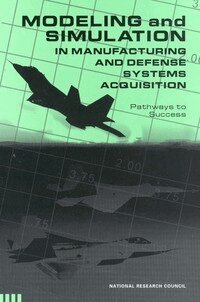
The Committee on Modeling and Simulation Enhancements for 21st Century Manufacturing and Acquisition was formed by the NRC in response to a request from the Defense Modeling and Simulation Office (DMSO) of DOD. The committee was asked to (1) investigate next-generation evolutionary and revolutionary M&S capabilities that will support enhanced defense systems acquisition; (2) identify specific emerging design, testing, and manufacturing process technologies that can be enabled by advanced M&S capabilities; (3) relate these emerging technologies to long-term DOD requirements; (4) assess ongoing efforts to develop advanced M&S capabilities and identify gaps that must be filled to make the emerging technologies a reality; (5) identify lessons learned from industry; and (6) recommend specific government actions to expedite development and to enable maximum DOD and U.S. commercial benefit from these capabilities. To complete its task, the committee identified relevant trends and their impact on defense acquisition needs; current use and support for use of M&S within DOD; lessons learned from commercial manufacturing; three cross-cutting and especially challenging uses of M&S technologies; and the areas in which basic research is needed in M&S in order to achieve the desired goals for manufacturing and defense acquisition.
617 kr
Läs direkt efter köp
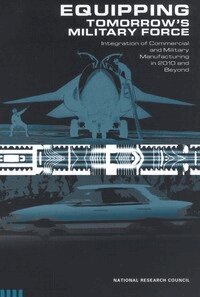
Owing to the expected nature of combat in 2010, U.S. military forces face a pressing need to transform themselves for rapid response to an unpredictablethreat. Rapid advances in commercial technology (particularly in electronics), coupled with the easy access to commercial technology enjoyed by potential adversaries, will compel DOD and defense contractors to excel at integrating commercial technology into defense systems. This integration of commercial and military manufacturing (ICMM) has begun on a small scale. By 2010, it needs to increase substantially if U.S. forces are to retain a technological edge. This report assesses the opportunities for increased ICMM in 2010 and beyond, identifies barriers, and recommends strategies for overcoming them.
714 kr
Läs direkt efter köp
The end of the Cold War, the evolving mission of the U.S. Armed Services, the dramatic improvements in commercial manufacturing—these and other trends are changing how we provide for the common defense. What will we need in the way of defense manufacturing in the year 2010—a short few years away? How should we best spend our defense funds?
Defense Manufacturing in 2010 and Beyond sets forth a vision for the nation''s defense manufacturing, including policies, technologies, systems, processes, practices, and financial implications. Eight specific trends are forecast—defense spending, the relationship between defense and commerical industries, the nature of the threat to our nation, the emergence of new technologies, and other areas—and their implications for defense manufacturing are explored.
The committee describes manufacturing advancements that are around the corner—virtual enterprise, and more—and examines how these breakthroughs will likely meet or fail to meet defense manufacturing requirements. This expert panel identifies the highest priorities and recommends strategies for matching future manufacturing capabilities with our defense needs. February
682 kr
Läs direkt efter köp
The managed flow of goods and information from raw material to final sale also known as a "supply chain" affects everything—from the U.S. gross domestic product to where you can buy your jeans. The nature of a company''s supply chain has a significant effect on its success or failure—as in the success of Dell Computer''s make-to-order system and the failure of General Motor''s vertical integration during the 1998 United Auto Workers strike.
Supply Chain Integration looks at this crucial component of business at a time when product design, manufacture, and delivery are changing radically and globally. This book explores the benefits of continuously improving the relationship between the firm, its suppliers, and its customers to ensure the highest added value.
This book identifies the state-of-the-art developments that contribute to the success of vertical tiers of suppliers and relates these developments to the capabilities that small and medium-sized manufacturers must have to be viable participants in this system. Strategies for attaining these capabilities through manufacturing extension centers and other technical assistance providers at the national, state, and local level are suggested.
This book identifies action steps for small and medium-sized manufacturers—the "seed corn" of business start-up and development—to improve supply chain management. The book examines supply chain models from consultant firms, universities, manufacturers, and associations. Topics include the roles of suppliers and other supply chain participants, the rise of outsourcing, the importance of information management, the natural tension between buyer and seller, sources of assistance to small and medium-sized firms, and a host of other issues.
Supply Chain Integration will be of interest to industry policymakers, economists, researchers, business leaders, and forward-thinking executives.
682 kr
Läs direkt efter köp
Manufacturing will unquestionably be a very different enterprise in 2020 from what it is today. This book presents an exciting picture of the profitable and productive potential of manufacturing two decades hence.
This book takes an international view of future manufacturing that considers the leaps and bounds of technological innovation and the blurring of the lines between the manufacturing and service industries. The authors identify ten strategic technology areas as the most important for research and development and they recommend ways to address crosscutting questions. Representing a variety of industries, the authors identify six "grand challenges" that must be overcome for their vision to be realized, including the human/technology interface, environmental concerns, and miniaturization.
A host of issues are discussed that will push and pull at manufacturing over the next 20 years: the changing workforce, the changing consumer, the rise of bio- and nanotechnology, the prospects for waste-free processing, simulation and modeling as design tools, shifts in global competition, and much more.
The information and analyses in this book will be vitally important to everyone concerned about the future of manufacturing: policymakers, executives, design and engineering professionals, researchers, faculty, and students.
617 kr
Läs direkt efter köp
Manufacturing process controls include all systems and software that exert control over production processes. Control systems include process sensors, data processing equipment, actuators, networks to connect equipment, and algorithms to relate process variables to product attributes.
Since 1995, the U.S. Department of Energy Office of Industrial Technology ''s (OIT) program management strategy has reflected its commitment to increasing and documenting the commercial impact of OIT programs. OIT''s management strategy for research and development has been in transition from a "technology push" strategy to a "market pull" strategy based on the needs of seven energy-and waste-intensive industries-steel, forest products, glass, metal casting, aluminum, chemicals, and petroleum refining. These industries, designated as Industries of the Future (IOF), are the focus of OIT programs. In 1997, agriculture, specifically renewable bioproducts, was added to the IOF group.
The National Research Council Panel on Manufacturing Process Controls is part of the Committee on Industrial Technology Assessments (CITA), which was established to evaluate the OIT program strategy, to provide guidance during the transition to the new IOF strategy, and to assess the effects of the change in program strategy on cross-cutting technology programs, that is, technologies applicable to several of the IOF industries. The panel was established to identify key processes and needs for improved manufacturing control technology, especially the needs common to several IOF industries; identify specific research opportunities for addressing these common industry needs; suggest criteria for identifying and prioritizing research and development (R&D) to improve manufacturing controls technologies; and recommend means for implementing advances in control technologies.
698 kr
Läs direkt efter köp
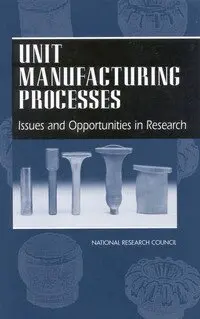
Manufacturing, reduced to its simplest form, involves the sequencing of product forms through a number of different processes. Each individual step, known as an unit manufacturing process, can be viewed as the fundamental building block of a nation''s manufacturing capability. A committee of the National Research Council has prepared a report to help define national priorities for research in unit processes. It contains an organizing framework for unit process families, criteria for determining the criticality of a process or manufacturing technology, examples of research opportunities, and a prioritized list of enabling technologies that can lead to the manufacture of products of superior quality at competitive costs. The study was performed under the sponsorship of the National Science Foundation and the Defense Department''s Manufacturing Technology Program.
471 kr
Läs direkt efter köp
390 kr
Läs direkt efter köp
390 kr
Läs direkt efter köp
390 kr
Läs direkt efter köp
568 kr
Läs direkt efter köp
390 kr
Läs direkt efter köp
The activities of the Department of Defense (DOD) and its contractors in manufacturing, testing, maintaining, and disposing of military equipment make up a significant portion of the industrial processes conducted in the United States. As is the case with the commercial industries, some of these activities, such as metal plating, have resulted in industrial pollution and environmental contamination. With increasing environmental regulation of such processes in recent decades, defense facilities have been faced with growing compliance issues. Department of Defense efforts to manage, correct, and prevent these problems have included the establishment of the National Defense Center for Environmental Excellence (NDCEE) under the management of the U.S. Army Industrial Ecology Center (IEC).
The National Research Council''s Committee to Evaluate Transfer of Pollution Prevention Technology for the U.S. Army was formed to identify major barriers to the transfer of pollution prevention technologies and to recommend pathways to success. To address the study objectives, the committee (1) reviewed the NDCEE''s technology transfer activities, (2) examined efforts to transfer technology in four areas, two of which were identified at the outset by the NDCEE as successful and two of which were identified as unsuccessful, and (3) identified opportunities for improving the transfer of pollution prevention technologies to maintenance and rework facilities in the Department of Defense and to industrial manufacturing facilities performing defense-related operations.
974 kr
Läs direkt efter köp
268 kr
Läs direkt efter köp
The activities of the Department of Defense (DOD) and its contractors in manufacturing, testing, maintaining, and disposing of military equipment make up a significant portion of the industrial processes conducted in the United States. As is the case with the commercial industries, some of these activities, such as metal plating, have resulted in industrial pollution and environmental contamination. With increasing environmental regulation of such processes in recent decades, defense facilities have been faced with growing compliance issues. Department of Defense efforts to manage, correct, and prevent these problems have included the establishment of the National Defense Center for Environmental Excellence (NDCEE) under the management of the U.S. Army Industrial Ecology Center (IEC).
The National Research Council''s Committee to Evaluate Transfer of Pollution Prevention Technology for the U.S. Army was formed to identify major barriers to the transfer of pollution prevention technologies and to recommend pathways to success. To address the study objectives, the committee (1) reviewed the NDCEE''s technology transfer activities, (2) examined efforts to transfer technology in four areas, two of which were identified at the outset by the NDCEE as successful and two of which were identified as unsuccessful, and (3) identified opportunities for improving the transfer of pollution prevention technologies to maintenance and rework facilities in the Department of Defense and to industrial manufacturing facilities performing defense-related operations.
438 kr
Läs direkt efter köp
Owing to the expected nature of combat in 2010, U.S. military forces face a pressing need to transform themselves for rapid response to an unpredictablethreat. Rapid advances in commercial technology (particularly in electronics), coupled with the easy access to commercial technology enjoyed by potential adversaries, will compel DOD and defense contractors to excel at integrating commercial technology into defense systems. This integration of commercial and military manufacturing (ICMM) has begun on a small scale. By 2010, it needs to increase substantially if U.S. forces are to retain a technological edge. This report assesses the opportunities for increased ICMM in 2010 and beyond, identifies barriers, and recommends strategies for overcoming them.
479 kr
Läs direkt efter köp
The managed flow of goods and information from raw material to final sale also known as a "supply chain" affects everything—from the U.S. gross domestic product to where you can buy your jeans. The nature of a company''s supply chain has a significant effect on its success or failure—as in the success of Dell Computer''s make-to-order system and the failure of General Motor''s vertical integration during the 1998 United Auto Workers strike.
Supply Chain Integration looks at this crucial component of business at a time when product design, manufacture, and delivery are changing radically and globally. This book explores the benefits of continuously improving the relationship between the firm, its suppliers, and its customers to ensure the highest added value.
This book identifies the state-of-the-art developments that contribute to the success of vertical tiers of suppliers and relates these developments to the capabilities that small and medium-sized manufacturers must have to be viable participants in this system. Strategies for attaining these capabilities through manufacturing extension centers and other technical assistance providers at the national, state, and local level are suggested.
This book identifies action steps for small and medium-sized manufacturers—the "seed corn" of business start-up and development—to improve supply chain management. The book examines supply chain models from consultant firms, universities, manufacturers, and associations. Topics include the roles of suppliers and other supply chain participants, the rise of outsourcing, the importance of information management, the natural tension between buyer and seller, sources of assistance to small and medium-sized firms, and a host of other issues.
Supply Chain Integration will be of interest to industry policymakers, economists, researchers, business leaders, and forward-thinking executives.
503 kr
Läs direkt efter köp
The end of the Cold War, the evolving mission of the U.S. Armed Services, the dramatic improvements in commercial manufacturing—these and other trends are changing how we provide for the common defense. What will we need in the way of defense manufacturing in the year 2010—a short few years away? How should we best spend our defense funds?
Defense Manufacturing in 2010 and Beyond sets forth a vision for the nation''s defense manufacturing, including policies, technologies, systems, processes, practices, and financial implications. Eight specific trends are forecast—defense spending, the relationship between defense and commerical industries, the nature of the threat to our nation, the emergence of new technologies, and other areas—and their implications for defense manufacturing are explored.
The committee describes manufacturing advancements that are around the corner—virtual enterprise, and more—and examines how these breakthroughs will likely meet or fail to meet defense manufacturing requirements. This expert panel identifies the highest priorities and recommends strategies for matching future manufacturing capabilities with our defense needs. February
479 kr
Läs direkt efter köp
Manufacturing will unquestionably be a very different enterprise in 2020 from what it is today. This book presents an exciting picture of the profitable and productive potential of manufacturing two decades hence.
This book takes an international view of future manufacturing that considers the leaps and bounds of technological innovation and the blurring of the lines between the manufacturing and service industries. The authors identify ten strategic technology areas as the most important for research and development and they recommend ways to address crosscutting questions. Representing a variety of industries, the authors identify six "grand challenges" that must be overcome for their vision to be realized, including the human/technology interface, environmental concerns, and miniaturization.
A host of issues are discussed that will push and pull at manufacturing over the next 20 years: the changing workforce, the changing consumer, the rise of bio- and nanotechnology, the prospects for waste-free processing, simulation and modeling as design tools, shifts in global competition, and much more.
The information and analyses in this book will be vitally important to everyone concerned about the future of manufacturing: policymakers, executives, design and engineering professionals, researchers, faculty, and students.
438 kr
Läs direkt efter köp
Manufacturing process controls include all systems and software that exert control over production processes. Control systems include process sensors, data processing equipment, actuators, networks to connect equipment, and algorithms to relate process variables to product attributes.
Since 1995, the U.S. Department of Energy Office of Industrial Technology ''s (OIT) program management strategy has reflected its commitment to increasing and documenting the commercial impact of OIT programs. OIT''s management strategy for research and development has been in transition from a "technology push" strategy to a "market pull" strategy based on the needs of seven energy-and waste-intensive industries-steel, forest products, glass, metal casting, aluminum, chemicals, and petroleum refining. These industries, designated as Industries of the Future (IOF), are the focus of OIT programs. In 1997, agriculture, specifically renewable bioproducts, was added to the IOF group.
The National Research Council Panel on Manufacturing Process Controls is part of the Committee on Industrial Technology Assessments (CITA), which was established to evaluate the OIT program strategy, to provide guidance during the transition to the new IOF strategy, and to assess the effects of the change in program strategy on cross-cutting technology programs, that is, technologies applicable to several of the IOF industries. The panel was established to identify key processes and needs for improved manufacturing control technology, especially the needs common to several IOF industries; identify specific research opportunities for addressing these common industry needs; suggest criteria for identifying and prioritizing research and development (R&D) to improve manufacturing controls technologies; and recommend means for implementing advances in control technologies.
390 kr
Läs direkt efter köp
268 kr
Läs direkt efter köp
Advanced energetic materials—explosive fill and propellants—are a critical technology for national security. While several new promising concepts and formulations have emerged in recent years, the Department of Defense is concerned about the nation''s ability to maintain and improve the knowledge base in this area. To assist in addressing these concerns, two offices within DOD asked the NRC to investigate and assess the scope and health of the U.S. R&D efforts in energetic materials. This report provides that assessment. It presents several findings about the current R&D effort and recommendations aimed at improving U.S. capabilities in developing new energetic materials technology.
This study reviewed U.S. research and development in advanced energetics being conducted by DoD, the DoE national laboratories, industries, and academia, from a list provided by the sponsors. It also: (a) reviewed papers and technology assessments of non-U.S. work in advanced energetics, assessed important parameters, such as validity, viability, and the likelihood that each of these materials can be produced in quantity; (b) identified barriers to scale-up and production, and suggested technical approaches for addressing potential problems; and (c) suggested specific opportunities, strategies, and priorities for government sponsorship of technologies and manufacturing process development.