National Materials Advisory Board – författare
592 kr
Skickas inom 3-6 vardagar
451 kr
Skickas inom 3-6 vardagar
276 kr
Läs direkt efter köp
The security of the U.S. commercial aviation system has been a growing concern since the 1970''s when the hijacking of aircraft became a serious problem. Over that period, federal aviation officials have been searching for more effective ways for non-invasive screening of passengers, luggage, and cargo to detect concealed explosives and weapons. To assist in this effort, the Transportation Security Administration (TSA) asked the NRC for a study of emerging screening technologies. This book - the fourth of four - focuses on data fusion as a means to significantly improve the ability of the existing suite of airport detection systems and access control systems to detect and prevent attacks. The book presents a discussion of the data fusion, an analysis of current data fusion efforts, and an assessment of data fusion opportunities for various airport security activities.

187 kr
Läs direkt efter köp
The U.S. industrial complex and its associated infrastructure are essential to the nation''s quality of life, its industrial productivity, international competitiveness, and security. Each component of the infrastructure—such as highways, airports, water supply, waste treatment, energy supply, and power generation—represents a complex system requiring significant investment. Within that infrastructure both the private and government sectors have equipment and facilities that are subject to degradation by corrosion, which significantly reduces the lifetime, reliability, and functionality of structures and equipment, while also threatening human safety. The direct costs of corrosion to the U.S. economy represent 3.2 percent of the gross domestic product (GDP), and the total costs to society can be twice that or greater. Opportunities for savings through improved corrosion control exist in every economic sector.
The workshop, Corrosion Education for the 21st Century, brought together corrosion specialists, leaders in materials and engineering education, government officials, and other interested parties. The workshop was also attended by members of NRC''s Committee on Assessing Corrosion Education, who are carrying out a study on this topic. The workshop panelists and speakers were asked to give their personal perspectives on whether corrosion abatement is adequately addressed in our nation''s engineering curricula and, if not, what issues need to be addressed to develop a comprehensive corrosion curriculum in undergraduate engineering. This proceedings consists of extended abstracts from the workshop''s speakers that reflect their personal views as presented to the meeting. Proceedings of the Materials Forum 2007: Corrosion Education for the 21st Century summarizes this form.576 kr
Läs direkt efter köp
Since 1939, the U.S. government, using the National Defense Stockpile (NDS), has been stockpiling critical strategic materials for national defense. The economic and national security environments, however, have changed significantly from the time the NDS was created. Current threats are more varied, production and processing of key materials is more globally dispersed, the global competition for raw materials is increasing, the U.S. military is more dependent on civilian industry, and industry depends far more on just-in-time inventory control. To help determine the significance of these changes for the strategic materials stockpile, the Department of Defense asked the NRC to assess the continuing need for and value of the NDS. This report begins with the historical context of the NDS. It then presents a discussion of raw-materials and minerals supply, an examination of changing defense planning and materials needs, an analysis of modern tools used to manage materials supply chains, and an assessment of current operational practices of the NDS.
Review of the Federal Strategy for Nanotechnology-Related Environmental, Health, and Safety Research
426 kr
Läs direkt efter köp
This new book from the National Research Council finds serious weaknesses in the government''s plan for research on the potential health and environmental risks posed by nanomaterials, which are increasingly being used in consumer goods and industry. An effective national plan for identifying and managing potential risks is essential to the successful development and public acceptance of nanotechnology-enabled products.The book recommends a robust national strategic plan for addressing nanotechnology-related EHS risks, which will need to focus on promoting research that can assist all stakeholders, including federal agencies, in planning, controlling, and optimizing the use of engineered nanomaterials while minimizing EHS effects of concern to society. Such a plan will ensure the timely development of engineered nanoscale materials that will bring about great improvements in the nation''s health, its environmental quality, its economy, and its security.
738 kr
Läs direkt efter köp
479 kr
Läs direkt efter köp
The threat from the degradation of materials in the engineered products that drive our economy, keep our citizenry healthy, and keep us safe from terrorism and belligerent threats has been well documented over the years. And yet little effort appears to have been made to apply the nation''s engineering community to developing a better understanding of corrosion and the mitigation of its effects.
The engineering workforce must have a solid understanding of the physical and chemical bases of corrosion, as well as an understanding of the engineering issues surrounding corrosion and corrosion abatement. Nonetheless, corrosion engineering is not a required course in the curriculum of most bachelor degree programs in MSE and related engineering fields, and in many programs, the subject is not even available. As a result, most bachelor-level graduates of materials- and design-related programs have an inadequate background in corrosion engineering principles and practices.
To combat this problem, the book makes a number of short- and long-term recommendations to industry and government agencies, educational institutions, and communities to increase education and awareness, and ultimately give the incoming workforce the knowledge they need.
430 kr
Läs direkt efter köp
Integrated computational materials engineering (ICME) is an emerging discipline that can accelerate materials development and unify design and manufacturing. Developing ICME is a grand challenge that could provide significant economic benefit. To help develop a strategy for development of this new technology area, DOE and DoD asked the NRC to explore its benefits and promises, including the benefits of a comprehensive ICME capability; to establish a strategy for development and maintenance of an ICME infrastructure, and to make recommendations about how best to meet these opportunities. This book provides a vision for ICME, a review of case studies and lessons learned, an analysis of technological barriers, and an evaluation of ways to overcome cultural and organizational challenges to develop the discipline.
268 kr
Läs direkt efter köp
528 kr
Läs direkt efter köp
Ductile iron pipe (DIP) was introduced about 50 years ago as a more economical and better-performing product for water transmission and distribution. As with iron or steel pipes, DIP is subject to corrosion, the rate of which depends on the environment in which the pipe is placed. Corrosion mitigation protocols are employed to slow the corrosion process to an acceptable rate for the application. When to use corrosion mitigation systems, and which system, depends on the corrosivity of the soils in which the pipeline is buried.
The Bureau of Reclamation''s specification for DIP in highly corrosive soil has been contested by some as an overly stringent requirement, necessitating the pipe to be modified from its as-manufactured state and thereby adding unnecessary cost to a pipeline system.
This book evaluates the specifications in question and presents findings and recommendations. Specifically, the authoring committee answers the following questions:
Does polyethylene encasement with cathodic protection work on ductile iron pipe installed in highly corrosive soils? Will polyethylene encasement and cathodic protection reliably provide a minimum service life of 50 years? What possible alternative corrosion mitigation methods for DIP would provide a service life of 50 years?811 kr
Läs direkt efter köp
763 kr
Läs direkt efter köp
Ductile iron pipe (DIP) was introduced about 50 years ago as a more economical and better-performing product for water transmission and distribution. As with iron or steel pipes, DIP is subject to corrosion, the rate of which depends on the environment in which the pipe is placed. Corrosion mitigation protocols are employed to slow the corrosion process to an acceptable rate for the application. When to use corrosion mitigation systems, and which system, depends on the corrosivity of the soils in which the pipeline is buried.
The Bureau of Reclamation''s specification for DIP in highly corrosive soil has been contested by some as an overly stringent requirement, necessitating the pipe to be modified from its as-manufactured state and thereby adding unnecessary cost to a pipeline system.
This book evaluates the specifications in question and presents findings and recommendations. Specifically, the authoring committee answers the following questions:
Does polyethylene encasement with cathodic protection work on ductile iron pipe installed in highly corrosive soils? Will polyethylene encasement and cathodic protection reliably provide a minimum service life of 50 years? What possible alternative corrosion mitigation methods for DIP would provide a service life of 50 years?430 kr
Läs direkt efter köp
Helium has long been the subject of public policy deliberation and management, largely because of its many strategic uses and its unusual source-it is a derived product of natural gas and its market has several anomalous characteristics. Shortly after sources of helium were discovered at the beginning of the last century, the U.S. government recognized helium''s potential importance to the nation''s interests and placed its production and availability under strict governmental control. In the 1960s, helium''s strategic value in cold war efforts was reflected in policies that resulted in the accumulation of a large reserve of helium owned by the federal government. The latest manifestation of public policy is expressed in the Helium Privatization Act of 1996 (1996 12 Act), which directs that substantially all of the helium accumulated as a result of those earlier policies be sold off by 2015 at prices sufficient to repay the federal government for its outlays associated with the helium program. The present volume assesses whether the interests of the United States have been well served by the 1996 Act and, in particular, whether selling off the helium reserve has had any adverse effect on U.S. scientific, technical, biomedical, and national security users of helium.
617 kr
Läs direkt efter köp
Helium has long been the subject of public policy deliberation and management, largely because of its many strategic uses and its unusual source-it is a derived product of natural gas and its market has several anomalous characteristics. Shortly after sources of helium were discovered at the beginning of the last century, the U.S. government recognized helium''s potential importance to the nation''s interests and placed its production and availability under strict governmental control. In the 1960s, helium''s strategic value in cold war efforts was reflected in policies that resulted in the accumulation of a large reserve of helium owned by the federal government. The latest manifestation of public policy is expressed in the Helium Privatization Act of 1996 (1996 12 Act), which directs that substantially all of the helium accumulated as a result of those earlier policies be sold off by 2015 at prices sufficient to repay the federal government for its outlays associated with the helium program. The present volume assesses whether the interests of the United States have been well served by the 1996 Act and, in particular, whether selling off the helium reserve has had any adverse effect on U.S. scientific, technical, biomedical, and national security users of helium.
503 kr
Läs direkt efter köp
The field of corrosion science and engineering is on the threshold of important advances. Advances in lifetime prediction and technological solutions, as enabled by the convergence of experimental and computational length and timescales and powerful new modeling techniques, are allowing the development of rigorous, mechanistically based models from observations and physical laws.
Despite considerable progress in the integration of materials by design into engineering development of products, corrosion considerations are typically missing from such constructs. Similarly, condition monitoring and remaining life prediction (prognosis) do not at present incorporate corrosion factors. Great opportunities exist to use the framework of these materials design and engineering tools to stimulate corrosion research and development to achieve quantitative life prediction, to incorporate state-of-the-art sensing approaches into experimentation and materials architectures, and to introduce environmental degradation factors into these capabilities.
Research Opportunities in Corrosion Science and Engineering identifies grand challenges for the corrosion research community, highlights research opportunities in corrosion science and engineering, and posits a national strategy for corrosion research. It is a logical and necessary complement to the recently published book, Assessment of Corrosion Education, which emphasized that technical education must be supported by academic, industrial, and government research. Although the present report focuses on the government role, this emphasis does not diminish the role of industry or academia.
682 kr
Läs direkt efter köp
Materials Science and Engineering (MSE) R&D is spreading globally at an accelerating rate. As a result, the relative U.S. position in a number of MSE subfields is in a state of flux. To understand better this trend and its implications for the U.S. economy and national security, the Department of Defense (DOD) asked the NRC to assess the status and impacts of the global spread of MSE R&D. This report presents a discussion of drivers affecting U.S. companies'' decisions about location of MSE R&D, an analysis of impacts on the U.S. economy and national security, and recommendations to ensure continued U.S. access to critical MSE R&D.
454 kr
Läs direkt efter köp
390 kr
Läs direkt efter köp
284 kr
Läs direkt efter köp
The emergence of nanotechnology as a major science and technology research topic has sparked substantial interest by the intelligence community. In particular the community is interested both in the potential for nanotechnology to assist intelligence operations and threats it could create. To explore these questions, the Intelligence Technology Innovation Center asked the National Research Council to conduct a number of activities to illustrate the potential for nanotechnology to address key intelligence community needs. The second of these was a workshop to explore how nanotechnology might enable advances in sensing and locating technology. This report presents a summary of that workshop. In includes an overview of security technologies, and discussions of systems, natural chemical/biological tags, passive chemical/biological tags, and radio/radar/optical tags.
390 kr
Läs direkt efter köp
Summary of the Power Systems Workshop on Nanotechnology for the Intelligence Community
Interim Report
276 kr
Läs direkt efter köp
The emergence of nanotechnology as a major science and technology research topic has sparked substantial interest by the intelligence community. In particular the community is interested both in the potential for nanotechnology to assist intelligence operations and threats it could create. To explore these questions, the Intelligence Technology Innovation Center asked the National Research Council to conduct a number of activities to illustrate the potential for nanotechnology to address key intelligence community needs. The first of these was a workshop to explore technology opportunities and challenges in power systems that could be addressed by nanotechnology. This report presents a summary of that workshop. It includes an overview of power technologies and discussions on nanoscale properties of energy storage materials, device experience, manufacturing and material handling considerations, and natural power.
552 kr
Läs direkt efter köp
1 136 kr
Läs direkt efter köp
518 kr
Läs direkt efter köp
The Office of Industrial Technologies (OIT) of the U. S. Department of Energy commissioned the National Research Council (NRC) to undertake a study on required technologies for the Mining Industries of the Future Program to complement information provided to the program by the National Mining Association. Subsequently, the National Institute for Occupational Safety and Health also became a sponsor of this study, and the Statement of Task was expanded to include health and safety. The overall objectives of this study are: (a) to review available information on the U.S. mining industry; (b) to identify critical research and development needs related to the exploration, mining, and processing of coal, minerals, and metals; and (c) to examine the federal contribution to research and development in mining processes.
390 kr
Läs direkt efter köp
This book details the forum that was held by the National Materials Advisory Board at the National Academy of Sciences. The purpose of this forum was to bring the importance of materials to the attention of policy makers and to promote interactions between policy makers and the materials community. Four key themes were addressed: the critical role of materials in advancing technology and enhancing the nation''s economy, security, and health, industrial and societal needs that will require materials development in the new millennium. Materials research areas with the greatest potential for meeting those needs, and federal and industrial research initiatives that can help the materials community meet those needs. To help focus this discussion, special sessions were convened to address the current and future roles of materials in four selected areas: information technology, health and biotechnology, national security, and energy and the environment.
568 kr
Läs direkt efter köp
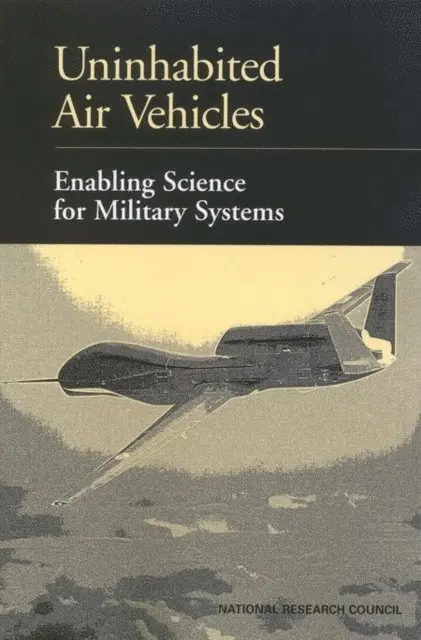
U.S. Air Force (USAF) planners have envisioned that uninhabited air vehicles (UAVs), working in concert with inhabited vehicles, will become an integral part of the future force structure. Current plans are based on the premise that UAVs have the potential to augment, or even replace, inhabited aircraft in a variety of missions. However, UAV technologies must be better understood before they will be accepted as an alternative to inhabited aircraft on the battlefield. The U.S. Air Force Office of Scientific Research (AFOSR) requested that the National Research Council, through the National Materials Advisory Board and the Aeronautics and Space Engineering Board, identify long-term research opportunities for supporting the development of technologies for UAVs. The objectives of the study were to identify technological developments that would improve the performance and reliability of "generation-after-next" UAVs at lower cost and to recommend areas of fundamental research in materials, structures, and aeronautical technologies. The study focused on innovations in technology that would "leapfrog" current technology development and would be ready for scaling-up in the post-2010 time frame (i.e., ready for use on aircraft by 2025).
471 kr
Läs direkt efter köp
The Helium Privatization Act of 1996 (P.L. 104-273) directs the Department of the Interior to begin liquidating the U.S. Federal Helium Reserve by 2005 in a manner consistent with "minimum market disruption" and at a price given by a formula specified in the act. It also mandates that the Department of the Interior "enter into appropriate arrangements with the National Academy of Sciences to study and report on whether such disposal of helium reserves will have a substantial adverse effect on U.S. scientific, technical, biomedical, or national security interests."
This report is the product of that mandate. To provide context, the committee has examined the helium market and the helium industry as a whole to determine how helium users would be affected under various scenarios for selling the reserve within the act''s constraints.
The Federal Helium Reserve, the Bush Dome reservoir, and the Cliffside facility are mentioned throughout this report. It is important to recognize that they are distinct entities. The Federal Helium Reserve is federally owned crude helium gas that currently resides in the Bush Dome reservoir. The Cliffside facility includes the storage facility on the Bush Dome reservoir and the associated buildings pipeline.
617 kr
Läs direkt efter köp
This report assesses the operational performance of explosives-detection equipment and hardened unit-loading devices (HULDs) in airports and compares their operational performance to their laboratory performance, with a focus on improving aviation security.
519 kr
Läs direkt efter köp
Materials are the foundation and fabric of manufactured products. In fact, many leading commercial products and military systems could not exist without advanced materials and many of the new products critical to the nation''s continued prosperity will come only through the development and commercialization of new materials. Thus, the field of materials science and engineering (MS&E) affects quality of life, industrial competitiveness, and the global environment.
The United States leads the world in materials research and development, but does not have as impressive a record in the commercialization of new materials. This book explores the relationships among the producers and users of materials and examines the processes of innovation—from the generation of knowledge to the ultimate integration of a material into a useful product. The authors recommend ways to accelerate the rate at which new ideas are integrated into finished products.
Real-life case studies provide an accurate depiction of the processes that take materials and process innovations from the laboratory, to the factory floor, and ultimately to the consumer, drawing on experiences with three distinctive MS&E applications—advanced aircraft turbines, automobiles, and computer chips and information-storage devices.