Brian F. Crisp - Böcker
Visar alla böcker från författaren Brian F. Crisp. Handla med fri frakt och snabb leverans.
4 produkter
4 produkter
1 349 kr
Skickas inom 5-8 vardagar
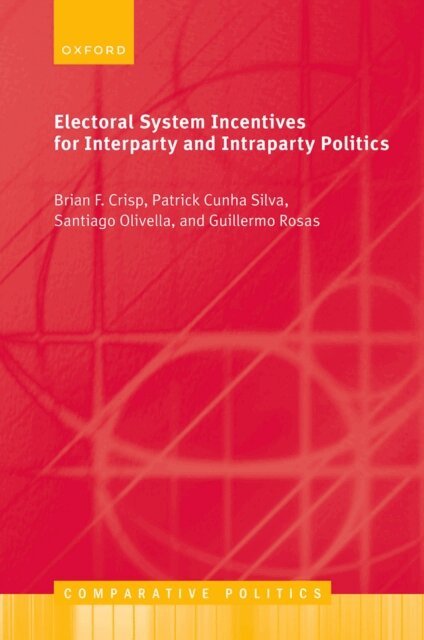
Electoral systems are sets of formal rules that create incentives for strategic behavior on the part of voters, (pre-) candidates, party elites, and elected representatives, including legislators and their chamber leaders. Most simply, they translate the choices made by voters into seats won by candidates and parties. In the process, rules influence both how many and which parties are viable and how elected official will go about their time in office as representatives. All electoral systems share a common set of component rules and each rule can take on a number of different values. When combining the values taken by these rules into a system, the number of possible combinations is quite large, which means that specific systems have the potential to provide precise, targeted incentives that govern relationships between political parties - interparty politics - and within parties - intraparty politics. Using novel computational tools and a comprehensive and updated dataset on electoral systems, this book develops precise and transparent measures of both electoral systems' interparty and intraparty incentives. These two simple quantities capture the extent to which a given system encourages the election of a limited number of large parties or a larger number of relatively smaller ones and the extent to which the lawmaking process will be conducted by unified, programmatic parties or by individually noteworthy politicians. They thus allow scholars to test the extent to which electoral rules shape political outcomes about which we care, and they allow practitioners to select the electoral system that is likely to encourage the form of representation they desire. The book shows that these indicators of electoral system incentives can explain variation in interparty politics - the effective number of parties, parties' locations in the policy space, congruence between citizens' preferences and policy - and intraparty politics - the content of campaigns, the amount of constituency service provided, the shape of legislative institutions, levels of party discipline, and the balance struck between programmatic policy and pork barrel politics.Comparative Politics is a series for researchers, teachers, and students of political science that deals with contemporary government and politics. Global in scope, books in the series are characterized by a stress on comparative analysis and strong methodological rigour. The series is published in association with the European Consortium for Political Research. For more information visit: www.ecprnet.eu .The series is edited by Nicole Bolleyer, Chair of Comparative Political Science, Geschwister Scholl Institut, LMU Munich and Jonathan Slapin, Professor of Political Institutions and European Politics, Department of Political Science, University of Zurich.
Democratic Institutional Design
The Powers and Incentives of Venezuelan Politicians and Interest Groups
Inbunden, Engelska, 2000
809 kr
Skickas inom 10-15 vardagar
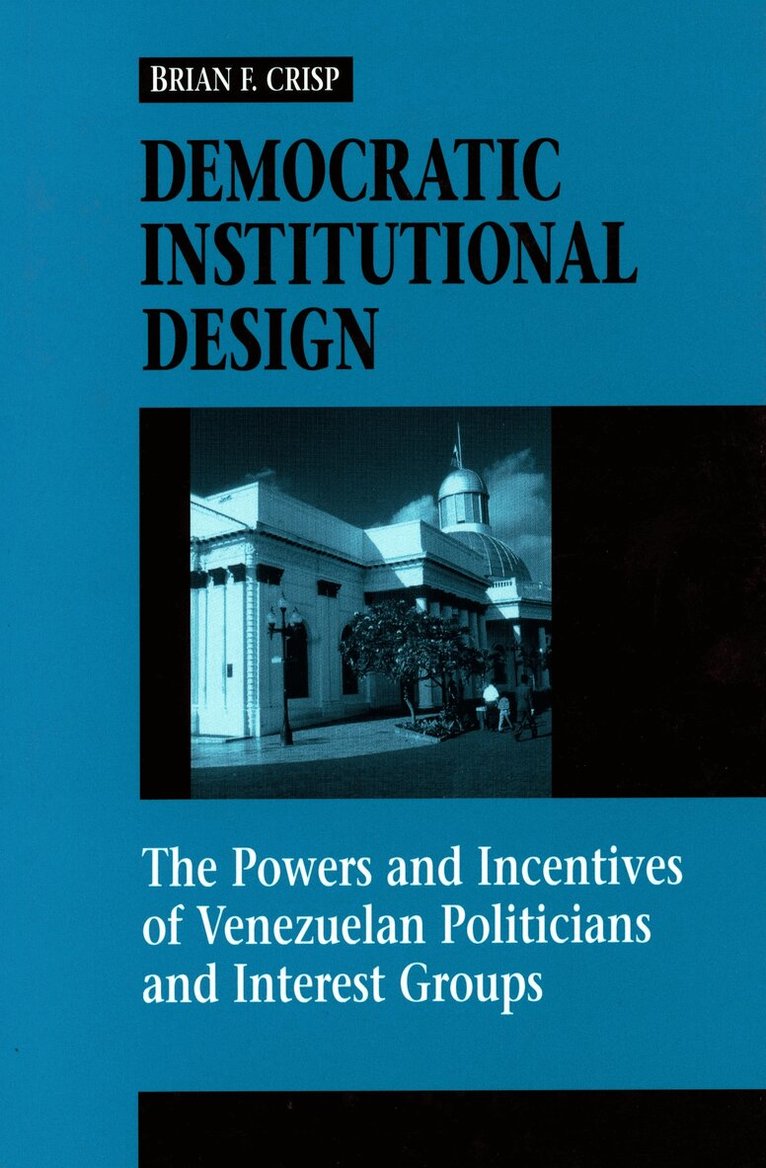
Based on the policy-making structures of Venezuelan government, this book examines the constitutionally allocated powers of the executive and legislature and shows how the powers of each branch are exercised given the incentives established by the electoral system and changing partisan strengths. Several institutional characteristics have led to a passive legislature and an activist chief executive. The advantages presidents enjoy as a result of their constitutional and partisan powers are demonstrated by a wealth of empirical evidence, including records of votes of censure, initiation of legislation, and the use of decree authority. Because of its dominance, the Venezuelan executive branch is the focus of interest-group pressure, which is institutionalized through consultative commissions and a decentralized public administration. The author analyzes memberships of more than 300 advisory commissions and governing boards, revealing the preponderance of posts filled by umbrella agencies for business and labor. The interaction of this limited version of civil society with policy makers in the executive branch has led to a highly protectionist development strategy and excessive government subsidies. The strategy and the political process that made it possible were both exhausted by the end of the 1980s. Venezuela was in political and economic crisis.The author places Venezuela in a comparative context with other Latin American states on three issues: the likelihood that executives will receive disciplined, majority support in the legislature; the constitutional powers of presidents; and the degree to which business and labor are formally incorporated through single peak associations. Participation and policy-making processes vary significantly across Latin American democracies, with few others reaching the level of centralization that has characterized Venezuela. At the other end of the spectrum, some Latin American institutional designs are characterized by diffusion and fragmentation. In conclusion, the author offers a blueprint to modify some of the counterproductive patterns associated with Venezuela, one of the longest-lived but now troubled democracies in Latin America.
The Chain of Representation
Preferences, Institutions, and Policy across Presidential Systems
Inbunden, Engelska, 2020
1 363 kr
Skickas inom 7-10 vardagar
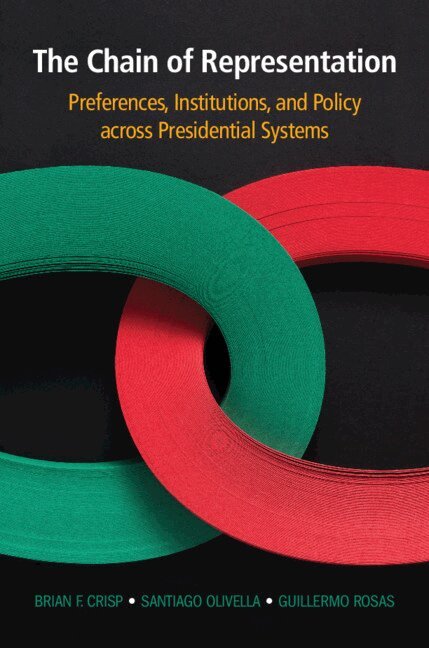
How do formal institutions affect the extent to which democracies adopt policies that reflect the preferences of their citizens? Based on a chain of representation model in which electoral rules and policy-making powers link citizens, politicians, and policies, this book reveals the conditions under which citizen preferences and implemented policies diverge. Comparative quantitative analyses encompassing eighteen Latin American countries show that presidential democracies vary greatly in the degree to which they demonstrate responsiveness to their electorates. Often, individual presidents with strong legislative powers have prompted policy changes that are unrepresentative of voter preferences. Other times, their interactions with legislatures result in more representative policies. Grounded in clear theory and thorough empirics, this study shows how rules can introduce dissonance between voters and politicians, but also how they can potentially reduce it. This is an excellent resource for scholars and graduate students interested in comparative politics, institutional design, economic policy, and Latin American studies.
The Chain of Representation
Preferences, Institutions, and Policy across Presidential Systems
Häftad, Engelska, 2020
460 kr
Skickas inom 7-10 vardagar
How do formal institutions affect the extent to which democracies adopt policies that reflect the preferences of their citizens? Based on a chain of representation model in which electoral rules and policy-making powers link citizens, politicians, and policies, this book reveals the conditions under which citizen preferences and implemented policies diverge. Comparative quantitative analyses encompassing eighteen Latin American countries show that presidential democracies vary greatly in the degree to which they demonstrate responsiveness to their electorates. Often, individual presidents with strong legislative powers have prompted policy changes that are unrepresentative of voter preferences. Other times, their interactions with legislatures result in more representative policies. Grounded in clear theory and thorough empirics, this study shows how rules can introduce dissonance between voters and politicians, but also how they can potentially reduce it. This is an excellent resource for scholars and graduate students interested in comparative politics, institutional design, economic policy, and Latin American studies.