• Fri frakt över 249 kr
  • •
  • Snabba leveranser
  • •
  • Billiga böcker
Kundservice

Du är på sajten för privatpersoner.

Företag, bibliotek eller offentlig verksamhet?

Du handlar på classic.bokus.com, där alla dina funktioner finns intakta.
Till classic.bokus.com
Bokus logotyp. Gå till startsidan.
  • Erbjudanden
  • Nyheter
  • Student
  • Topplistor
  • Barn & ungdom
  • Bokus Play
  • E-böcker
  • Pocketböcker
  • Spel & pussel

10% rabatt på allt med kod: NYSTART10 →

Sidfot

Mina sidor

    Hjälp

    • Kundservice
    • Vanliga frågor och svar
    • Frakt och leverans
    • Retur vid ångerrätt
    • Reklamera vara
    • Betalning
    • Köpvillkor
    • Allmänna villkor
    • Information om webbplatsens tillgänglighet

    Om Bokus

    • Om oss
    • Pressrum
    • För studenter
    • För företag
    • För bibliotek och offentlig verksamhet
    • För leverantörer
    • Hållbarhet

    Populärt

    • Aktuella erbjudanden
    • Presentkort
    • Studentlitteratur
    • Nya böcker
    • Topplistor
    • Signerade böcker
    • Engelska böcker

    Inspiration

    • Boktips
    • BookTok
    • Populära bokserier
    • Barnbokskaraktärer
    • Populära författare
    Logotyp för Bokus
    Följ oss på Facebook (extern länk)Följ oss på Instagram (extern länk)Följ oss på YouTube (extern länk)Följ oss på TikTok (extern länk)
    bokus @ CookiesAnpassa cookiesIntegritetspolicyKöpvillkor
    Till Citymail hemsida (extern länk)Till Budbee hemsida (extern länk)Till Postnord hemsida (extern länk)Till Schenker hemsida (extern länk)Till Early Bird hemsida (extern länk)Till Walleys hemsida (extern länk)
    1. Samhälle och politik
    2. Politik och statsskick
    3. Politiska partier

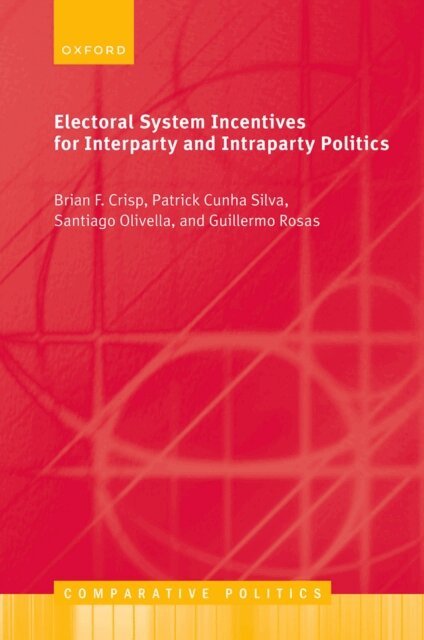
    Electoral System Incentives for Interparty and Intraparty Politics

    AvBrian F. Crisp,Patrick Cunha Silva

    Inbunden, Engelska, 2025

    Del i serien Comparative Politics

    1 374 kr

    Beställningsvara. Skickas inom 5-8 vardagar. Fri frakt över 249 kr.

    Beskrivning

    Electoral systems are sets of formal rules that create incentives for strategic behavior on the part of voters, (pre-) candidates, party elites, and elected representatives, including legislators and their chamber leaders. Most simply, they translate the choices made by voters into seats won by candidates and parties. In the process, rules influence both how many and which parties are viable and how elected official will go about their time in office as representatives. All electoral systems share a common set of component rules and each rule can take on a number of different values. When combining the values taken by these rules into a system, the number of possible combinations is quite large, which means that specific systems have the potential to provide precise, targeted incentives that govern relationships between political parties - interparty politics - and within parties - intraparty politics. Using novel computational tools and a comprehensive and updated dataset on electoral systems, this book develops precise and transparent measures of both electoral systems' interparty and intraparty incentives. These two simple quantities capture the extent to which a given system encourages the election of a limited number of large parties or a larger number of relatively smaller ones and the extent to which the lawmaking process will be conducted by unified, programmatic parties or by individually noteworthy politicians. They thus allow scholars to test the extent to which electoral rules shape political outcomes about which we care, and they allow practitioners to select the electoral system that is likely to encourage the form of representation they desire. The book shows that these indicators of electoral system incentives can explain variation in interparty politics - the effective number of parties, parties' locations in the policy space, congruence between citizens' preferences and policy - and intraparty politics - the content of campaigns, the amount of constituency service provided, the shape of legislative institutions, levels of party discipline, and the balance struck between programmatic policy and pork barrel politics.Comparative Politics is a series for researchers, teachers, and students of political science that deals with contemporary government and politics. Global in scope, books in the series are characterized by a stress on comparative analysis and strong methodological rigour. The series is published in association with the European Consortium for Political Research. For more information visit: www.ecprnet.eu .The series is edited by Nicole Bolleyer, Chair of Comparative Political Science, Geschwister Scholl Institut, LMU Munich and Jonathan Slapin, Professor of Political Institutions and European Politics, Department of Political Science, University of Zurich.

    Produktinformation

    • Utgivningsdatum:2025-06-12
    • Mått:160 x 240 x 24 mm
    • Vikt:626 g
    • Format:Inbunden
    • Språk:Engelska
    • Serie:Comparative Politics
    • Antal sidor:320
    • Förlag:OUP OXFORD
    • ISBN:9780198956556

    Utforska kategorier

    • Politiska partier inom Samhälle och politik
    • Statsvetenskap och politisk teori inom Samhälle och politik

    Mer om författaren

    Brian F. Crisp is Professor Emeritus in the Department of Political Science at Washington University in St. Louis. His work on electoral systems, legislative politics, interbranch relations, and policy choices has been published in The American Journal of Political Science, The American Political Science Review, The Journal of Politics, and elsewhere.Patrick Cunha Silva is Assistant Professor in the Department of Political Science at Loyola University Chicago. His research interests focus on representation and electoral politics. His work has been published in The Journal of Politics, British Journal of Political Science, and Political Behavior, among others.Santiago Olivella is an Associate Professor in Political Science and of Data Science and Society at the University of North Carolina at Chapel Hill. Olivella has published work in a variety of journals, including the Journal of the American Statistical Association, Political Analysis, and Electoral Studies, and has contributed open-source software for quantitative research.Guillermo Rosas is Professor in the Department of Political Science at Washington University in St. Louis. His research focuses on the economic consequences of political regimes and on the effects of political institutions on political elite behavior, especially in Latin America, and has appeared in the American Journal of Political Science, the Journal of Politics, and Comparative Political Studies, among others.

    Recensioner i media

    An original and pathbreaking work. ...Highly recommended.

    Innehållsförteckning

    • List of Figures List of Tables List of Abbreviations Part I The Rules of the Game 1: Party Politics 2: Electoral Rules 3: Electoral Systems Part II Incentives in the I-I Space 4: Simulating the Effect of Electoral System Incentives 5: Component Rules and Interparty and Intraparty Incentives 6: Placing "Real-World" Electoral Systems in the I-I Space Part III Interparty Politics 7: The Size of the Party System 8: The Distribution of Partisan Ideological Locations 9: Congruence Part IV Intraparty Politics 10: Campaigns for Office 11: Constituency Service 12: Committee Systems and Assignments 13: Party Unity 14: Programmatic Policy or Pork Barrel Part V Conclusion 15: Electing to Simulate Appendices Appendix A: Examples of Seat Allocation Formulas in Proportional Representation Systems Appendix B: Alternative Electoral System Names Appendix C: Gradient-Boosted Machine Models: The Fine Print C.1: Predicting {tde C.2: Predicting {ap C.3: Coding real electoral systems Appendix D: Measures of Unity Based on Network Eigendecomposition Appendix E: Data Sources Bibliography Index