• Fri frakt över 249 kr
  • •
  • Snabba leveranser
  • •
  • Billiga böcker
Kundservice

Du är på sajten för privatpersoner.

Företag, bibliotek eller offentlig verksamhet?

Du handlar på classic.bokus.com, där alla dina funktioner finns intakta.
Till classic.bokus.com
Bokus logotyp. Gå till startsidan.
  • Erbjudanden
  • Nyheter
  • Student
  • Topplistor
  • Barn & ungdom
  • Bokus Play
  • E-böcker
  • Pocketböcker
  • Spel & pussel

10% rabatt på allt med kod: NYSTART10 →

Sidfot

Mina sidor

    Hjälp

    • Kundservice
    • Vanliga frågor och svar
    • Frakt och leverans
    • Retur vid ångerrätt
    • Reklamera vara
    • Betalning
    • Köpvillkor
    • Allmänna villkor
    • Information om webbplatsens tillgänglighet

    Om Bokus

    • Om oss
    • Pressrum
    • För studenter
    • För företag
    • För bibliotek och offentlig verksamhet
    • För leverantörer
    • Hållbarhet

    Populärt

    • Aktuella erbjudanden
    • Presentkort
    • Studentlitteratur
    • Nya böcker
    • Topplistor
    • Signerade böcker
    • Engelska böcker

    Inspiration

    • Boktips
    • BookTok
    • Populära bokserier
    • Barnbokskaraktärer
    • Populära författare
    Logotyp för Bokus
    Följ oss på Facebook (extern länk)Följ oss på Instagram (extern länk)Följ oss på YouTube (extern länk)Följ oss på TikTok (extern länk)
    bokus @ CookiesAnpassa cookiesIntegritetspolicyKöpvillkor
    Till Citymail hemsida (extern länk)Till Budbee hemsida (extern länk)Till Postnord hemsida (extern länk)Till Schenker hemsida (extern länk)Till Early Bird hemsida (extern länk)Till Walleys hemsida (extern länk)
    1. Samhälle och politik
    2. Politik och statsskick
    3. Statsvetenskap och politisk teori

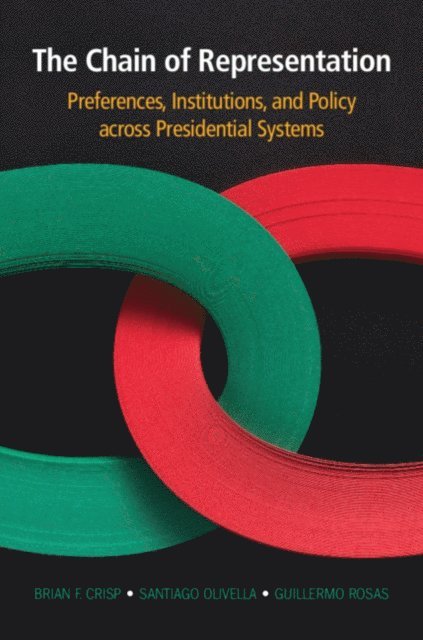
    The Chain of Representation

    Preferences, Institutions, and Policy across Presidential Systems

    AvBrian F. Crisp,Santiago Olivella

    Inbunden, Engelska, 2020

    1 389 kr

    Beställningsvara. Skickas inom 10-15 vardagar. Fri frakt över 249 kr.

    Fler format och utgåvor

    Häftad

    494 kr

    Beskrivning

    How do formal institutions affect the extent to which democracies adopt policies that reflect the preferences of their citizens? Based on a chain of representation model in which electoral rules and policy-making powers link citizens, politicians, and policies, this book reveals the conditions under which citizen preferences and implemented policies diverge. Comparative quantitative analyses encompassing eighteen Latin American countries show that presidential democracies vary greatly in the degree to which they demonstrate responsiveness to their electorates. Often, individual presidents with strong legislative powers have prompted policy changes that are unrepresentative of voter preferences. Other times, their interactions with legislatures result in more representative policies. Grounded in clear theory and thorough empirics, this study shows how rules can introduce dissonance between voters and politicians, but also how they can potentially reduce it. This is an excellent resource for scholars and graduate students interested in comparative politics, institutional design, economic policy, and Latin American studies.

    Produktinformation

    • Utgivningsdatum:2020-03-19
    • Mått:157 x 235 x 23 mm
    • Vikt:500 g
    • Format:Inbunden
    • Språk:Engelska
    • Antal sidor:280
    • Förlag:Cambridge University Press
    • ISBN:9781108478014

    Utforska kategorier

    • Statsvetenskap och politisk teori inom Samhälle och politik
    • Politik och statsskick inom Samhälle och politik
    • Etnicitet inom Samhälle och politik

    Mer om författaren

    Brian F. Crisp is a Professor of Political Science at Washington University, St Louis. His work on electoral systems, legislative politics, interbranch relations, and policy choices has been published in The American Journal of Political Science, The American Political Science Review, and The Journal of Politics. He is also the Executive Editor of Legislative Studies Quarterly. Santiago Olivella is an Assistant Professor of Political Science at the University of North Carolina, Chapel Hill. His research focuses on developing quantitative tools to study issues in electoral and legislative politics. He has published articles in Political Analysis, the American Journal of Political Science, the British Journal of Political Science, the Journal of Politics, and Electoral Studies. Guillermo Rosas is an Associate Professor of Political Science at Washington University, St Louis. His research explores the economic consequences of political regimes and political elite behavior. He is the author of Curbing Bailouts: Bank Crises and Democratic Accountability in Comparative Perspective (2010) and co-author of Latin American Party Systems (Cambridge, 2010).

    Recensioner i media

    'This very important book applies the logic of institutional design and sequential stages of representation to describe and explain the connections between citizens and policies in presidential democracies. The 'separation-of-powers' systems of Latin America, with their directly elected chief executives and greatly varying policymaking powers, provide an additional level of institutional variation. Its incorporation in this book makes a unique and memorable contribution to the representation literature.' G. Bingham Powell, Jr, University of Rochester

    Innehållsförteckning

    • 1. Studying the chain of representation; 2. Our solutions to the challenges of studying the chain of representation; Part I. Stages: 3. Stage 1: citizens' preferences; 4. Stage 2: policymakers' preferences; 5. Stage 3: public policies chosen; 6. Placing preferences and policies on a common scale; Part II. Linkages: 7. Linkage 1: electoral systems; 8. Linkage 2: policymaking processes; Part III. Testing the Chain of Representation: 9. From citizens to policymakers; 10. From policymakers to policies; 11. From citizen to policies; 12. A chain is only as strong as its weakest link.