C. Anthony Di Benedetto – författare
1 757 kr
Skickas inom 5-8 vardagar
The Sage Handbook of Industrial Marketing addresses the dynamic and complex landscape of industrial marketing, emphasizing the unique challenges and opportunities within business-to-business transactions. In an era marked by technological advancements and globalization, this handbook offers a comprehensive resource that defines the industrial marketing field, captures its historical foundations, and charts a course for its future. It aims to be a benchmark, offering both retrospective and prospective international perspectives to frame, assess, and synthesize the current state of industrial marketing.
Emphasizing the industrial context, the handbook defines the boundaries of industrial marketing, differentiating it from consumer-focused approaches. It explores the distinctive characteristics of business-to-business products and services within industrial markets, acknowledging the specialized nature of these transactions.
The edited collection aims for a holistic view of industrial marketing, encompassing organizational aspects, customer behavior, market research, customer value proposition, market segmentation, product innovation, product management, marketing communications, channels of distribution, and emerging industrial trends. This breadth ensures that readers gain a deep understanding of the multifaceted nature of industrial marketing.
Recognizing the global nature of industrial markets, the handbook brings together leading scholars from around the world. This inclusivity ensures diverse perspectives, addressing global variations and challenges inherent in industrial marketing practices.
The handbook is thematically organized into sections, each dedicated to a crucial aspect of industrial marketing. This structure allows for an in-depth exploration of specific topics, ensuring a nuanced examination of both traditional and contemporary industrial marketing issues. A dedicated section explores emerging industrial trends, ensuring the collection remains relevant in the face of evolving technologies and market dynamics specific to the industrial context.
The Sage Handbook of Industrial Marketing is an essential resource for scholars, practitioners, and students seeking to navigate the complexities of industrial marketing and leverage opportunities within business-to-business transactions.
Part 1: Field of Business-to-Business MarketingPart 2: Business-to-Business OrganizationsPart 3: Business-to-Business Customer BehaviorPart 4: Business-to-Business Market ResearchPart 5: Business Customer Value PropositionPart 6: Market Segmentation and PositioningPart 7: Product InnovationPart 8: Product ManagementPart 9: Marketing CommunicationsPart 10: Channels of DistributionPart 11: New Trends
833 kr
Skickas inom 3-6 vardagar
909 kr
Slutsåld
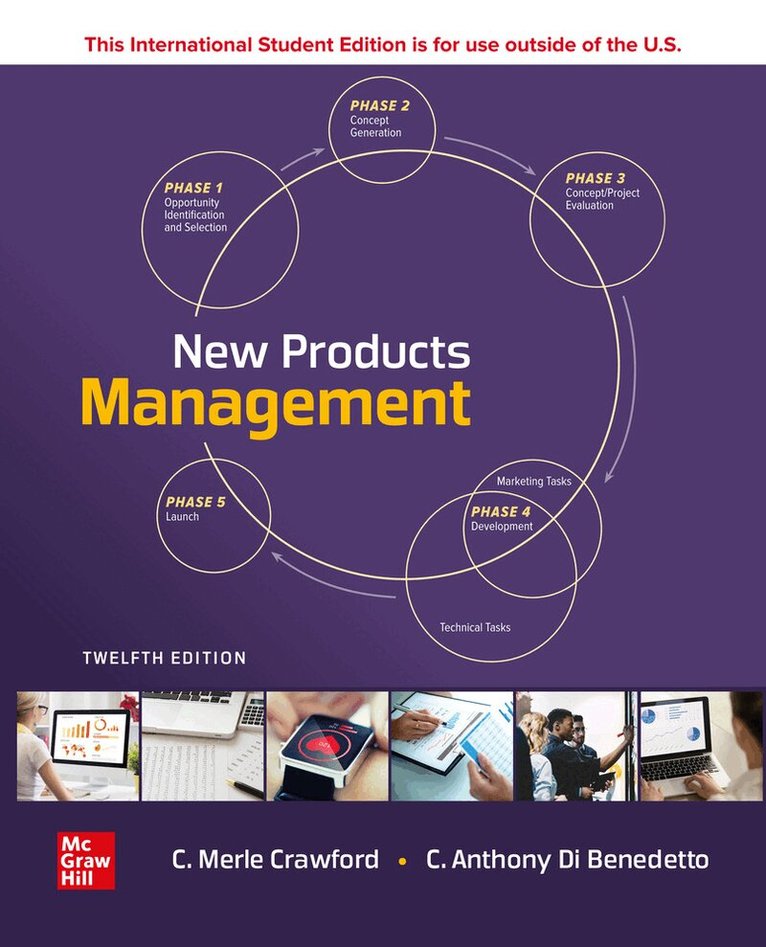
Crawford's New Product Management 12e provides the management approach to teaching new products, with the perspective of marketing.
Adopters of previous editions will notice that the format is slimmed down to 18 chapters. This streamlined presentation focuses on the topics that will be of most importance and
interest to new product managers. Significant updates can be found throughout, and great pains have been taken to present the "best practices" of industry and relevancy to readers.
Past adopters of New Products Management will notice major changes in this edition.
While there are some changes in virtually every chapter, some of the most substantial
changes are as follows:
1.We have made major additions and updates to the cases to provide more plentiful
and more current examples. We retired several cases from the previous edition,
wrote many new cases, and thoroughly updated many others. New cases
for this edition include: Oculus Rift, Adidas Parley sustainable running shoes,
Google Glass, Indiegogo, Tesla, Chipotle, Chick-fil-A, Corporate Social Responsibility
at Starbucks, and many others. As always, we aim to offer a mix of high tech
products and consumer products and services in the set of cases.
2.In addition, we have substantially updated examples throughout the text wherever
possible.We try to make use of illustrative examples that will resonate with
today’s students wherever possible. Of course, we welcome the reader’s comments
and suggestions for improvement.
3.There continues to be much new research in new products, and we have tried to
stay current on all of these topics. Readers will notice new or expanded coverage
of portfolio management, value curve creation, the TRIZ method, crowd-sourcing,
crowdfunding,observational research, open innovation, organizational structure,
3D modeling, beta testing, sustainable product development, and frugal
innovation,among other topics.
4.We continue the practice of referencing Web sites of interest throughout the
text,and we have added the web addresses for several useful YouTube videos
and other resources.