C. S. Holling - Böcker
Visar alla böcker från författaren C. S. Holling. Handla med fri frakt och snabb leverans.
9 produkter
9 produkter
1 129 kr
Skickas inom 11-20 vardagar
This volume uses a series of case studies to test an emerging theory of complex adaptive systems that forms the basis for explaining the interrelated dynamics of ecosystems, institutions and society. It deals equally with institutional organization and ecosystem structure.
1 566 kr
Skickas inom 7-10 vardagar
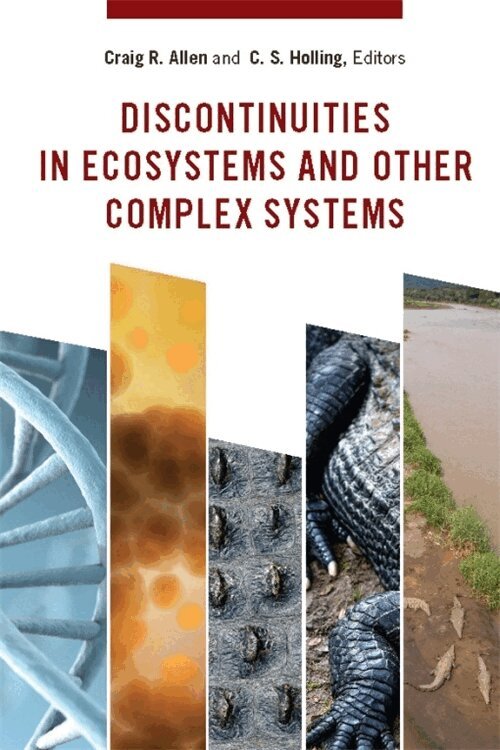
Following the publication of C. S. Holling's seminal work on the relationship between animal body mass patterns and scale-specific landscape structure, ecologists began to explore the theoretical and applied consequences of discontinuities in ecosystems and other complex systems. Are ecosystems and their components continuously distributed and do they adhere to scaling laws, or are they discontinuous and more complex than early models would have us believe? The resulting propositions over the structure of complex systems sparked an ongoing debate regarding the mechanisms generating discontinuities and the statistical methods used for their detection. This volume takes the view that ecosystems and other complex systems are inherently discontinuous and that such fields as ecology, economics, and urban studies greatly benefit from this paradigm shift. Contributors present evidence of the ubiquity of discontinuous distributions in ecological and social systems and how their analysis provides insight into complex phenomena. The book is divided into three sections.The first focuses on background material and contrasting views concerning the discontinuous organization of complex systems. The second discusses discontinuous patterns detected in a number of different systems and methods for detecting them, and the third touches on the potential significance of discontinuities in complex systems. Science is still dominated by a focus on power laws, but the contributors to this volume are convinced power laws often mask the interesting dynamics of systems and that those dynamics are best revealed by investigating deviations from assumed power law distributions. In 2008, a grand conference on resilience was held in Stockholm, hosting 600 participants from around the world. There are now three big centers established with resilience, the most recent one being the Stockholm Resilience Center, with others in Australia (an international coral reef center), Arizona State University's new sustainability center focusing on anthropology, and Canada's emerging social sciences and resilience center. Activity continues to flourish in Alaska, South Africa, and the Untied Kingdom, and a new center is forming in Uruguay.
400 kr
Skickas inom 7-10 vardagar
Following the publication of C. S. Holling's seminal work on the relationship between animal body mass patterns and scale-specific landscape structure, ecologists began to explore the theoretical and applied consequences of discontinuities in ecosystems and other complex systems. Are ecosystems and their components continuously distributed and do they adhere to scaling laws, or are they discontinuous and more complex than early models would have us believe? The resulting propositions over the structure of complex systems sparked an ongoing debate regarding the mechanisms generating discontinuities and the statistical methods used for their detection. This volume takes the view that ecosystems and other complex systems are inherently discontinuous and that such fields as ecology, economics, and urban studies greatly benefit from this paradigm shift. Contributors present evidence of the ubiquity of discontinuous distributions in ecological and social systems and how their analysis provides insight into complex phenomena. The book is divided into three sections.The first focuses on background material and contrasting views concerning the discontinuous organization of complex systems. The second discusses discontinuous patterns detected in a number of different systems and methods for detecting them, and the third touches on the potential significance of discontinuities in complex systems. Science is still dominated by a focus on power laws, but the contributors to this volume are convinced power laws often mask the interesting dynamics of systems and that those dynamics are best revealed by investigating deviations from assumed power law distributions. In 2008, a grand conference on resilience was held in Stockholm, hosting 600 participants from around the world. There are now three big centers established with resilience, the most recent one being the Stockholm Resilience Center, with others in Australia (an international coral reef center), Arizona State University's new sustainability center focusing on anthropology, and Canada's emerging social sciences and resilience center. Activity continues to flourish in Alaska, South Africa, and the Untied Kingdom, and a new center is forming in Uruguay.
1 258 kr
Skickas inom 7-10 vardagar
This volume reports key findings of the Biodiversity Program of the Royal Swedish Academy of Sciences' Beijer Institute. The program brought together a number of eminent ecologists and economists to consider the nature and significance of the biodiversity problem. In encouraging collaborative work between these closely related disciplines it sought to shed new light on the concept of diversity; the implications of biological diversity for the functioning of ecosystems; the driving forces behind biodiversity loss; and the options for promoting biodiversity conservation. The results of the program are surprising. It is shown that the core of the biodiversity problem is a loss of ecosystem resilience and the insurance it provides against the uncertain environmental effects of economic and population growth. This is as much a local as a global problem, implying that biodiversity conservation offers benefits that are as much local as global. The solutions as well as the causes of biodiversity loss lie in incentives to local users.
523 kr
Skickas inom 7-10 vardagar
This volume reports key findings of the Biodiversity Program of the Royal Swedish Academy of Sciences' Beijer Institute. The program brought together a number of eminent ecologists and economists to consider the nature and significance of the biodiversity problem. In encouraging collaborative work between these closely related disciplines it sought to shed new light on the concept of diversity; the implications of biological diversity for the functioning of ecosystems; the driving forces behind biodiversity loss; and the options for promoting biodiversity conservation. The results of the program are surprising. It is shown that the core of the biodiversity problem is a loss of ecosystem resilience and the insurance it provides against the uncertain environmental effects of economic and population growth. This is as much a local as a global problem, implying that biodiversity conservation offers benefits that are as much local as global. The solutions as well as the causes of biodiversity loss lie in incentives to local users.
190 kr
Skickas
‘Panarchy’ is a new term coined from the name of the Greek god Pan, a symbol of universal nature and associated with unpredictable change. It represents an alternative framework for managing the issues that emerge from the interaction between people and nature. That interaction generates countless surprises, often the result of slow changes that can accumulate and unexpectedly flip an ecosystem or an economy into a qualitatively different state. That state may be not only impoverished, but also effectively irreversible. Thus, understanding how such change occurs is critical to achieving a sustainable society. Developed from the work of the Resilience Alliance, a worldwide group of leading organizations and individuals involved in ecological and economic research, Panarchy provides a framework to understand the cycles of change in complex systems and to gauge if, when, and how they can be influenced. This synopsis introduces lay readers and decision makers to this widely acclaimed line of inquiry and to the basic concept behind Panarchy, published by Island Press.
739 kr
Skickas inom 11-20 vardagar
This title presents the evolution of resilience theory in seminal papers and commentary. Ecological resilience provides a theoretical foundation for understanding how complex systems adapt to and recover from localized disturbances like hurricanes, fires, pest outbreaks, and floods, as well as large-scale perturbations such as climate change. Ecologists have developed resilience theory over the past three decades in an effort to explain surprising and nonlinear dynamics of complex adaptive systems. Resilience theory is especially important to environmental scientists for its role in underpinning adaptive management approaches to ecosystem and resource management. "Foundations of Ecological Resilience" is a collection of the most important articles on the subject of ecological resilience - those writings that have defined and developed basic concepts in the field and help explain its importance and meaning for scientists and researchers.The book's three sections cover articles that have shaped or defined the concepts and theories of resilience, including key papers that broke new conceptual ground and contributed novel ideas to the field; examples that demonstrate ecological resilience in a range of ecosystems; and, articles that present practical methods for understanding and managing nonlinear ecosystem dynamics. "Foundations of Ecological Resilience" is an important contribution to our collective understanding of resilience and an invaluable resource for students and scholars in ecology, wildlife ecology, conservation biology, sustainability, environmental science, public policy, and related fields.
440 kr
Skickas inom 7-10 vardagar
This title presents the evolution of resilience theory in seminal papers and commentary. Ecological resilience provides a theoretical foundation for understanding how complex systems adapt to and recover from localized disturbances like hurricanes, fires, pest outbreaks, and floods, as well as large-scale perturbations such as climate change. Ecologists have developed resilience theory over the past three decades in an effort to explain surprising and nonlinear dynamics of complex adaptive systems. Resilience theory is especially important to environmental scientists for its role in underpinning adaptive management approaches to ecosystem and resource management. "Foundations of Ecological Resilience" is a collection of the most important articles on the subject of ecological resilience - those writings that have defined and developed basic concepts in the field and help explain its importance and meaning for scientists and researchers.The book's three sections cover articles that have shaped or defined the concepts and theories of resilience, including key papers that broke new conceptual ground and contributed novel ideas to the field; examples that demonstrate ecological resilience in a range of ecosystems; and, articles that present practical methods for understanding and managing nonlinear ecosystem dynamics. "Foundations of Ecological Resilience" is an important contribution to our collective understanding of resilience and an invaluable resource for students and scholars in ecology, wildlife ecology, conservation biology, sustainability, environmental science, public policy, and related fields.
526 kr
Skickas inom 5-8 vardagar