Karl-Goran Maler - Böcker
Visar alla böcker från författaren Karl-Goran Maler. Handla med fri frakt och snabb leverans.
10 produkter
10 produkter
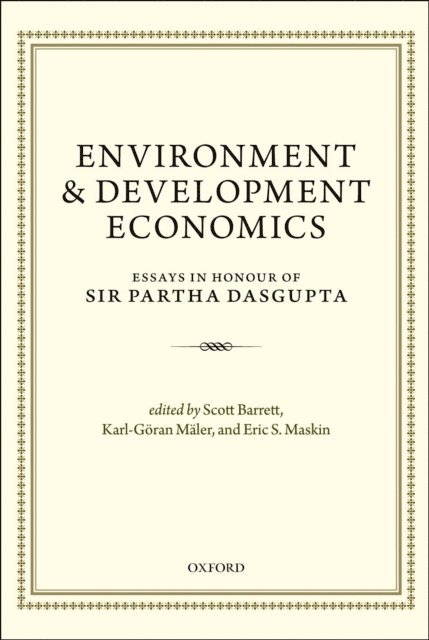
Environment and Development Economics
Essays in Honour of Sir Partha Dasgupta
Inbunden, Engelska, 2014
1 717 kr
Skickas inom 7-10 vardagar
This book honours Partha Dasgupta, and the field he helped establish; environment and development economics. It concerns the relationship between social systems (to include families, local communities, national economies, and the world as a whole) and natural systems (critical ecosystems, forests, water resources, mineral deposits, pollution, fisheries, and the Earth's climate). Above all, it concerns the poverty-environment nexus: the complex pathways by which people become or remain poor, and resources become or remain overexploited. With contributions by some of the world's leading economists, including five recipients of the Nobel Prize in Economics, in addition to scholars based in developing countries, this volume offers a unique perspective on the environmental issues that matter most to developing countries.
Del 1 - Handbook of Environmental Economics
Handbook of Environmental Economics
Environmental Degradation and Institutional Responses
Inbunden, Engelska, 2003
1 552 kr
Skickas inom 7-10 vardagar
The Handbook of Environmental Economics focuses on the economics of environmental externalities and environmental public goods. Volume I examines environmental degradation and policy responses from a microeconomic, institutional standpoint. Its perspective is dynamic, including a consideration of the dynamics of natural systems, and global, with attention paid to issues in both rich and poor nations. In addition to chapters on well-established topics such as the theory and practice of pollution regulation, it includes chapters on new areas of environmental economics research related to common property management regimes; population and poverty; mechanism design; political economy of regulation; experimental evaluations of policy instruments; and technological change.
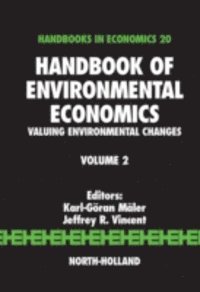
Del 2 - Handbook of Environmental Economics
Handbook of Environmental Economics
Valuing Environmental Changes
Inbunden, Engelska, 2005
1 507 kr
Skickas inom 7-10 vardagar
Much applied environmental economics is concerned with the valuation of changes in environmental quality. Obtaining reliable valuation estimates requires attention to theoretical and econometric issues that are often quite subtle. Volume 2 of the Handbook of Environmental Economics presents both the theory and the practice of environmental valuation. It synthesizes the vast literature that has accumulated since the publication of the Handbook of Natural Resource and Energy Economics two decades ago. It includes chapters on individual valuation methods written by researchers responsible for fundamental advances in those methods. It also includes cross-cutting chapters that deal with aspects of welfare theory, uncertainty, experimental methods, and public health that are pertinent to valuation. Throughout the volume, attention is paid to research and policy issues that arise not only in high-income countries, where most of the theory and econometrics that underlie applied valuation methods have been developed, but also in poorer parts of the world. The volume provides a state-of-the-art reference for scholars and practitioners alike.
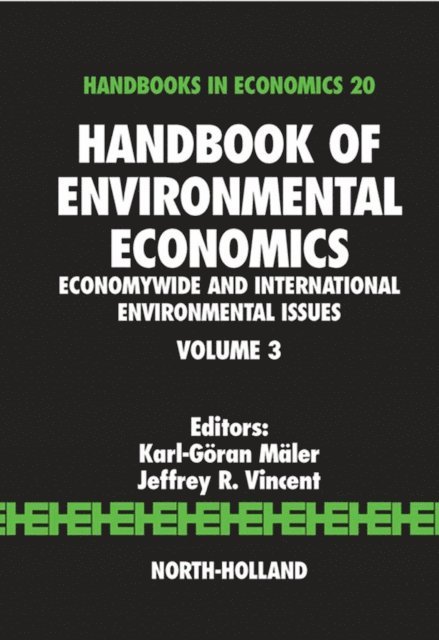
Del 3 - Handbook of Environmental Economics
Handbook of Environmental Economics
Economywide and International Environmental Issues
Inbunden, Engelska, 2005
1 507 kr
Skickas inom 7-10 vardagar
Many of the frontiers of environmental economics research are at the interface of large-scale and long-term environmental change with national and global economic systems. This is also where some of the most of challenging environmental policy issues occur. Volume 3 of the Handbook of Environmental Economics provides a synthesis of the latest theory on economywide and international environmental issues and a critical review of models for analyzing those issues. It begins with chapters on the fundamental relationships that connect environmental resources to economic growth and long-run social welfare. The following chapters consider how environmental policy differs in a general-equiIibrium setting from a partial-equilibrium setting and in a distorted economy from a perfect economy. The volume closes with chapters on environmental issues that cross or transcend national borders, such as trade and the environment, biodiversity conservation, acid rain, ozone depletion, and global climate change. The volume provides a useful reference for not only natural resource and environmental economists but also international economists, development economists, and macroeconomists.
1 258 kr
Skickas inom 7-10 vardagar
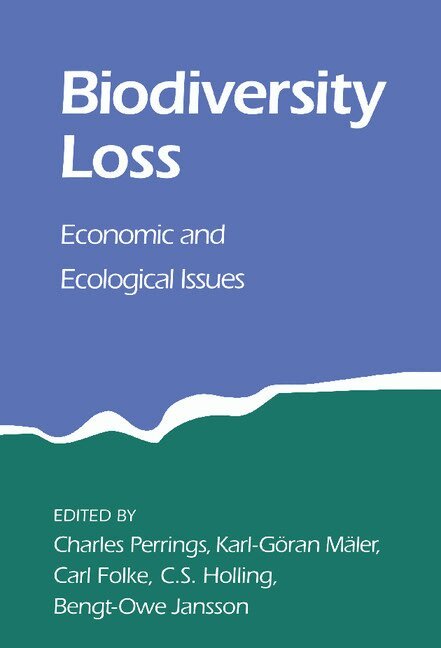
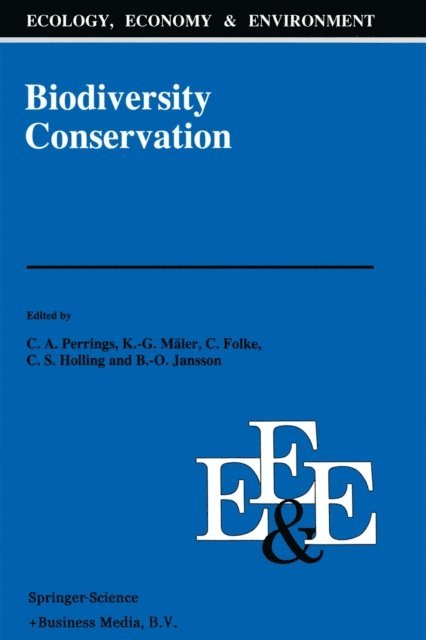
This volume reports key findings of the Biodiversity Program of the Royal Swedish Academy of Sciences' Beijer Institute. The program brought together a number of eminent ecologists and economists to consider the nature and significance of the biodiversity problem. In encouraging collaborative work between these closely related disciplines it sought to shed new light on the concept of diversity; the implications of biological diversity for the functioning of ecosystems; the driving forces behind biodiversity loss; and the options for promoting biodiversity conservation. The results of the program are surprising. It is shown that the core of the biodiversity problem is a loss of ecosystem resilience and the insurance it provides against the uncertain environmental effects of economic and population growth. This is as much a local as a global problem, implying that biodiversity conservation offers benefits that are as much local as global. The solutions as well as the causes of biodiversity loss lie in incentives to local users.
523 kr
Skickas inom 7-10 vardagar
This volume reports key findings of the Biodiversity Program of the Royal Swedish Academy of Sciences' Beijer Institute. The program brought together a number of eminent ecologists and economists to consider the nature and significance of the biodiversity problem. In encouraging collaborative work between these closely related disciplines it sought to shed new light on the concept of diversity; the implications of biological diversity for the functioning of ecosystems; the driving forces behind biodiversity loss; and the options for promoting biodiversity conservation. The results of the program are surprising. It is shown that the core of the biodiversity problem is a loss of ecosystem resilience and the insurance it provides against the uncertain environmental effects of economic and population growth. This is as much a local as a global problem, implying that biodiversity conservation offers benefits that are as much local as global. The solutions as well as the causes of biodiversity loss lie in incentives to local users.
Rights to Nature
Ecological, Economic, Cultural, and Political Principles of Institutions for the Environment
Häftad, Engelska, 1996
504 kr
Skickas inom 11-20 vardagar
Property rights are a tool humans use in regulating their use of natural resources. Understanding how rights to resources are assigned and how they are controlled is critical to designing and implementing effective strategies for environmental management and conservation.Rights to Nature is a nontechnical, interdisciplinary introduction to the systems of rights, rules, and responsibilities that guide and control human use of the environment. Following a brief overview of the relationship between property rights and the natural environment, chapters consider: ecological systems and how they function the effects of culture, values, and social organization on the use of natural resources the design and development of property rights regimes and the costs of their operation cultural factors that affect the design and implementation of property rights systems coordination across geographic and jurisdictional boundaries The book provides a valuable synthesis of information on how property rights develop, why they develop in certain ways, and the ways in which they function. Representing a unique integration of natural and social science, it addresses the full range of ecological, economic, cultural, and political factors that affect natural resource management and use, and provides valuable insight into the role of property rights regimes in establishing societies that are equitable, efficient, and sustainable.
1 817 kr
Skickas inom 10-15 vardagar
First Published in 2011. This is Volume VII out a series of eight on Environmental and Resource Economics and looks at Environmental Economics and in particular the problems connected with environmental quality.
Nobel Lectures In Economic Sciences, Vol 2 (1981-1990): The Sveriges Riksbank (Bank Of Sweden) Prize In Economic Sciences In Memory Of Alfred Nobel
Inbunden, Engelska, 1992
1 009 kr
Tillfälligt slut
Below is a list of the prizewinners during the period 1981 - 1990 with a description of the works which won them their prizes:(1981) J TOBIN — for his analysis of financial markets and their relations to expenditure decisions, employment, production and prices; (1982) G J STIGLER — for his seminal studies of industrial structures, functioning of markets and causes and effects of public regulation; (1983) G DEBREU — for having incorporated new analytical methods into economic theory and for his rigorous reformulation of the theory of general equilibrium; (1984) R STONE — for having made fundamental contributions to the development of systems of national accounts and hence greatly improved the basis for empirical economic analysis; (1985) F MODIGLIANI — for his pioneering analyses of saving and of financial markets; (1986) J BUCHANAN, JR — for his development of the contractual and constitutional bases for the theory of economic and political decision-making; (1987) R M SOLOW — for his contributions to the theory of economic growth; (1988) M ALLAIS — for his pioneering contributions to the theory of markets and efficient utilization of resources; (1989) T HAAVELMO — for his clarification of the probability theory foundations of econometrices and his analyses of simultaneous economic structures; (1990) H M MARKOWITZ, M H MILLER & W F SHARPE — for their pioneering work in the theory of financial economics.
Nobel Lectures In Economic Sciences, Vol 2 (1981-1990): The Sveriges Riksbank (Bank Of Sweden) Prize In Economic Sciences In Memory Of Alfred Nobel
Häftad, Engelska, 1992
494 kr
Tillfälligt slut
Below is a list of the prizewinners during the period 1981 - 1990 with a description of the works which won them their prizes:(1981) J TOBIN — for his analysis of financial markets and their relations to expenditure decisions, employment, production and prices; (1982) G J STIGLER — for his seminal studies of industrial structures, functioning of markets and causes and effects of public regulation; (1983) G DEBREU — for having incorporated new analytical methods into economic theory and for his rigorous reformulation of the theory of general equilibrium; (1984) R STONE — for having made fundamental contributions to the development of systems of national accounts and hence greatly improved the basis for empirical economic analysis; (1985) F MODIGLIANI — for his pioneering analyses of saving and of financial markets; (1986) J BUCHANAN, JR — for his development of the contractual and constitutional bases for the theory of economic and political decision-making; (1987) R M SOLOW — for his contributions to the theory of economic growth; (1988) M ALLAIS — for his pioneering contributions to the theory of markets and efficient utilization of resources; (1989) T HAAVELMO — for his clarification of the probability theory foundations of econometrices and his analyses of simultaneous economic structures; (1990) H M MARKOWITZ, M H MILLER & W F SHARPE — for their pioneering work in the theory of financial economics.