Craig R. Allen - Böcker
Visar alla böcker från författaren Craig R. Allen. Handla med fri frakt och snabb leverans.
6 produkter
6 produkter
1 572 kr
Skickas inom 7-10 vardagar
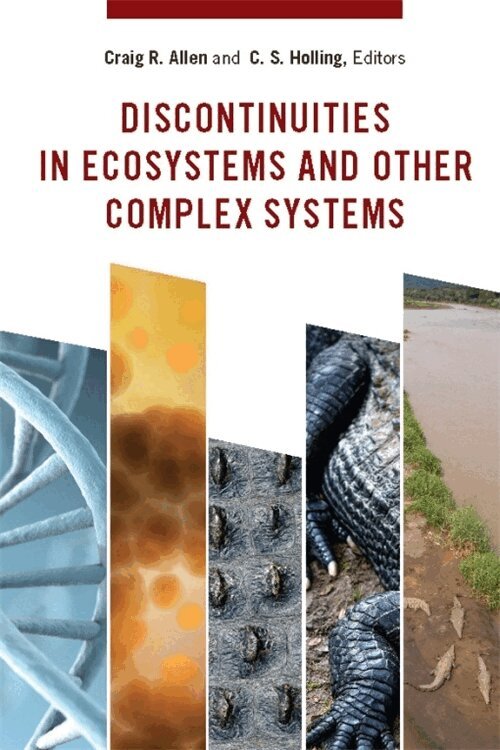
Following the publication of C. S. Holling's seminal work on the relationship between animal body mass patterns and scale-specific landscape structure, ecologists began to explore the theoretical and applied consequences of discontinuities in ecosystems and other complex systems. Are ecosystems and their components continuously distributed and do they adhere to scaling laws, or are they discontinuous and more complex than early models would have us believe? The resulting propositions over the structure of complex systems sparked an ongoing debate regarding the mechanisms generating discontinuities and the statistical methods used for their detection. This volume takes the view that ecosystems and other complex systems are inherently discontinuous and that such fields as ecology, economics, and urban studies greatly benefit from this paradigm shift. Contributors present evidence of the ubiquity of discontinuous distributions in ecological and social systems and how their analysis provides insight into complex phenomena. The book is divided into three sections.The first focuses on background material and contrasting views concerning the discontinuous organization of complex systems. The second discusses discontinuous patterns detected in a number of different systems and methods for detecting them, and the third touches on the potential significance of discontinuities in complex systems. Science is still dominated by a focus on power laws, but the contributors to this volume are convinced power laws often mask the interesting dynamics of systems and that those dynamics are best revealed by investigating deviations from assumed power law distributions. In 2008, a grand conference on resilience was held in Stockholm, hosting 600 participants from around the world. There are now three big centers established with resilience, the most recent one being the Stockholm Resilience Center, with others in Australia (an international coral reef center), Arizona State University's new sustainability center focusing on anthropology, and Canada's emerging social sciences and resilience center. Activity continues to flourish in Alaska, South Africa, and the Untied Kingdom, and a new center is forming in Uruguay.
402 kr
Skickas inom 7-10 vardagar
Following the publication of C. S. Holling's seminal work on the relationship between animal body mass patterns and scale-specific landscape structure, ecologists began to explore the theoretical and applied consequences of discontinuities in ecosystems and other complex systems. Are ecosystems and their components continuously distributed and do they adhere to scaling laws, or are they discontinuous and more complex than early models would have us believe? The resulting propositions over the structure of complex systems sparked an ongoing debate regarding the mechanisms generating discontinuities and the statistical methods used for their detection. This volume takes the view that ecosystems and other complex systems are inherently discontinuous and that such fields as ecology, economics, and urban studies greatly benefit from this paradigm shift. Contributors present evidence of the ubiquity of discontinuous distributions in ecological and social systems and how their analysis provides insight into complex phenomena. The book is divided into three sections.The first focuses on background material and contrasting views concerning the discontinuous organization of complex systems. The second discusses discontinuous patterns detected in a number of different systems and methods for detecting them, and the third touches on the potential significance of discontinuities in complex systems. Science is still dominated by a focus on power laws, but the contributors to this volume are convinced power laws often mask the interesting dynamics of systems and that those dynamics are best revealed by investigating deviations from assumed power law distributions. In 2008, a grand conference on resilience was held in Stockholm, hosting 600 participants from around the world. There are now three big centers established with resilience, the most recent one being the Stockholm Resilience Center, with others in Australia (an international coral reef center), Arizona State University's new sustainability center focusing on anthropology, and Canada's emerging social sciences and resilience center. Activity continues to flourish in Alaska, South Africa, and the Untied Kingdom, and a new center is forming in Uruguay.
1 170 kr
Skickas inom 7-10 vardagar
Environmental law envisions ecological systems as existing in an equilibrium state, reinforcing a rigid legal framework unable to absorb rapid environmental changes and innovations in sustainability. For the past four decades, "resilience theory," which embraces uncertainty and nonlinear dynamics in complex adaptive systems, has provided a robust, invaluable foundation for sound environmental management. Reforming American law to incorporate this knowledge is the key to sustainability. This volume features top legal and resilience scholars speaking on resilience theory and its legal applications to climate change, biodiversity, national parks, and water law.
297 kr
Skickas inom 7-10 vardagar
Environmental law envisions ecological systems as existing in an equilibrium state, reinforcing a rigid legal framework unable to absorb rapid environmental changes and innovations in sustainability. For the past four decades, "resilience theory," which embraces uncertainty and nonlinear dynamics in complex adaptive systems, has provided a robust, invaluable foundation for sound environmental management. Reforming American law to incorporate this knowledge is the key to sustainability. This volume features top legal and resilience scholars speaking on resilience theory and its legal applications to climate change, biodiversity, national parks, and water law.
1 276 kr
Skickas inom 10-15 vardagar
Adaptive management is an approach to managing social-ecological systems that fosters learning about the systems being managed and remains at the forefront of environmental management nearly 40 years after its original conception. Adaptive management persists because it allows action despite uncertainty, and uncertainty is reduced when learning occurs during the management process. Often termed “learning by doing”, the allure of this management approach has entrenched the concept widely in agency direction and statutory mandates across the globe. This exceptional volume is a collection of essays on the past, present and future of adaptive management written by prominent authors with long experience in developing, implementing, and assessing adaptive management. Moving forward, the book provides policymakers, managers and scientists a powerful tool for managing for resilience in the face of uncertainty.
1 102 kr
Skickas inom 10-15 vardagar
Adaptive management is an approach to managing social-ecological systems that fosters learning about the systems being managed and remains at the forefront of environmental management nearly 40 years after its original conception. Adaptive management persists because it allows action despite uncertainty, and uncertainty is reduced when learning occurs during the management process. Often termed “learning by doing”, the allure of this management approach has entrenched the concept widely in agency direction and statutory mandates across the globe. This exceptional volume is a collection of essays on the past, present and future of adaptive management written by prominent authors with long experience in developing, implementing, and assessing adaptive management. Moving forward, the book provides policymakers, managers and scientists a powerful tool for managing for resilience in the face of uncertainty.