Carl E. Schorske - Böcker
Visar alla böcker från författaren Carl E. Schorske. Handla med fri frakt och snabb leverans.
5 produkter
5 produkter
362 kr
Skickas inom 3-6 vardagar
529 kr
Skickas inom 7-10 vardagar
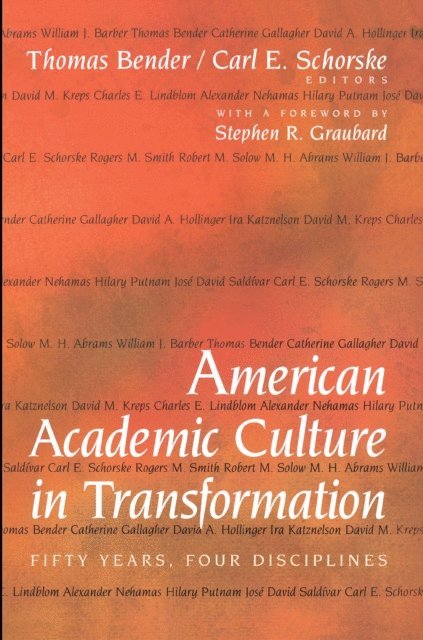
In the half century since World War II, American academic culture has changed profoundly. Until now, those changes have not been charted, nor have their implications for current discussions of the academy been appraised. In this book, however, eminent academic figures who have helped to produce many of the changes of the last fifty years explore how four disciplines in the social sciences and humanities--political science, economics, philosophy, and literary studies--have been transformed. Edited by the distinguished historians Thomas Bender and Carl Schorske, the book places academic developments in their intellectual and socio-political contexts. Scholarly innovators of different generations offer insiders' views of the course of change in their own fields, revealing the internal dynamics of disciplinary change. Historians examine the external context for these changes--including the Cold War, Vietnam, feminism, civil rights, and multiculturalism. They also compare the very different paths the disciplines have followed within the academy and the consequent alterations in their relations to the larger public.Initiated by the American Academy of Arts and Sciences, the study was first published in Daedalus in its 1997 winter issue. The contributors are M. H. Abrams, William Barber, Thomas Bender, Catherine Gallagher, Charles Lindblom, Robert Solow, David Kreps, Hilary Putnam, Jose David Saldivar, Alexander Nehamas, Rogers Smith, Carl Schorske, Ira Katznelson, and David Hollinger.
390 kr
Skickas inom 7-10 vardagar
In this book, the distinguished historian Carl Schorske--author of the Pulitzer Prize-winning Fin-de-Siecle Vienna--draws together a series of essays that reveal the changing place of history in nineteenth-and twentieth-century cultures. In most intellectual and artistic fields, Schorske argues, twentieth-century Europeans and Americans have come to do their thinking without history. Modern art, modern architecture, modern music, modern science--all have defined themselves not as emerging from or even reacting against the past, but as detached from it in a new, autonomous cultural space. This is in stark contrast to the historicism of the nineteenth century, he argues, when ideas about the past pervaded most fields of thought from philosophy and politics to art, music, and literature. However, Schorske also shows that the nineteenth century's attachment to thinking with history and the modernist way of thinking without history are more than just antitheses. They are different ways of trying to address the problems of modernity, to give shape and meaning to European civilization in the era of industrial capitalism and mass politics.Schorske begins by reflecting on his own vocation as it was shaped by the historical changes he has seen sweep across political and academic culture. Then he offers a European sampler of ways in which nineteenth-century European intellectuals used conceptions of the past to address the problems of their day: the city as community and artifact; the function of art; social dislocation. Narrowing his focus to Fin-de-Siecle Vienna in a second group of essays, he analyzes the emergence of ahistorical modernism in that city. Against the background of Austria's persistent, conflicting Baroque and Enlightenment traditions, Schorske examines three Viennese pioneers of modernism--Adolf Loos, Gustav Mahler, and Sigmund Freud--as they sought new orientation in their fields. In a concluding essay, Schorske turns his attention to thinking about history. In the context of a postmodern culture, when other disciplines that had once abandoned history are discovering new uses for it, he reflects on the nature and limits of history for the study of culture. Originally published in 1998.The Princeton Legacy Library uses the latest print-on-demand technology to again make available previously out-of-print books from the distinguished backlist of Princeton University Press. These editions preserve the original texts of these important books while presenting them in durable paperback and hardcover editions. The goal of the Princeton Legacy Library is to vastly increase access to the rich scholarly heritage found in the thousands of books published by Princeton University Press since its founding in 1905.
1 728 kr
Skickas inom 3-6 vardagar
In this book, the distinguished historian Carl Schorske--author of the Pulitzer Prize-winning Fin-de-Siecle Vienna--draws together a series of essays that reveal the changing place of history in nineteenth-and twentieth-century cultures. In most intellectual and artistic fields, Schorske argues, twentieth-century Europeans and Americans have come to do their thinking without history. Modern art, modern architecture, modern music, modern science--all have defined themselves not as emerging from or even reacting against the past, but as detached from it in a new, autonomous cultural space. This is in stark contrast to the historicism of the nineteenth century, he argues, when ideas about the past pervaded most fields of thought from philosophy and politics to art, music, and literature. However, Schorske also shows that the nineteenth century's attachment to thinking with history and the modernist way of thinking without history are more than just antitheses. They are different ways of trying to address the problems of modernity, to give shape and meaning to European civilization in the era of industrial capitalism and mass politics.Schorske begins by reflecting on his own vocation as it was shaped by the historical changes he has seen sweep across political and academic culture. Then he offers a European sampler of ways in which nineteenth-century European intellectuals used conceptions of the past to address the problems of their day: the city as community and artifact; the function of art; social dislocation. Narrowing his focus to Fin-de-Siecle Vienna in a second group of essays, he analyzes the emergence of ahistorical modernism in that city. Against the background of Austria's persistent, conflicting Baroque and Enlightenment traditions, Schorske examines three Viennese pioneers of modernism--Adolf Loos, Gustav Mahler, and Sigmund Freud--as they sought new orientation in their fields. In a concluding essay, Schorske turns his attention to thinking about history. In the context of a postmodern culture, when other disciplines that had once abandoned history are discovering new uses for it, he reflects on the nature and limits of history for the study of culture. Originally published in 1998.The Princeton Legacy Library uses the latest print-on-demand technology to again make available previously out-of-print books from the distinguished backlist of Princeton University Press. These editions preserve the original texts of these important books while presenting them in durable paperback and hardcover editions. The goal of the Princeton Legacy Library is to vastly increase access to the rich scholarly heritage found in the thousands of books published by Princeton University Press since its founding in 1905.
224 kr
Skickas inom 5-8 vardagar
Numret inleds med en självbiografisk skiss av rättshistorikern och psykoanalytikern Pierre Legendre. Därpå följer ett samtal mellan Per Magnus Johansson och Paul George Johansson med det övergripande temat erfarenhet och överlåtelse. I essän »Att skolas till poet« reflekterar Louise Glück över vad som har format hennes skrivande. Mikaela Blomqvist argumenterar för att jaget hos Glück alltid har drag av exempel. Parabeln ses som en typisk form i författarskapet och pekar ut den distans med vilken alla hennes dikter bör läsas. I sin dikt »dopet« undersöker Lyra Ekström Lindbäck den kristna namngivningen från en rad håll. I den därpå följande essän, »Nå? Fanns Gud?«, står utgångspunkten att finna i en scen ur Ingmar Bergmans Smultronstället. Över en längre tid har Per Magnus Johansson fört en dialog med Maxim Grigoriev i Paris, som följts upp av ett skriftligt utbyte vilket antagit formen av en ingående skildring av den samtida litteraturens villkor. Här publiceras ett kapitel ur Carl E. Schorskes Fin-de-siècle Vienna, som främst fokuserar på Oskar Kokoschka och Arnold Schönberg. Därpå följer ett samtal mellan Petra Gipp och Johan Linton som kretsar kring Gipps byggnader och hennes relation till sitt arkitektoniska skapande. Ett oväntat möte med den tongivande litteraturkritikern Fredrik Bööks dotter Gun Böök-Hederström återges i Paulus Tiozzos minnesteckning från en sensommardag i Förslöv i Skåne. Hannah Siegrist skriver om den delade staden Berlin, skildrad genom författarna Uwe Johnson (1934-1984)och Christa Wolf (1929-2011). Avslutningvis publiceras Ingela Strandbergs diktsvit »Hunden«.