Charles L. Schultze - Böcker
Visar alla böcker från författaren Charles L. Schultze. Handla med fri frakt och snabb leverans.
5 produkter
5 produkter
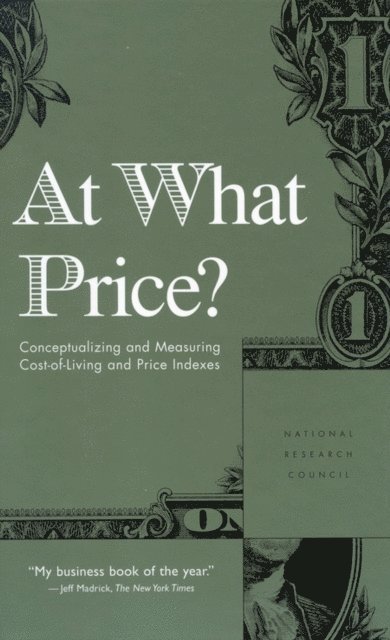
At What Price?
Conceptualizing and Measuring Cost-of-Living and Price Indexes
Inbunden, Engelska, 2002
665 kr
Tillfälligt slut
How well does the consumer price index (CPI) reflect the changes that people actually face in living costsa "from apples to computers to health care? Given how it is used, is it desirable to construct the CPI as a cost-of-living index (COLI)? With what level of accuracy is it possible to construct a single index that represents changes in the living costs of the nationa (TM)s diverse population? At What Price? examines the foundations for consumer price indexes, comparing the conceptual and practical strengths, weaknesses, and limitations of traditional a /fixed basketa and COLI approaches. The book delves into a range of complex issues, from how to deal with the changing quality of goods and services, including difficult-to-define medical services, to how to weight the expenditure patterns of different consumers. It sorts through the key attributes and underlying assumptions that define each index type in order to answer the question: Should a COLI framework be used in constructing the U.S. CPI? In answering this question, the book makes recommendations as to how the Bureau of Labor Statistics can continue to improve the accuracy and relevance of the CPI.With conclusions that could affect the amount of your next pay raise, At What Price? is important to everyone, and a must-read for policy makers, researchers, and employers.
287 kr
Skickas inom 10-15 vardagar
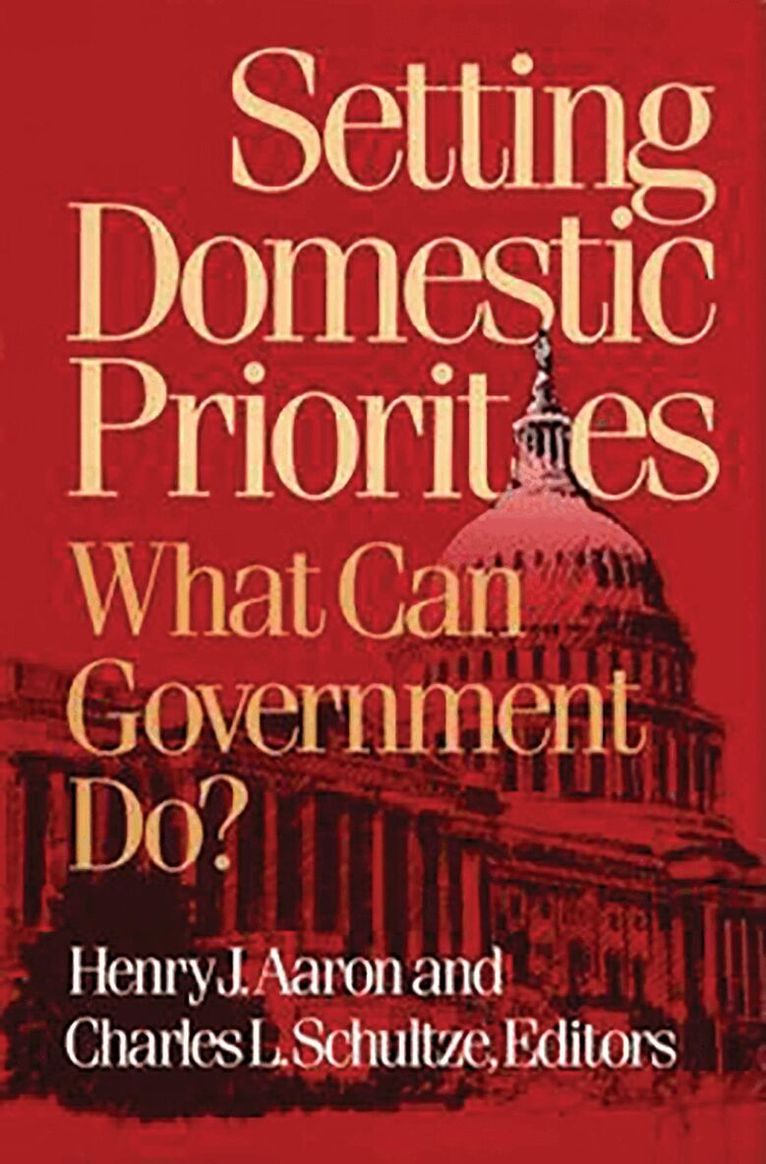
In recent years, workers earnings have hardly grown, violence and crime have plagued the inner cities, homelessness and public begging have become commonplace, and family life has greatly deteriorated. With governments facing large deficits and slowly growing revenues, and public distrust in the efficiency of government and elected officials at all-time highs, the authors ask, ""What can government do for you?""This book brings together a prominent group of experts to answer this critical question. Edited by Henry Aaron and Charles L. Schultze, two of the nation's most noted and experienced economists, the book focuses on the crucial domestic and social issues confronting America today.Seven vital areas are discussed by the following contributors: Henry Aaron on health care; Gordon L Berlin and William McAllister on homelessness; Linda R Cohen and Roger G. Noll on research and development; John J. DiIulio, Jr., on crime; Frank Levy and Richard J. Murnane on education and training; Isabel V. Sawhill on children and families; and Clifford M. Winston and Barry P. Bosworth on infrastructure. In each problem area, the authors use the results of research and analysis to identify existing or proposed governmental interventions that are likely to work, as well as some that are likely to fail and some that need to be reformed. They then present a budget proposal that not only pays for suggested changes in domestic policy, but brings the budget into virtual balance in ten years.
274 kr
Skickas inom 10-15 vardagar
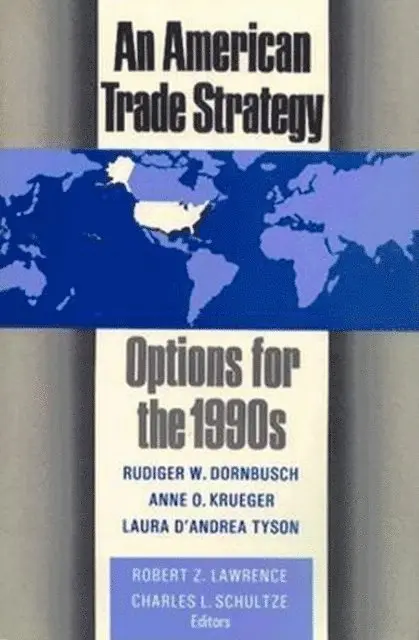
The world trading envionment changed dramatically in the 1980s. America's trade balance declined sharply, while Japan, Germany, and the newly industrialized countries of Asia built up large, continuing surpluses. Such developments led many people to question whether the traditional postwar strategy of reliance on multilateral free trade agreements is still the best course for the United States, or even a viable one.The challenges to the multilateral system are both practical and theoretical. Various nations are already forming ""free trade"" blocs-- notably the Europe 1992 and the Canadian-American trade arrangements. The United States has increasingly bypassed the GATT and bargained bilaterally in trade disputes, especially with Japan. Several prominent economists have developed new theories that support a more active role for the government to help shape technological change and improve the competitive position of the United States in world markets. Others strongly defend the current arrangements and caution that greater reliance on bilateral bargaining and trading blocs will lead to fragmented world trade and cartel-like arrangements among a few major producers. They are even more skeptical of an interventionist government successfully ""managing"" trade.An American Trade Strategy assesses options for the decade ahead, examining the case for mulitlateral free trade, aggressive bilateralism, and managed trade, as well as their shortcomings. The editors and contributors evaluate the alternative strategies and reflect on their implications for the future direction of American trade policy.
282 kr
Skickas inom 10-15 vardagar
American Living Standards contends that the central problem of the U.S. economy has been for some years now, and for the foreseeable future will continue to be, the slowdown in the growth of living standards. This decline began in the early 1970s, was masked by a resort to overseas borrowing in the early 1980s, and now threatens to get worse in the years immediately ahead as the foreign debt bills come due. The editors and contributes to this volume seek to advance our understanding of the causes and consequences of this potential slowdown in the growth of living standards. Equally important, the book examines what policy measure holds out the best hope for presenting, or at the very least, minimizing this slowdown. Various chapters explore the changes in the level and distribution of incomes that have occurred in recent years; changes in the quality and distribution of jobs among industries and regions; what economists do and do not know about recent trends in productivity growth and in the quality of education; and what events could trigger a recession.
296 kr
Skickas inom 10-15 vardagar
According to conventional wisdom, government may intervene when private markets fail to provide goods and services that society values. This view has led to the passage of much legislation and the creation of a host of agencies that have attempted, by exquisitely detailed regulations, to compel legislatively defined behavior in a broad range of activities affecting society as a wholehealth care, housing, pollution abatement, transportation, to name only a few. Far from achieving the goals of the legislators and regulators, these efforts have been largely ineffective; worse, they have spawned endless litigation and countless administrative proceedings as the individuals and firms on who the regulations fall seek to avoid, or at least soften, their impact. The result has been long delays in determining whether government programs work at all, thwarting of agreed-upon societal aims, and deep skepticism about the power of government to make any difference. Strangely enough in a nation that since its inception has valued both the means and the ends of the private market system, the United States has rarely tried to harness private interests to public goals. Whenever private markets fail to produce some desired good or service (or fail to deter undesirable activity), the remedies proposed have hardly ever involved creating a system of incentives similar to those of the market place so as to make private choice consonant with public virtue. In this revision of the Godkin Lectures presented at Harvard University in November and December 1976, Charles L. Schultze examines the sources of this paradox. He outlines a plan for government intervention that would turn away from the direct ""command and control"" regulating techniques of the past and rely instead on market-like incentives to encourage people indirectly to take publicly desired actions.