Charles Platter - Böcker
Visar alla böcker från författaren Charles Platter. Handla med fri frakt och snabb leverans.
8 produkter
8 produkter
2 401 kr
Skickas inom 10-15 vardagar
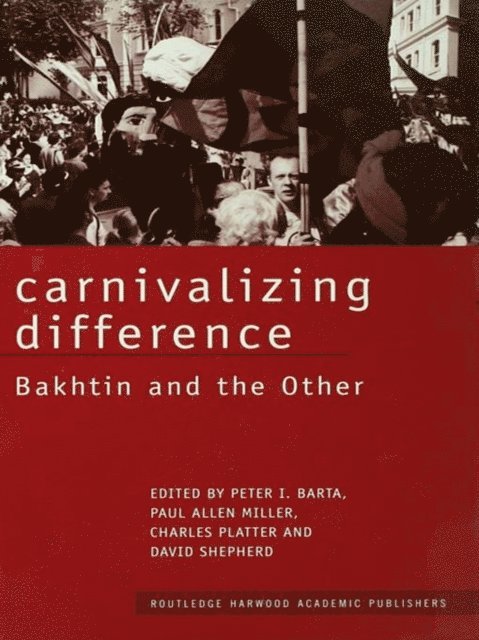
It has seemed at times that there is no neutral territory between those who see Bakhtin as the practitioner of a kind of neo-Marxist, or at least materialist, deconstruction and those who look at the same texts and see a defender of traditional, liberal humanist values and classical conceptions of order, a conservative in the true sense of the term. Arising from a conference under the same title held at Texas Tech University, Carnivalizing Difference seeks to explore the actual and possible relationships between Bakhtinian theory and cultural practice. The introduction explores the changing configurations of our understanding of Bakhtin's work in the context of recent theory and outlines how that understanding can inform, and be informed by, culture both ancient and modern. Eleven articles, spanning a wide range of periods and cultural forms, then address these issues in detail, revealing the ways in which Bakhtinian thought illuminates, sometimes obfuscates, but always challenges.
834 kr
Skickas inom 10-15 vardagar
It has seemed at times that there is no neutral territory between those who see Bakhtin as the practitioner of a kind of neo-Marxist, or at least materialist, deconstruction and those who look at the same texts and see a defender of traditional, liberal humanist values and classical conceptions of order, a conservative in the true sense of the term. Arising from a conference under the same title held at Texas Tech University, Carnivalizing Difference seeks to explore the actual and possible relationships between Bakhtinian theory and cultural practice. The introduction explores the changing configurations of our understanding of Bakhtin's work in the context of recent theory and outlines how that understanding can inform, and be informed by, culture both ancient and modern. Eleven articles, spanning a wide range of periods and cultural forms, then address these issues in detail, revealing the ways in which Bakhtinian thought illuminates, sometimes obfuscates, but always challenges.
414 kr
Skickas inom 7-10 vardagar
The Euthyphro is crucially important for understanding Plato’s presentation of the last days of Socrates, dramatized in four brief dialogues: Euthyphro, Apology, Crito, and Phaedo. In addition to narrating this evocative series of events in the life of Plato’s philosophical hero, the texts also can be read as reflecting how a wise man faces death. This particular dialogue contains Socrates’ vivid examination of the intentions of Euthyphro to prosecute his own father for murder and culminates in an attempt to understand holiness—a topic central both to Euthyphro’s justification of his actions and to the charge of impiety that Socrates faces before the Athenian court.This accessible student commentary by Charles Platter presents an introduction to the Euthyphro, the full Greek text, and a commentary designed for undergraduates and selected graduate students. As part of the series Michigan Classical Commentaries, now edited by Josiah Osgood and Alexander Sens at Georgetown University, and K. Sara Myers at the University of Virginia, the volume is sized and priced for student use.
1 068 kr
Skickas inom 7-10 vardagar
The Euthyphro is crucially important for understanding Plato’s presentation of the last days of Socrates, dramatized in four brief dialogues: Euthyphro, Apology, Crito, and Phaedo. In addition to narrating this evocative series of events in the life of Plato’s philosophical hero, the texts also can be read as reflecting how a wise man faces death. This particular dialogue contains Socrates’ vivid examination of the intentions of Euthyphro to prosecute his own father for murder and culminates in an attempt to understand holiness—a topic central both to Euthyphro’s justification of his actions and to the charge of impiety that Socrates faces before the Athenian court.This accessible student commentary by Charles Platter presents an introduction to the Euthyphro, the full Greek text, and a commentary designed for undergraduates and selected graduate students. As part of the series Michigan Classical Commentaries, now edited by Josiah Osgood and Alexander Sens at Georgetown University, and K. Sara Myers at the University of Virginia, the volume is sized and priced for student use.
623 kr
Skickas inom 7-10 vardagar
In this collection of provocative essays, historians and literary theorists assess the influence of Michel Foucault, particularly his History of Sexuality, on the study of classics. Foucault's famous work presents a bold theory of sexuality for both ancient and modern times, and yet until now it has remained under-explored and insufficiently analyzed. By bringing together the historical knowledge, philological skills, and theoretical perspectives of a wide range of scholars, this collection enables the reader to explore Foucault's model of Greek culture and see how well his interpretation accounts for the full range of evidence from Greece and Rome. Not only do the essays bring to light the assumptions, ideas, and practices that constituted the intimate lives of men and women in the ancient Mediterranean world, but they also demonstrate the importance of the History of Sexuality for fields as diverse as Greco-Roman antiquity, women's history, cultural studies, philosophy, and modern sexuality.The essays include "Situating The History of Sexuality" (the editors), "Taking the Sex Out of Sexuality: Foucault's Failed History" (Joel Black), "Incipit Philosophia" (Alain Vizier), "The Subject in Antiquity after Foucault" (Page duBois), "This Myth Which Is Not One: Construction of Discourse in Plato's Symposium" (Jeffrey S. Carnes), "Foucault's History of Sexuality: A Useful Theory for Women?" (Amy Richlin), "Catullan Consciousness, the 'Care of the Self,' and the Force of the Negative in History" (Paul Allen Miller), "Reversals of Platonic Love in Petronius' Satyricon" (Daniel B. McGlathery), and an essay from Dislocating Masculinity (Lin Foxhall).
428 kr
Skickas inom 7-10 vardagar
Examines interrelated topics in Medieval and Renaissance Latin literature: the status of women as writers, the status of women as rhetorical figures, and the status of women in society from the fifth to the early seventeenth century.This collection reclaims a vast body of long-neglected Latin texts from the Middle Ages and the Renaissance and examines how they represent the feminine and the female body. The authors explore the ideological values explicitly encoded by the feminine in these texts, other, less articulated values implied by the feminine, and the role of the classical tradition in communicating those values. The examination of women both as subjects and as rhetorical constructions in Medieval and Renaissance Latin literature sheds light on the larger dialogue about feminism occurring throughout the humanities. In addition, the inclusion of a new body of texts and the rescue of others from their present isolation will expand the reach of classical and humanist scholarship.Traditional studies of Latin literature end around the beginning of the fifth century C.E. despite the fact that Latin continued to be the dominant literary and intellectual language until at least the latter half of the sixteenth century. Thus most classicists ignore over one thousand years of the Latin literary tradition. Few non-classicists read Latin comfortably and fewer still have a detailed understanding of the history of classical Latin literature. Nevertheless, a knowledge of this history was assumed by most Neo-Latin writers as well as their contemporaries who wrote in the vernacular. This collection supplies tools to examine more completely the construction and application of gender in both Latin and vernacular texts of the Middle Ages and the Renaissance.
792 kr
Skickas inom 7-10 vardagar
The comedies of Aristophanes are known not only for their boldly imaginative plots but for the ways in which they incorporate and orchestrate a wide variety of literary genres and speech styles. Unlike the writers of tragedy, who prefer a uniformly elevated tone, Aristophanes articulates his dramatic dialogue with striking literary and linguistic juxtapositions, producing a carnivalesque medley of genres that continually forces both audience and reader to readjust their perspectives. In this energetic and original study, Charles Platter interprets the complexities of Aristophanes' work through the lens of Mikhail Bakhtin's critical writing. This book charts a new course for Aristophanic comedy, taking its lead from the work of Bakhtin. Bakhtin describes the way multiple voices-vocabularies, tones, and styles of language originating in different social classes and contexts-appear and interact within literary texts. He argues that the dynamic quality of literature arises from the dialogic relations that exist among these voices.Although Bakhtin applied his theory primarily to the epic and the novel, Platter finds in his work profound implications for Aristophanic comedy, where stylistic heterogeneity is the genre's lifeblood.
309 kr
Skickas inom 10-15 vardagar
The significance of Plato's Apology of Socrates is impossible to overestimate. An account of the famous trial of Socrates in 399 b.c., it appeals to historians, philosophers, political scientists, classicists, and literary critics. It is also essential reading for students of ancient Greek.This new commentary on Plato's canonical work is designed to accommodate the needs of students in intermediate-level Greek classes, where they typically encounter the Apology for the first time. Paul Allen Miller and Charles Platter, two highly respected classicists and veteran instructors, present the Apology in its traditional thirty-three-chapter structure. They amplify the text with running commentary and glosses of unfamiliar words at the bottom of each page; brief chapter introductions to relevant philosophical, historical, and rhetorical issues; and a separate series of thought-provoking essays, one on each chapter. The essays can serve as bases for class discussions or as starting points for paper topics or general reflection.By integrating background material into the text at regular intervals rather than front-loading it in a lengthy initial overview or burying it in back-of-the-book endnotes, the authors offer students a rich encounter with the text. Their commentary incorporates the latest research on both the trial of Socrates and Plato's version of it, and it engages major philosophical issues from a contemporary perspective. This book is not only a much-needed aid for students of Greek. It is also the basis of a complete course on the Apology.