Christopher Warley – författare
Visar alla böcker från författaren Christopher Warley. Handla med fri frakt och snabb leverans.
4 produkter
4 produkter
Del 49 - Cambridge Studies in Renaissance Literature and Culture
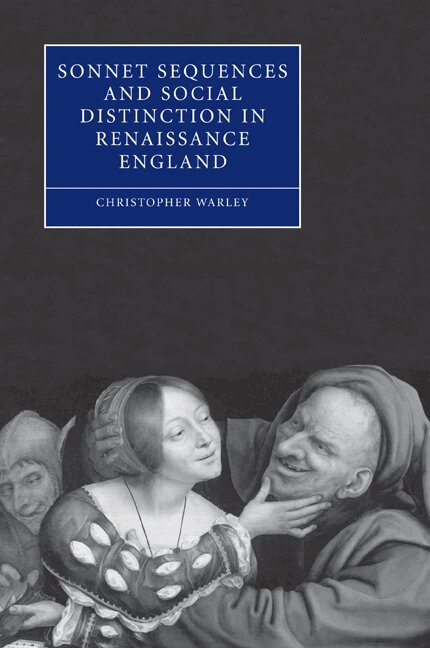
Sonnet Sequences and Social Distinction in Renaissance England
Häftad, Engelska, 2009
538 kr
Skickas inom 7-10 vardagar
Why were sonnet sequences popular in Renaissance England? In this study, Christopher Warley suggests that sonneteers created a vocabulary to describe, and to invent, new forms of social distinction before an explicit language of social class existed. The tensions inherent in the genre - between lyric and narrative, between sonnet and sequence - offered writers a means of reconceptualizing the relation between individuals and society, a way to try to come to grips with the broad social transformations taking place at the end of the sixteenth century. By stressing the struggle over social classification, the book revises studies that have tied the influence of sonnet sequences to either courtly love or to Renaissance individualism. Drawing on Marxist aesthetic theory, it offers detailed examinations of sequences by Lok, Sidney, Spenser, Shakespeare and Milton. It will be valuable to readers interested in Renaissance and genre studies, and post-Marxist theories of class.
Del 49 - Cambridge Studies in Renaissance Literature and Culture
Sonnet Sequences and Social Distinction in Renaissance England
Inbunden, Engelska, 2005
1 371 kr
Skickas inom 7-10 vardagar
Why were sonnet sequences popular in Renaissance England? In this study, Christopher Warley suggests that sonneteers created a vocabulary to describe, and to invent, new forms of social distinction before an explicit language of social class existed. The tensions inherent in the genre - between lyric and narrative, between sonnet and sequence - offered writers a means of reconceptualizing the relation between individuals and society, a way to try to come to grips with the broad social transformations taking place at the end of the sixteenth century. By stressing the struggle over social classification, the book revises studies that have tied the influence of sonnet sequences to either courtly love or to Renaissance individualism. Drawing on Marxist aesthetic theory, it offers detailed examinations of sequences by Lok, Sidney, Spenser, Shakespeare and Milton. It will be valuable to readers interested in Renaissance and genre studies, and post-Marxist theories of class.
1 371 kr
Skickas inom 7-10 vardagar
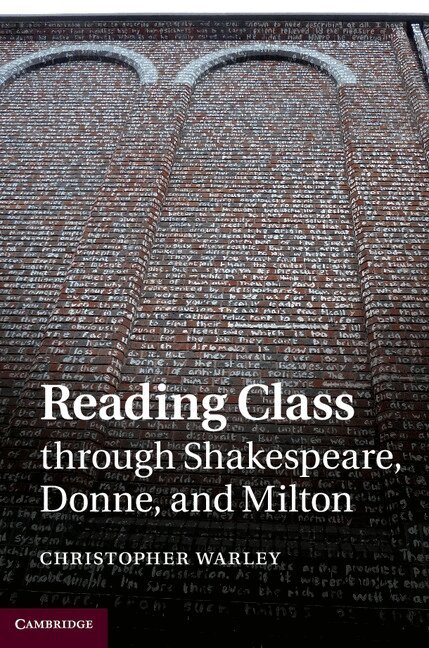
Why study Renaissance literature? Reading Class through Shakespeare, Donne, and Milton examines six canonical Renaissance works to show that reading literature also means reading class. Warley demonstrates that careful reading offers the best way to understand social relations and in doing so he offers a detailed historical argument about what class means in the seventeenth century. Drawing on a wide range of critics, from Erich Auerbach to Jacques Rancière, from Cleanth Brooks to Theodor Adorno, and from Raymond Williams to Jacques Derrida, the book implicitly defends literary criticism. It reaffirms six Renaissance poems and plays, including poems by Donne, Shakespeare's Hamlet, and Milton's Paradise Lost, as the sophisticated and moving works of art that generations of readers have loved. These accessible interpretations also offer exciting new directions for the roles of art and criticism in the contemporary, post-industrial world.
493 kr
Skickas inom 7-10 vardagar
Why study Renaissance literature? Reading Class through Shakespeare, Donne, and Milton examines six canonical Renaissance works to show that reading literature also means reading class. Warley demonstrates that careful reading offers the best way to understand social relations and in doing so he offers a detailed historical argument about what class means in the seventeenth century. Drawing on a wide range of critics, from Erich Auerbach to Jacques Rancière, from Cleanth Brooks to Theodor Adorno, and from Raymond Williams to Jacques Derrida, the book implicitly defends literary criticism. It reaffirms six Renaissance poems and plays, including poems by Donne, Shakespeare's Hamlet, and Milton's Paradise Lost, as the sophisticated and moving works of art that generations of readers have loved. These accessible interpretations also offer exciting new directions for the roles of art and criticism in the contemporary, post-industrial world.