Darrell Williamson - Böcker
Visar alla böcker från författaren Darrell Williamson. Handla med fri frakt och snabb leverans.
3 produkter
3 produkter
536 kr
Skickas inom 7-10 vardagar
This text is intended to be used by postgraduate and advanced undergraduate students in the study of discrete-time integrals. It focuses on an algebraic approach to the analysis and design of discrete-time signal processing algorithms which renders the Laplace and z-transforms redundant for this purpose. While the material on difference equations is developed slowly, from an elementary base, it is assumed that the reader has a working knowledge of complex numbers and has completed a first course in vector and matrix analysis.Various subjects and problems are discussed including: - The solution of both difference and state space equations - Provides an alternative approach to the use of Laplace and z-transformations - Linear-algebraic ideas for the analysis and design of linear signals - The Design of recursive (IIR) and nonrecursive (FIR) digital filters - The design of classical Butterworth, Chebyshev and Elliptical analog filters and the transformation of analog filters - The Discrete Fourier Transform and its implementation through the Fast Fourier Transform - Applications of least-squares analysis to the design of linear phase FIR filters, convolution (FIR and IIR) signal models, and state space signal models - Design of digital filters via discrete approximation of analog filters, digital transformation of analog filter, and digital transformation of digital filter - Finite wordlength (FWL) implementation of IIR digital filters including the basic properties of both fixed and floating point arithmetic representations, implication of arithmetic quantizations and filter structure on accuracy and speed of real-time implementation - Written with clarity and containing the latest, detailed results based on comprehensive research, this book is an important textbook for all students interested in discrete-time signals - The text supports the use of algebra-based software packages, such as MATLAB .
Del 426 - Studies in Computational Intelligence
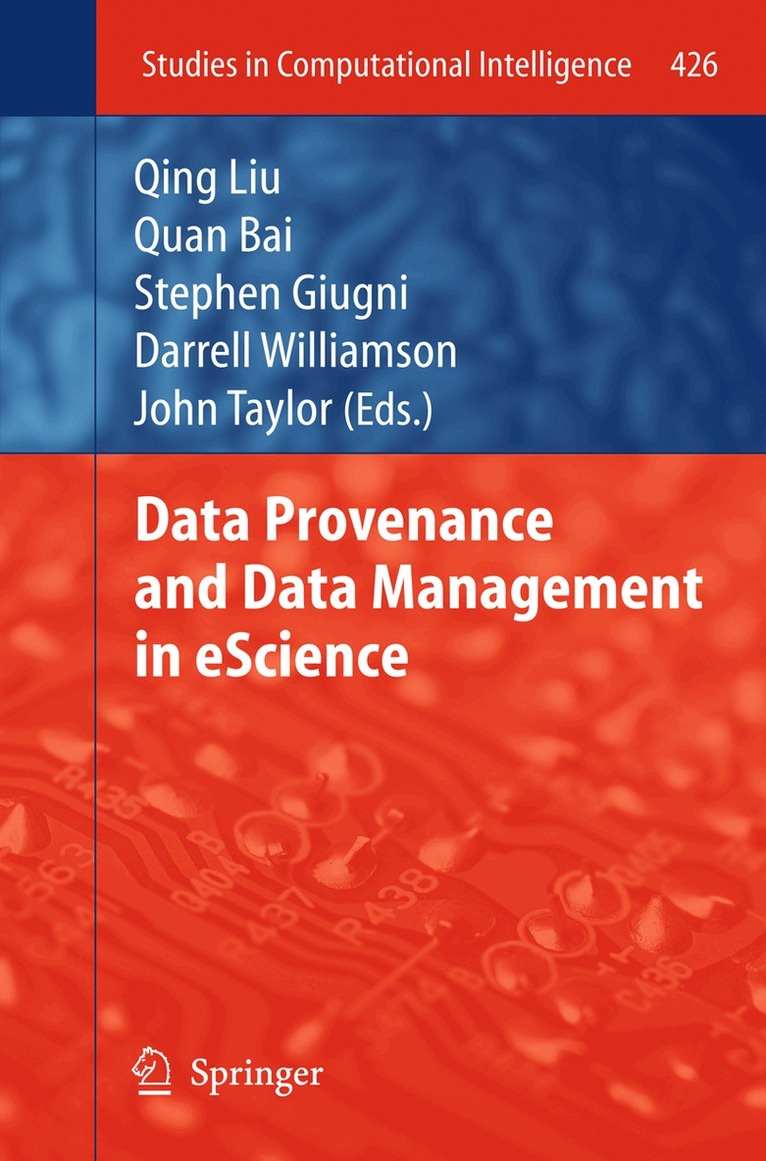
Data Provenance and Data Management in eScience
Inbunden, Engelska, 2012
1 064 kr
Skickas inom 10-15 vardagar
eScience allows scientific research to be carried out in highly distributed environments. The complex nature of the interactions in an eScience infrastructure, which often involves a range of instruments, data, models, application, people and computational facilities, suggests there is a need for data provenance and data management (DPDM). The W3C Provenance Working Group defines the provenance of a resource as a “record that describes entities and processes involved in producing and delivering or otherwise influencing that resource”. It has been widely recognised that provenance is a critical issue to enable sharing, trust, authentication and reproducibility of eScience process.Data Provenance and Data Management in eScience identifies the gaps between DPDM foundations and their practice within eScience domains including clinical trials, bioinformatics and radio astronomy. The book covers important aspects of fundamental research in DPDM including provenance representation and querying. It also explores topics that go beyond the fundamentals including applications. This book is a unique reference for DPDM with broad appeal to anyone interested in the practical issues of DPDM in eScience domains.
Del 426 - Studies in Computational Intelligence
Data Provenance and Data Management in eScience
Häftad, Engelska, 2014
1 064 kr
Skickas inom 10-15 vardagar
eScience allows scientific research to be carried out in highly distributed environments. The complex nature of the interactions in an eScience infrastructure, which often involves a range of instruments, data, models, application, people and computational facilities, suggests there is a need for data provenance and data management (DPDM). The W3C Provenance Working Group defines the provenance of a resource as a “record that describes entities and processes involved in producing and delivering or otherwise influencing that resource”. It has been widely recognised that provenance is a critical issue to enable sharing, trust, authentication and reproducibility of eScience process.Data Provenance and Data Management in eScience identifies the gaps between DPDM foundations and their practice within eScience domains including clinical trials, bioinformatics and radio astronomy. The book covers important aspects of fundamental research in DPDM including provenance representation and querying. It also explores topics that go beyond the fundamentals including applications. This book is a unique reference for DPDM with broad appeal to anyone interested in the practical issues of DPDM in eScience domains.