David Laud – författare
Visar alla böcker från författaren David Laud. Handla med fri frakt och snabb leverans.
3 produkter
3 produkter
1 847 kr
Skickas
How can knowledge management (KM) help your firm exceed your clients' expectations and differentiate you from your closest competitors? This guide written by senior figures in legal KM in the US and UK will show how you can achieve this and more, drawing upon case studies from some of the most innovative firms using KM to their advantage. KM is helping law firms adapt to an evolving legal landscape. Increasingly, firms like yours are seeing knowledge management and its potential as an "organisational capability" for leveraging the firm's experience, data and intellectual capital as a strategic resource. Many firms have a KM function in place. But has this function evolved to become a key business unit recognised by the rest of the firm, focused on achieving business outcomes measurable goals important to a firm's overall success? Perhaps you're finding it challenging persuading your fee earners to spare billable time to embed knowledge into your firm's systems, to the overall benefit of your firm. Or perhaps you're having trouble proving ROI on certain initiatives. Whatever the KM challenge you're facing, Law Firm KM: Driving Practice Innovation and Redefining Service Delivery will help you solve key challenges and ensure you can take advantage of opportunities that arise after using KM as a strategic tool. Written by some of the best minds in legal and business consulting, this guide is split into two sections: *Part One examines how KM professionals can support law firm and in-house needs, while considering some of the challenges they face. *Part Two is made up of practical guidance in the form of case studies from UK and US law firms who are trailblazing in legal KM and who have integrated vital KM principles into their overall firm strategy. In today's evolving competitive market, firms must be looking to not only please their clients, but to find ways that go beyond the level of service they expect. More and more firms are turning to KM to help them do this. Are you? Why buy this guide? *Read case studies from firms who are actively integrating KM principles into their firm strategy with success, so you can understand how this is done in practice *Gain insight on how to use KM to inform new service models and pricing structure, innovation and efficiency to please your clients and exceed their expectations of your firm *Discover how to measure the success of KM strategy to prove ROI and make it easy for your firm to invest in future KM initiatives *Learn how to embed KM within your firm's culture to ensure stress-free adoption and adaptation. Hear from firms trailblazing in the KM space including: *Littler Mendelson *BLM *Donelson, Bearman, Caldwell & Berkowitz *Samuel Phillips Law Firm You'll love this guide if you're a... *Knowledge management officer *Information officer *Professional Support Lawyer (PSL) *Managing partner *C-suite professional, looking for new strategic inspiration *Head of Department/Practice Group *Partner
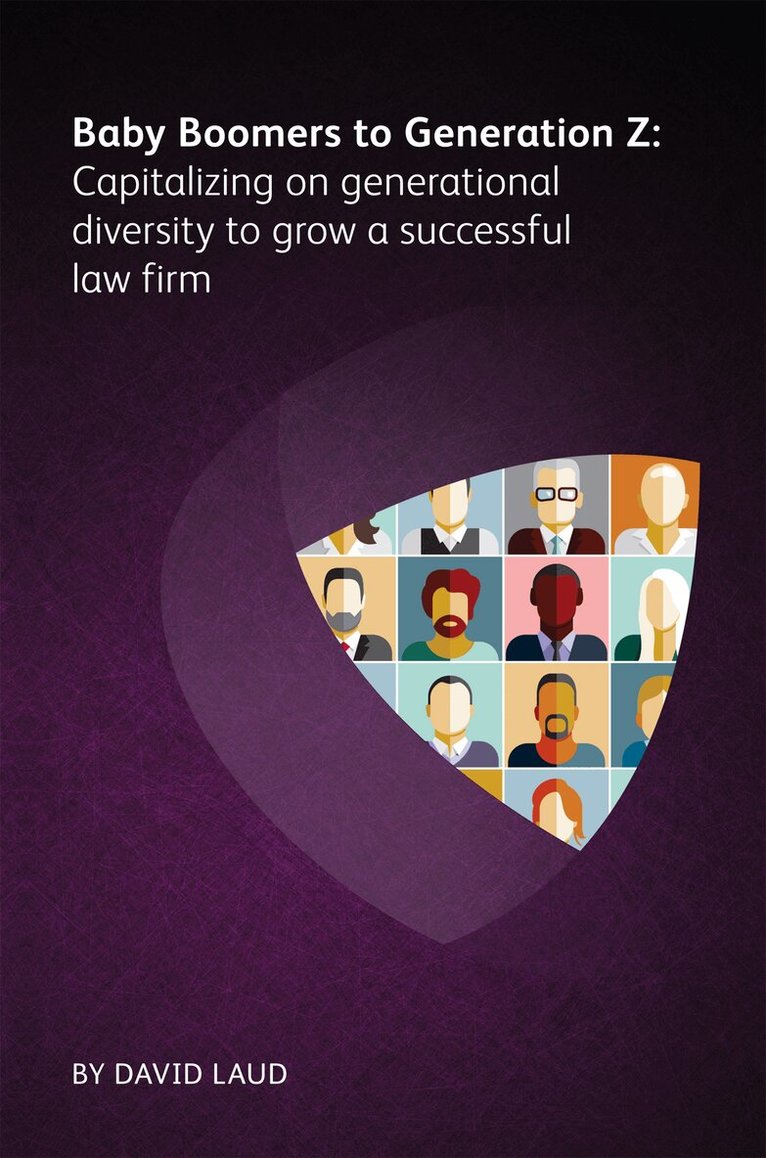
Baby Boomers to Generation Z: Capitalizing on generational diversity to grow a successful law firm
Häftad, Engelska, 2019
2 279 kr
Skickas inom 5-8 vardagar
In this current period of the 21st century, our workplace is more diverse than at any other point in time. This diversity is due to a broadening ethnic mix, gender representation and spread of generations. Greater mobility, socioeconomic and legislative developments account in the most part for the first two factors, but what of the third? What has caused this widening of the generational spectrum in the workplace? Historically in law firms, the older generation, in particular partners, would move toward retirement and hand over the reins to the next oldest. In today's world of work, with improved healthcare, increased life expectancy, greater knowledge of fitness, and in part historic anxiety over the effects of the global recession, there's a reluctance to rush to retirement. Specifically, here we're talking about the Baby Boomer generation, who are aged between 55 and 73 and, as the name suggests, are not in short supply. Typically schooled in a traditional hierarchical command management style they are the generation now most often faced with tackling the integration of disruptive and aspirational Gen X'ers and more technologically adept and collaborative (but considered less driven) Gen Y or Millennials. They're also now seeing the newest arrivals, Gen Z, who bring an even greater affinity to everything digital but are not quite so comfortable with matters of an interpersonal nature. It's quite a challenge and the reason why this publication delves into the differences between the generations, their influences, preferences, strengths, and weaknesses, to better understand and thereby manage the staff who fall into the respective age groupings. The consequence of older generations remaining in a post is a fascinating and yet challenging prospect. Law firms can be presented with the task of managing at least four and sometimes five different age groups. It becomes five if we add that fit and able and working who are in their mid-70s and beyond, who belong to the "silent generation". Multiple generations in one practice with the oldest holding on to the power base and ownership can create pressure points for younger, ambitious professionals seeking a stake rather than simply a "steady job". It's likely that in many law firms those appealing for a place at the partners' table will now be coming from Generation Y or Millennials aged in their early to late 30s. Millennials are considered more focused on experiences outside of work than within, but this does not hide or diminish their need for recognition and reward. Gen X'ers will mostly be in their 40s and early 50s and the majority of this group will already have established their partnership credentials. In other words, if it was going to happen for them, it's likely to have been handled one way or another. The X'ers are something of a filling in the career sandwich, with slices of Millennial below and Boomer above. There is a smaller population of Generation X and they will need to find appropriate skills and knowledge to work with their younger and older generational colleagues for mutual gain. By 2020, 50 percent of the US workforce will be made up of Millennial or the "Y" Generation; by 2030 it will be 75 percent. These Millennial employees, born between 1980 and 1996, have ridden several seismic waves of change - from political and environmental to communication and technological innovation - and this pace of change shows little sign of abating. Having experienced an ever more connected, digitally-driven world, Millennials are now moving through firms to take greater responsibility, head teams, run departments or entire businesses, and in certain cases creating their own version of a law firm. This book explores the various generations within law firms and the challenges, threats, and opportunities they face as staff deal with colleagues from younger or older groups be they Baby Boomer or Generations X, Y (Millennial) or the next wave of "Z's" as they enter the world of work.
2 279 kr
Skickas inom 5-8 vardagar
The legal profession stands on the precipice of transformative change. The Law Firm of 2030: How the future law firm might look delves into the dynamic and rapidly evolving landscape of law, offering a visionary glimpse into what the future holds for legal practitioners. This insightful book brings together the perspectives of leading thought leaders, providing a comprehensive guide to staying ahead in an era of exponential growth and innovation.From the integration of artificial intelligence and cutting-edge technology to the evolution of people management and workplace culture, The Law Firm of 2030 covers the critical areas that will shape the future of legal practice. Readers will gain insights into the latest advancements in cybersecurity and data management, understand how ESG and DEI might transform in the future, and explore the ethical considerations that will guide the profession in the coming decade.This book also addresses the emergence of new legal fields and the impact of global geopolitical shifts, equipping lawyers with the knowledge they need to remain competitive and at the forefront of their industry. Whether it's adapting to new ways of working or navigating the complexities of a changing world, The Law Firm of 2030 is an essential resource for legal professionals committed to excellence and innovation.