David Speiser - Böcker
Visar alla böcker från författaren David Speiser. Handla med fri frakt och snabb leverans.
15 produkter
15 produkter
2 110 kr
Skickas inom 10-15 vardagar
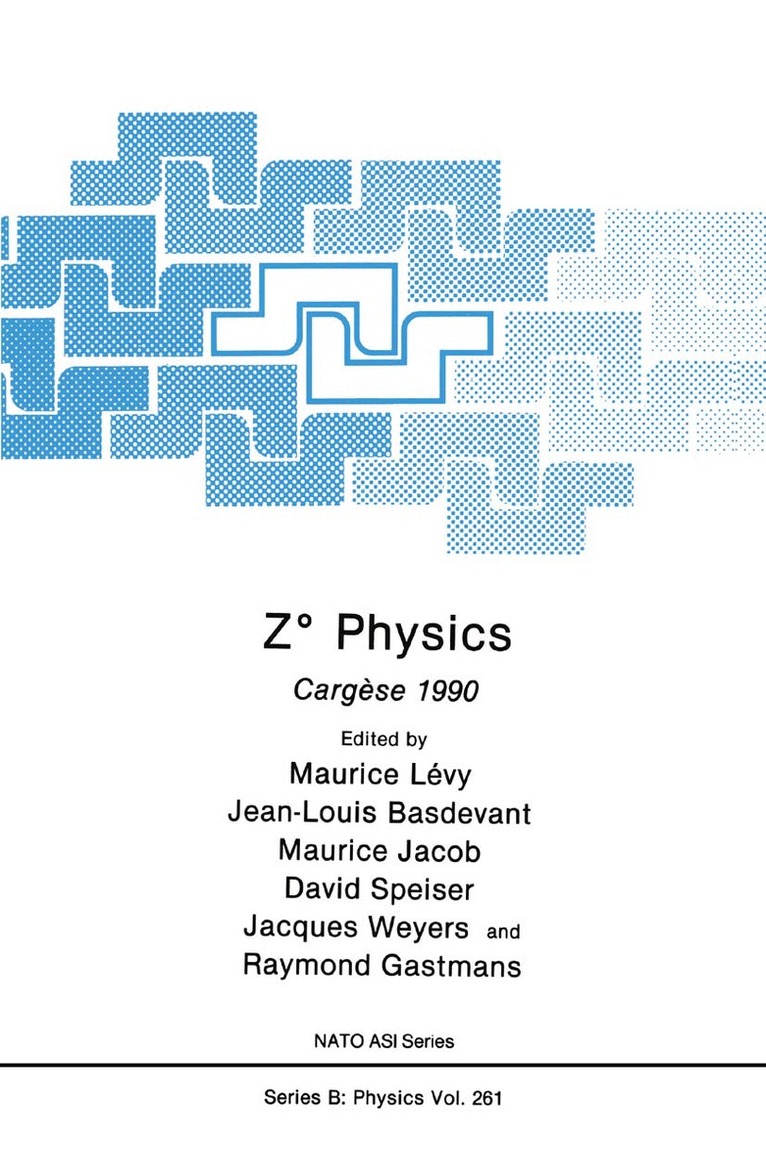
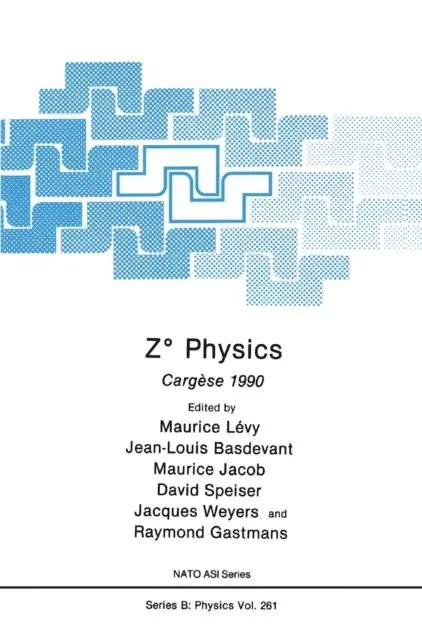
The 1990 Cargese Summer Institute on ZO-Physics was organized by the Univer- site Pierre et Marie Curie, Paris (M. Levy and J.-L. Basdevant), CERN (M. Jacob), the Universite Catholique de Louvain (D. Speiser and J. Weyers), and the Katholieke Universiteit te Leuven (R. Gastmans), which, since 1975, have joined their efforts and worked in common. It was the ninth Summer Institute on High Energy Physics orga- nized jointly at Cargese by these three universities. Because of the start-up of LEP in the summer of 1989, we broke with our tradition of having our Summer Institutes in the odd years. Indeed, it seemed to us that the many new data from LEP had to be presented in detail as soon as possible in order to prepare the young researchers in particle physics better for the experimental results with which they will be confronted in the coming years. The main theme of the school was therefore ZO-physics, with particular emphasis on the way the experiments at LEP are analyzed. We had one lecturer from each LEP experiment: they agreed among each other to present different topics in e+e- physics.Nevertheless, they made sure that all the major topics were discussed and that the results could be critically compared.
538 kr
Skickas inom 10-15 vardagar
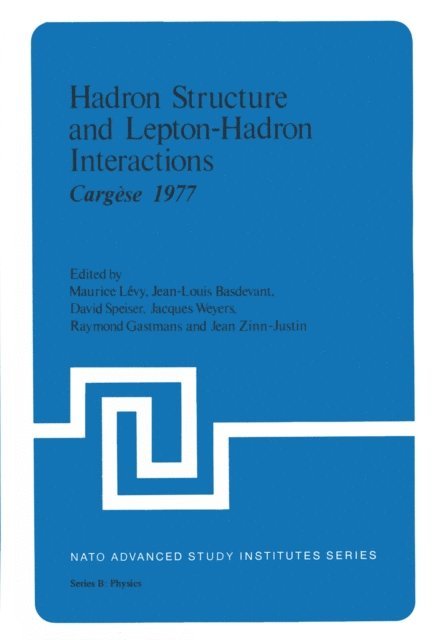
The 1981 Cargese Summer Institute on Fundamental Interactions was organized by the Universite Pierre et Marie Curie, Paris (M. LEVY and J-L. BASDEVANT), CERN (M. JACOB), the Universite Catholique de Louvain (D. SPEISER and J. WEYERS), and the Kotholieke Universiteit te Leuven (R. GASTMANS), which, since 1975 have joined their efforts and worked in common. It was the 24th Summer Institute held at Cargese and the 8th one organized by the two institutes of theoretical physics at Leuven and Louvain-Ia-Neuve. The 1985 school was centered around two main themes : the standard model of the fundamental interactions (and beyond) and astrophysics. The remarkable advances in the theoretical understanding and experimental confirmation of the standard model were reviewed in several lectures where the reader will find a thorough analysis of recent experiments as well as a detailed comparaison of the standard model with experiment. On a more theoretical side, supersymmetry, supergravity and strings were discussed as well. The second theme concerns astrophysics where the school was quite successful in bridging the gap between this fascinating subject and more conventional particle physics. We owe many thanks to all those who have made this Summer Institute possible ! Thanks are due to the Scientific Committee of NATO and its President and to the "Region Corse" for a generous grant. .. We wish to thank Miss M-F. HANSELER, Mrs ALRIFRAI, Mr and Mrs ARIANO, and Mr BERNIA and all others from Paris, Leuven, Louvain-la-Neuve and especially Cargese for their collaboration.
697 kr
Skickas inom 10-15 vardagar
Del 4 - Nato ASI Subseries B:
Particle Interactions at Very High Energies
Part B
Häftad, Engelska, 2014
538 kr
Skickas inom 10-15 vardagar
538 kr
Skickas inom 10-15 vardagar
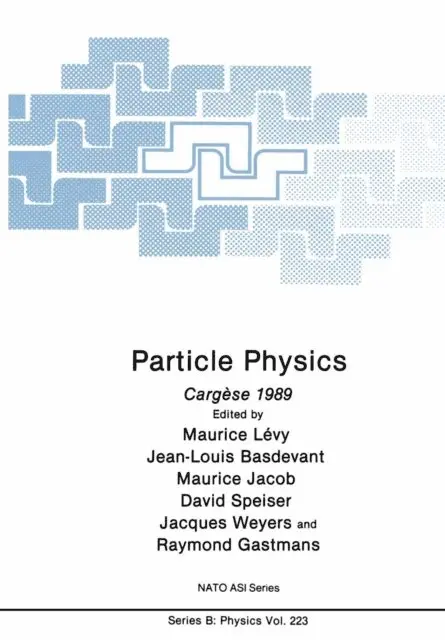
The 1989 Cargese Summer Institute on Particle Physics was organized by the Universite Pierre et Marie Curie, Paris (M. Levy and J.-L. Basdevant), CERN (M. Jacob), the Universite Catholique de Louvain (D. Speiser and J. Weyers) and the Katholieke Universiteit te Leuven (R. Gastmans), which, since 1975, have joined their efforts and worked in common. It was the twenty-sixth Summer Institute held at Cargese and the tenth organized by the two Institutes of Theoretical Physics at Leuven and Louvain-la-Neuve. The 1989 school centered on the following topics - new experimental results - strings, superstrings and conformal field theory - lattice approximations. Of the many new experimental results, we would like to mention especially those from SLAC presented by Professor G. Feldman. On the other hand, we had the tantalizing knowledge that LEP would begin to operate only right after the end of the school! For this we received ample replacement: Professor J. Steinberger summed up all major CP violation experiments done to date and commented upon them. The reader will find also various other most interesting contributions, for instance on high energy ion beams.Once more theoreticians and experimentalists (this time more than usual) came together to discuss high energy particle physics.
538 kr
Skickas inom 10-15 vardagar
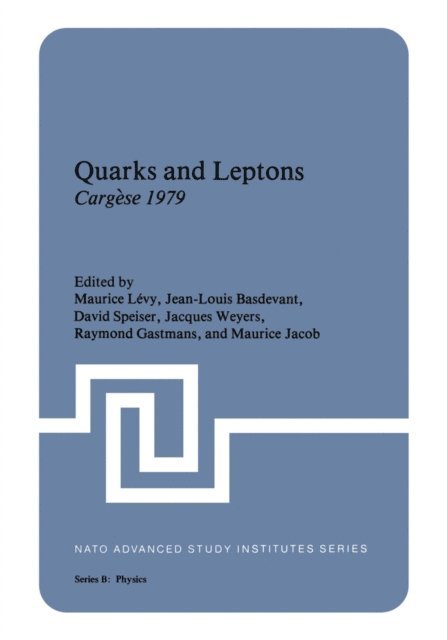
The 1979 Cargese Summer Institute on Quarks and Leptons was organized by the Universite Pierre et Marie Curie, Paris (M. LEVY and J.-L. BASDEVANT), CERN (M. JACOB), the Universite Catholi~ue de Louvain (D. SPEISER and J. WEYERS), and the Katholieke Universiteit te Leuven (R. GASTMANS), who, like in 1975 and 1977, had joined their efforts and worked in common. It was the 20th Summer Institute held at Cargese and the 5th one organized by the two institutes of theoretical physics at Leuven and Louvain-la- Neuve. This time, the school was dominated by the impressive advances which were made in the field of perturbative ~uantum chromodyna- mics and its applications to high energy phenomena involving strongly interacting particles. The unification of weak and electromagnetic interactions being well established, a new picture in particle physics emerges wherein a possible unification of weak, electromagnetic, and strong forces is put forward. Its conse~uences were also discussed in detail.Finally, to complete the picture of the present status of high energy physics, experi- mentalists from the major laboratories around the world reported on the latest developments in electron-positron scattering, neutrino induced reactions, and hadron collisions. We owe many thanks to all those who have made this Summer Institute possible! Thanks are due to the Scientific Committee of NATO and its President for a generous grant and especially to the head of the Scientific Affairs Division, Dr. M. DI LULLO for his constant help and encouragements.
729 kr
Skickas inom 5-8 vardagar
538 kr
Skickas inom 10-15 vardagar
The Summer Institute on High Energy Physics was the second of this kind organized at Louvain. Four years ago we had already decided to organize a Summer Institute. The first one was con- ceived in 1970, at Kiev, by D. Speiser, J. Weyers, and G. Zweig, and thanks to a NATO grant took place from August 20th to Septem- ber 15th 1971, at Louvain in the Groot Begijnhof. All lectures were directed toward one subject: duality. The lecturers were R. Brout (ULB - Bruxelles), D. Fairlie (University of Durham), F. Gilman (SLAC - Stanford), D. Horn (University of Tel Aviv), J. Mandula (Caltech - Pasadena), C. Michael (CERN - Geneva), J. Rosner (University of Minnesota), C. Schmidt (CERN - Geneva), J. Veneziano (The Weizmann Institute), J. Weyers (UCL - Louvain and CERN - Geneva), and G. Zweig (Caltech - Pasadena). The direc- tion was in the hands of F. Cerulus (KUL - Louvain), R. Rodenberg (Technische Hochschule, Aachen), D. Speiser (UCL - Louvain), and J. Weyers (CERN - Geneva). Unfortunately it was not possible to publish the lecture notes for that Institute. The second Summer Institute on Elementary Particle Physics took place from August 12th to August 25th 1973, again in Louvain.It was initiated in Chicago, in 1972, by F. Halzen (University of Wisconsin) and J. Weyers (UCL - Louvain and CERN - Geneva). Lecturers included R. Carlitz (University of Chicago), F. Gilman (SLAC - Stanford), F. Halzen (University of Wisconsin), D.
538 kr
Skickas inom 10-15 vardagar
The 1983 Cargese Summer Institute on Particles and Fields was organized by the Universite Pierre et Marie Curie, Paris (M. LEVY and J.-L. BASDEVANT), C.E.R.N. (M. JACOB), the Universite Catholique de Louvain (D. SPEISER and J. WEYERS), and the Katholieke Universiteit Leuven (R. GASTMANS). After 1975, 1977, 1979, and 1981, it was the fifth time they joined their efforts for organizing this Summer Insti- tute. This school was characterized by simultaneous progress in the theory of elementary particles and by impressive experimental advances. On the theoretical front, one witnessed the new developments in lattice gauge theories, which explore the world of strongly interacting par- ticles in a non-perturbative way, and progress in a better understan- ding of the unity of all interactions based on supersymmetry. The experimentalists were ~roud to announce the discovery of the interme- diate vector bosons; W- and ZO, at C.E.R.N., while physicists working with e+e- colliding beams continued to probe more deeply the validity of the theoretical models of strong, weak and electromagnetic inter- actions. We owe many thanks to all those who have made this Summer Insti- tute possible!Thanks are due to the Scientific Committee of NATO and its Presi- dent for a generous grant and especially to the head of the Advanced Study Institute Program and his collaborators for their constant help and encouragement. We also thank the National Science Foundation (USA) for their financial assistance.
2 110 kr
Skickas inom 10-15 vardagar
The 1990 Cargese Summer Institute on ZO-Physics was organized by the Univer- site Pierre et Marie Curie, Paris (M. Levy and J.-L. Basdevant), CERN (M. Jacob), the Universite Catholique de Louvain (D. Speiser and J. Weyers), and the Katholieke Universiteit te Leuven (R. Gastmans), which, since 1975, have joined their efforts and worked in common. It was the ninth Summer Institute on High Energy Physics orga- nized jointly at Cargese by these three universities. Because of the start-up of LEP in the summer of 1989, we broke with our tradition of having our Summer Institutes in the odd years. Indeed, it seemed to us that the many new data from LEP had to be presented in detail as soon as possible in order to prepare the young researchers in particle physics better for the experimental results with which they will be confronted in the coming years. The main theme of the school was therefore ZO-physics, with particular emphasis on the way the experiments at LEP are analyzed. We had one lecturer from each LEP experiment: they agreed among each other to present different topics in e+e- physics.Nevertheless, they made sure that all the major topics were discussed and that the results could be critically compared.
1 481 kr
Skickas inom 7-10 vardagar
Commentationes physicae ad theoriam caloris, electricitatis et magnetismi pertinentes
Inbunden, Engelska, 2004
2 373 kr
Skickas inom 10-15 vardagar
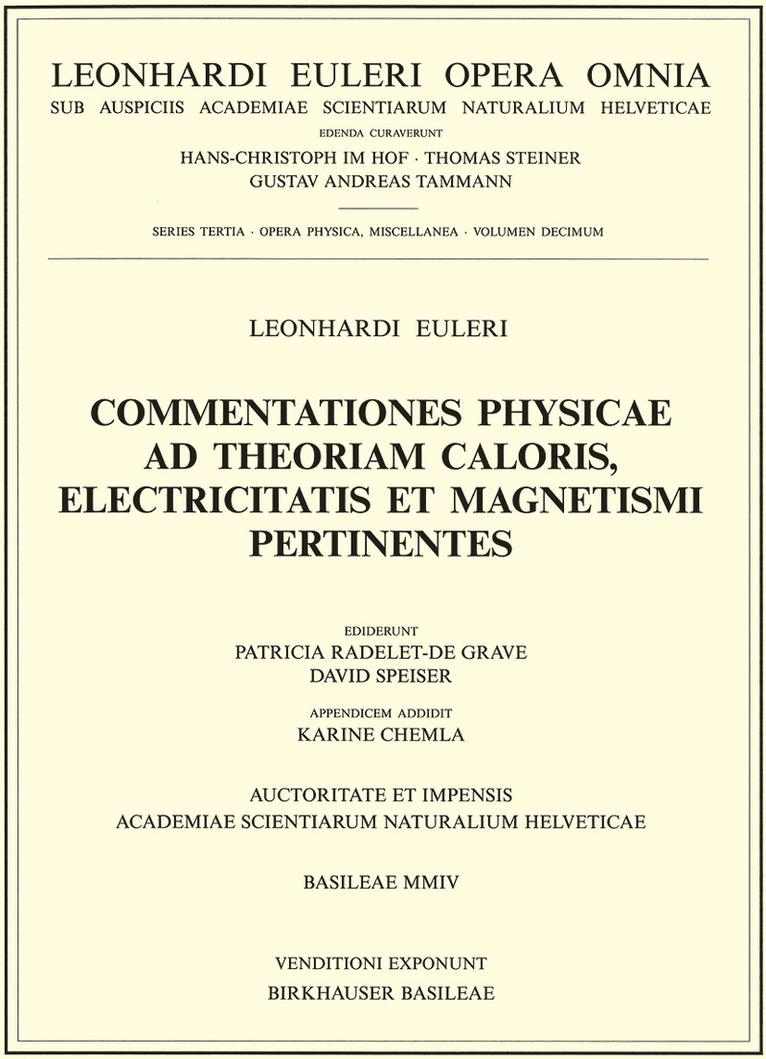
This volume contains eleven articles, seven of them written by Leonhard Euler himself (4 contributions in Latin, 3 in French) and four written by his son Johann Albrecht Euler (3 contributions inFrench,1 in Latin). Four of the papers are prized essays submitted to the Académie Royale des Sciences in Paris and to the Imperial Academy in St. Petersburg. There are three articles on heat, two on matters of electricity and six articles on magnetism. The extensive introduction, written in English, is divided into the parts thermodynamics, electricity, magnetism, and several comments and appendices on Euler's "Anleitung zur Naturlehre", on Euler's summery of Aepinius' paper on electricity, and Euler's work in spherical trigonometry.
1 584 kr
Skickas inom 7-10 vardagar
Correction to the text about C.S. Roero printed on the inside front cover page:Clara Silvia Roero began her research with Tullio Viola, full Professor of Analysis at Turin University. From 1987 to 2000 she was associate professor of Matematiche Complementari and of History of Mathematics at the University of Cagliari (1987-1990) and at the University of Turin (1990-2000). From 2000 she is full professor of History of Mathematics at Turin University, Faculty of Mathematical and Physical Sciences. She is currently President of the Italian Society of History of Mathematics (Società Italiana di Storia delle Matematiche). She is author of several articles and books on the history of mathematics from antiquity to 20th century, in particular on the history of the Leibnizian Calculus; and she is a member of the editorial board of the Bollettino di Storia delle Scienze Matematiche.
Die Werke von Daniel Bernoulli
Band 1: Medizin und Physiologie, Mathematische Jugendschriften, Positionsastronomie
Inbunden, Latin, 1996
1 682 kr
Skickas inom 7-10 vardagar
The works from Daniel Bernoulli's youth contained in this first volume of his Collected Works bear witness above all of his versatility; they deal with subjects as different as physiology, formal logic, mathematical analysis, hydrodynamics and positional astronomy. Daniel Bernoulli's contacts with Italian scientists gave rise to several controversies. The present volume documents both sides in each of these debates, which culminated with the publication of Bernoulli's first book Exercitationes mathe- maticae in 1724. The discussions with the renowned mathematician Jacopo Riccati on second-order differential equations and on the Newtonian theory of the out-flow of fluids from vessels deserve particular interest. A third group of texts goes back to the time Bernoulli spent at the newly- founded Academy of Sciences in St. Petersburg, where he had been appointed in 1725. There he worked out two more contributions to physiological research - on muscle movement and on the blind spot in the human eye - as well as his only paper in positional astronomy. This last work - suggested by a prize question of the Paris Académie des Sciences - became the occasion for a vehement conflict; the present volume documents these "Zänkereien" (squabbles) and also reproduces three competing treatises. To complete the documentation of Daniel Bernoulli's work on physiology, the volume also includes his academic ceremonial speech De Vita of 1737, where he sketches for the first time the circulation of the work done by the human heart, and its elaboration by Bernoulli's student Daniel Passavant.
1 584 kr
Skickas inom 7-10 vardagar
This volume contains the work of the great Swiss mathematician on differential geometry, a field marked by some of his greatest achievements. In the 1680s, Leibniz had given the first public hints of his "new method", differential and integral calculus. Together with Huygens, Tschirnhaus and L'Hopital, Jacob Bernoulli and his younger brother Johann belonged to the small group of scientists who developed these cryptic ideas and made use of them in their research. In the intense, sometimes competitive intellectual exchange that followed in their publications and correspondence, Leibnizian infinitesimal calculus evolved into the analytical method that was to dominate mathematical thinking for two centuries. Between 1690 and 1700, Jacob Bernoulli published 12 treatises in the scientific journal "Acta Eruditorum" on the use of infinitesimal methods to answer geometrical questions. Preparatory notes for most of these papers and on many other themes are found in Bernoulli's scientific diary "Meditationes", from which 29 texts are published here for the first time.Among the curves considered are the isochrones (lines of constant descent), the parabolic spiral, the loxodrome, the cycloid, the tractrix and the logarithmic spiral (Bernoulli's "spira mirabilis", which also adorns his tombstone). The description of these curves by differential equations and by geometrical constructions, their rectification and quadrature, and the determination of the evolutes and caustics offered Bernoulli and his colleagues a range of challenging problems, many of them relevant for mechanical or optical applications. At the same time, questions of a more general nature that were to shape the development of calculus in the 18th century gradually came into focus: the local geometry of general planar curves, their curvature and singularities; elliptic integrals and their transformation properties; and the search for algorithms for integrating algebraic functions. Through mutual suggestions, challenges and critiques, the small group of the first champions of infinitesimal calculus developed the techniques that shape differential geometry to this day.The volume concludes with Bernoulli's previously unpublished work on the classification of planar cubic curves as presented by his students Jacob Hermann and Nicolaus I Bernoulli. Though it was surpassed by Newton's contemporary research, the background of Bernoulli's contribution is of no small interest.