Diana C. Mutz - Böcker
Visar alla böcker från författaren Diana C. Mutz. Handla med fri frakt och snabb leverans.
9 produkter
9 produkter
417 kr
Skickas inom 7-10 vardagar
Political Persuasion and Attitude Change defines and introduces a new field of research, one that investigates the alteration of people's attitudes: when people can be moved, and when they cannot. Each chapter synopsizes a major area of political persuasion and provides an update on the latest findings as well as overviews of past research in each area. Whole sections of the book center on the three major agents involved in the political persuasion process: the mass media, political elites, and individual citizens themselves.Political Persuasion and Attitude Change boldly contradicts the received wisdom on the extent of mass media's influence on political attitudes and argues that the media's effects are indeed massive, rather than limited. It explores the impact of political elites on the persuasion process, and focuses on individual control over the persuasion process.This volume is unique in that chapters address theoretical as well as methodological issues, simultaneously combining reviews of literature with the latest research findings. It will appeal to scholars and students interested in the study of political persuasion in contemporary politics across the disciplines of political science, psychology, sociology, and communications. Part I. Mass Media and Political Persuasion. Contributors are Steven Ansolabehere and Shanto Iyengar; Joanne M. Miller and Jon A. Krosnick; and John Zaller.Part II. Persuasion by Political Elites. Contributors are James H. Kuklinski and Norman L. Hurley; Kathleen M. McGraw and Clark Hubbard; Lee Sigelman and Alan Rosenblatt.Part III. Individual Control of the Political Persuasion Process. Contributors are Steven H. Chaffee and Rajiv Rimal; Dennis Chong; Gregory Andrade Diamond and Michael D. Cobb; Jeffrey Mondak, Diana C. Mutz, and Robert Huckfeldt.Diana C. Mutz is Associate Professor of Political Science and Mass Communications, University of Wisconsin, Madison. Paul M. Sniderman is Professor of Political Science, Stanford University. Richard A. Brody is Professor Emeritus of Political Science and Communications, Stanford University.
271 kr
Skickas inom 7-10 vardagar
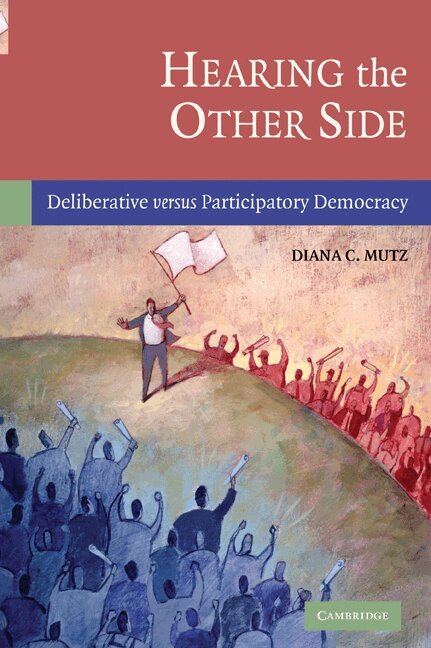
'Religion and politics', as the old saying goes, 'should never be discussed in mixed company.'And yet fostering discussions that cross lines of political difference has long been a central concern of political theorists. More recently, it has also become a cause célèbre for pundits and civic-minded citizens wanting to improve the health of American democracy. But only recently have scholars begun empirical investigations of where and with what consequences people interact with those whose political views differ from their own. Hearing the Other Side examines this theme in the context of the contemporary United States. It is unique in its effort to link political theory with empirical research. Drawing on her empirical work, Mutz suggests that it is doubtful that an extremely activist political culture can also be a heavily deliberative one.
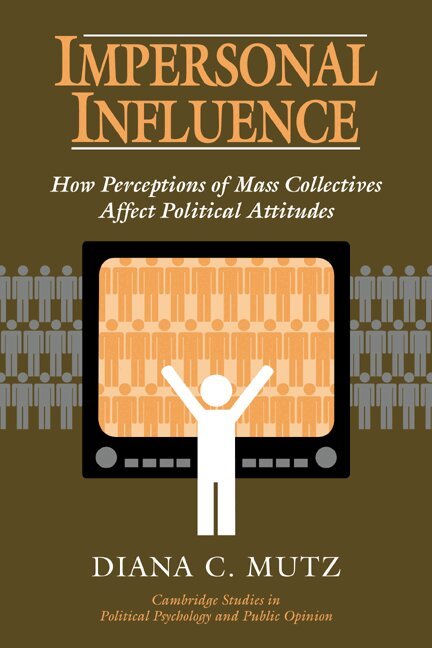
Impersonal Influence
How Perceptions of Mass Collectives Affect Political Attitudes
Häftad, Engelska, 1998
397 kr
Skickas inom 7-10 vardagar
People's perceptions of the attitudes and experiences of mass collectives are an increasingly important force in contemporary political life. In Impersonal Influence, Mutz goes beyond simply providing examples of how impersonal influence matters in the political process to provide a micro-level understanding of why information about distant and impersonal others often influence people's political attitudes and behaviors. Impersonal Influence is worthy of attention both from the standpoint of its impact on contemporary politics, and because of its potential to expand the boundaries of our understanding of social influence processes, and media's relation to them. The book's conclusions do not exonerate media from the effects of inaccurate portrayals of collective experience or opinion, but they suggest that the ways in which people are influenced by these perceptions are in themselves, not so much deleterious to democracy as absolutely necessary to promoting accountability in a large scale society.
1 034 kr
Skickas inom 7-10 vardagar
'Religion and politics', as the old saying goes, 'should never be discussed in mixed company.'And yet fostering discussions that cross lines of political difference has long been a central concern of political theorists. More recently, it has also become a cause célèbre for pundits and civic-minded citizens wanting to improve the health of American democracy. But only recently have scholars begun empirical investigations of where and with what consequences people interact with those whose political views differ from their own. Hearing the Other Side examines this theme in the context of the contemporary United States. It is unique in its effort to link political theory with empirical research. Drawing on her empirical work, Mutz suggests that it is doubtful that an extremely activist political culture can also be a heavily deliberative one.
282 kr
Skickas inom 7-10 vardagar
Population-based survey experiments have become an invaluable tool for social scientists struggling to generalize laboratory-based results, and for survey researchers besieged by uncertainties about causality. Thanks to technological advances in recent years, experiments can now be administered to random samples of the population to which a theory applies. Yet until now, there was no self-contained resource for social scientists seeking a concise and accessible overview of this methodology, its strengths and weaknesses, and the unique challenges it poses for implementation and analysis. Drawing on examples from across the social sciences, this book covers everything you need to know to plan, implement, and analyze the results of population-based survey experiments. But it is more than just a "how to" manual. This lively book challenges conventional wisdom about internal and external validity, showing why strong causal claims need not come at the expense of external validity, and how it is now possible to execute experiments remotely using large-scale population samples.Designed for social scientists across the disciplines, Population-Based Survey Experiments provides the first complete introduction to this methodology. * Offers the most comprehensive treatment of the subject * Features a wealth of examples and practical advice * Reexamines issues of internal and external validity * Can be used in conjunction with downloadable data from ExperimentCentral.org for design and analysis exercises in the classroom
338 kr
Skickas inom 7-10 vardagar
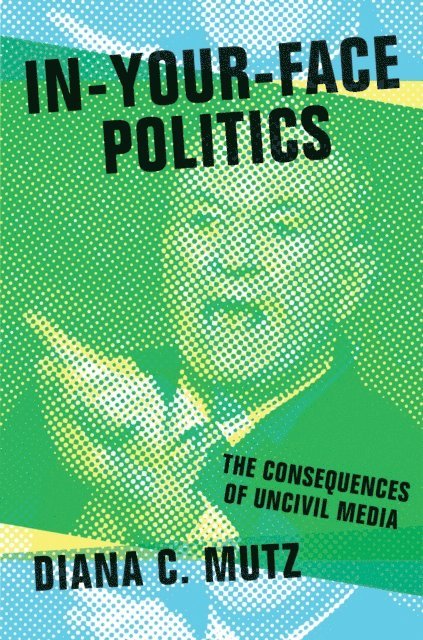
Americans are disgusted with watching politicians screaming and yelling at one another on television. But does all the noise really make a difference? Drawing on numerous studies, Diana Mutz provides the first comprehensive look at the consequences of in-your-face politics. Her book contradicts the conventional wisdom by documenting both the benefits and the drawbacks of in-your-face media. "In-your-face" politics refers to both the level of incivility and the up-close and personal way that we experience political conflict on television. Just as actual physical closeness intensifies people's emotional reactions to others, the appearance of closeness on a video screen has similar effects. We tend to keep our distance from those with whom we disagree. Modern media, however, puts those we dislike in our faces in a way that intensifies our negative reactions. Mutz finds that incivility is particularly detrimental to facilitating respect for oppositional political viewpoints and to citizens' levels of trust in politicians and the political process.On the positive side, incivility and close-up camera perspectives contribute to making politics more physiologically arousing and entertaining to viewers. This encourages more attention to political programs, stimulates recall of the content, and encourages people to relay content to others. In the end, In-Your-Face Politics demonstrates why political incivility is not easily dismissed as a disservice to democracy--it may even be a necessity in an age with so much competition for citizens' attention.
227 kr
Skickas inom 7-10 vardagar
Americans are disgusted with watching politicians screaming and yelling at one another on television. But does all the noise really make a difference? Drawing on numerous studies, Diana Mutz provides the first comprehensive look at the consequences of in-your-face politics. Her book contradicts the conventional wisdom by documenting both the benefits and the drawbacks of in-your-face media. "In-your-face" politics refers to both the level of incivility and the up-close and personal way that we experience political conflict on television. Just as actual physical closeness intensifies people's emotional reactions to others, the appearance of closeness on a video screen has similar effects. We tend to keep our distance from those with whom we disagree. Modern media, however, puts those we dislike in our faces in a way that intensifies our negative reactions. Mutz finds that incivility is particularly detrimental to facilitating respect for oppositional political viewpoints and to citizens' levels of trust in politicians and the political process.On the positive side, incivility and close-up camera perspectives contribute to making politics more physiologically arousing and entertaining to viewers. This encourages more attention to political programs, stimulates recall of the content, and encourages people to relay content to others. In the end, In-Your-Face Politics demonstrates why political incivility is not easily dismissed as a disservice to democracy--it may even be a necessity in an age with so much competition for citizens' attention.
275 kr
Skickas inom 7-10 vardagar
From acclaimed political scientist Diana Mutz, a revealing look at why people's attitudes on trade differ from their own self-interestWinners and Losers challenges conventional wisdom about how American citizens form opinions on international trade. While dominant explanations in economics emphasize personal self-interest—and whether individuals gain or lose financially as a result of trade—this book takes a psychological approach, demonstrating how people view the complex world of international trade through the lens of interpersonal relations.Drawing on psychological theories of preference formation as well as original surveys and experiments, Diana Mutz finds that in contrast to the economic view of trade as cooperation for mutual benefit, many Americans view trade as a competition between the United States and other countries—a contest of us versus them. These people favor trade as long as they see Americans as the "winners" in these interactions, viewing trade as a way to establish dominance over foreign competitors. For others, trade is a means of maintaining more peaceful relations between countries. Just as individuals may exchange gifts to cement relationships, international trade is a tie that binds nations together in trust and cooperation.Winners and Losers reveals how people's orientations toward in-groups and out-groups play a central role in influencing how they think about trade with foreign countries, and shows how a better understanding of the psychological underpinnings of public opinion can lead to lasting economic and societal benefits.
872 kr
Skickas inom 7-10 vardagar
From acclaimed political scientist Diana Mutz, a revealing look at why people's attitudes on trade differ from their own self-interestWinners and Losers challenges conventional wisdom about how American citizens form opinions on international trade. While dominant explanations in economics emphasize personal self-interest—and whether individuals gain or lose financially as a result of trade—this book takes a psychological approach, demonstrating how people view the complex world of international trade through the lens of interpersonal relations.Drawing on psychological theories of preference formation as well as original surveys and experiments, Diana Mutz finds that in contrast to the economic view of trade as cooperation for mutual benefit, many Americans view trade as a competition between the United States and other countries—a contest of us versus them. These people favor trade as long as they see Americans as the "winners" in these interactions, viewing trade as a way to establish dominance over foreign competitors. For others, trade is a means of maintaining more peaceful relations between countries. Just as individuals may exchange gifts to cement relationships, international trade is a tie that binds nations together in trust and cooperation.Winners and Losers reveals how people's orientations toward in-groups and out-groups play a central role in influencing how they think about trade with foreign countries, and shows how a better understanding of the psychological underpinnings of public opinion can lead to lasting economic and societal benefits.