James H Kuklinski – författare
Visar alla böcker från författaren James H Kuklinski. Handla med fri frakt och snabb leverans.
18 produkter
18 produkter
Häftad, Engelska, 1990
327 kr
Skickas inom 5-8 vardagar
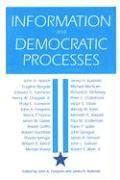
The golden democratic tradition of an informed and involved electorate freely and rationally choosing its public officials seems to be at odds with American political reality. Thus the questions: On what basis do people vote and form opinions? How does the lack of information at the individual level affect system performance? In this collection twenty-six distinguished political scientists discuss, debate, and define the relationship between information and the democracy it supposedly serves. The contributors address both the empirical and normative aspects of governing in the United States, employing psychological, sociological, and economic perspectives.
Häftad, Engelska, 2002
342 kr
Skickas inom 7-10 vardagar
Americans often complain about the operation of their government, but scholars have never developed a complete picture of people's preferred type of government. In this provocative and timely book, Hibbing and Theiss-Morse, employing an original national survey and focus groups, report the governmental procedures Americans desire. Contrary to the prevailing view that people want greater involvement in politics, most citizens do not care about most policies and therefore are content to turn over decision-making authority to someone else. People's wish for the political system is that decision makers be empathetic and, especially, non-self-interested, not that they be responsive and accountable to the people's largely nonexistent policy preferences or, even worse, that the people be obligated to participate directly in decision making. Hibbing and Theiss-Morse conclude by cautioning communitarians, direct democrats, social capitalists, deliberation theorists, and all those who think that greater citizen involvement is the solution to society's problems.
Häftad, Engelska, 2008
604 kr
Skickas inom 7-10 vardagar
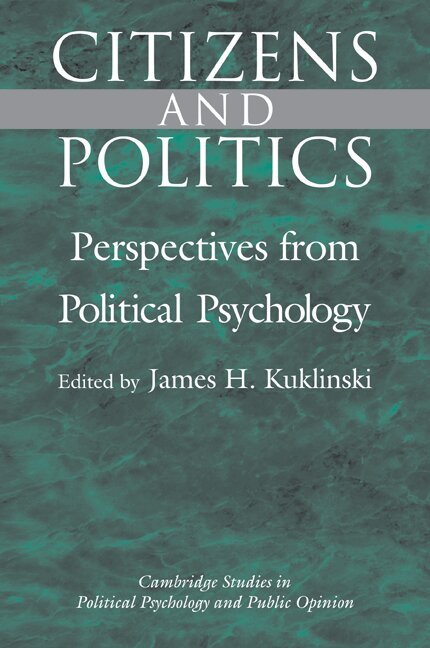
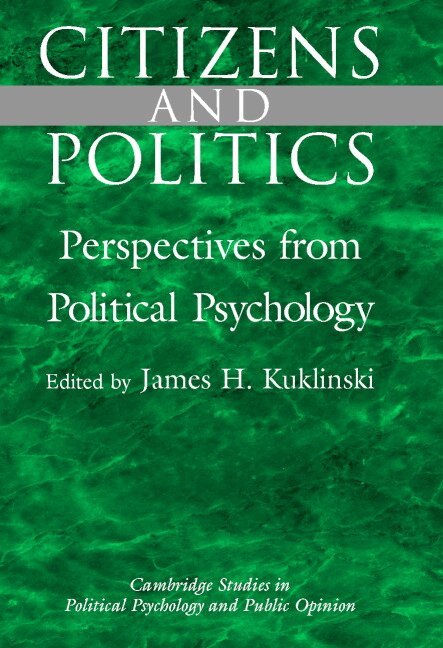
Citizens and Politics: Perspectives from Political Psychology brings together some of the research on citizen decision making. It addresses the questions of citizen political competence from different political psychology perspectives. Some of the authors in this volume look to affect and emotions to determine how people reach political judgements, others to human cognition and reasoning. Still others focus on perceptions or basic political attitudes such as political ideology. Several demonstrate the impact of values on policy preferences. The collection features chapters from some of the most talented political scientists in the field.
Häftad, Engelska, 2009
526 kr
Skickas inom 7-10 vardagar
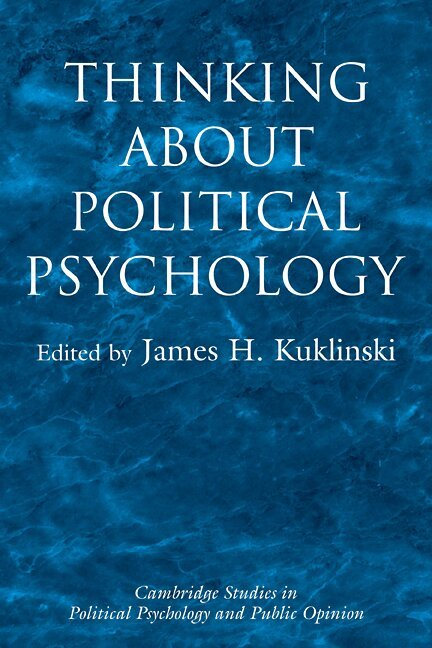
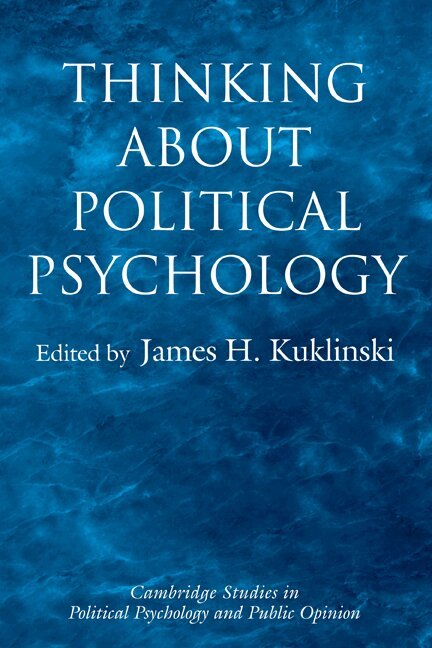
In this 2002 volume, political psychologists take a hard look at political psychology. They pose and then address, the kinds of tough questions that those outside the field would be inclined to ask and those inside should be able to answer satisfactorily. Not everyone will agree with the answers the authors provide and in some cases, the best an author can do is offer well-grounded speculations. Nonetheless, the chapters raise questions that will lead to an improved political psychology and will generate further discussion and research in the field. The individual chapters are organised around four themes. Part I tries to define political psychology and provides an overview of the field. Part II raises questions about theory and empirical methods in political psychology. Part III contains arguments ranging from the position that the field is too heavily psychological to the view that it is not psychological enough. Part IV considers how political psychologists might best connect individual-level mental processes to aggregate outcomes.
Häftad, Engelska, 2011
603 kr
Skickas inom 7-10 vardagar
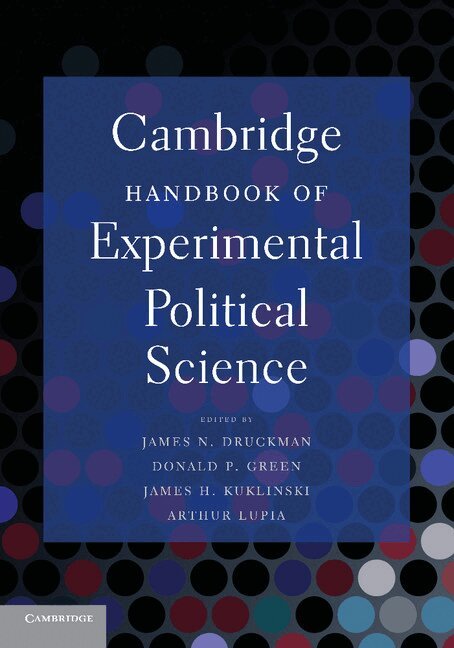
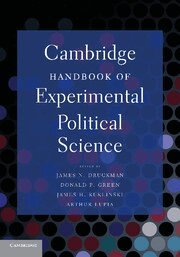
Laboratory experiments, survey experiments and field experiments occupy a central and growing place in the discipline of political science. The Cambridge Handbook of Experimental Political Science is the first text to provide a comprehensive overview of how experimental research is transforming the field. Some chapters explain and define core concepts in experimental design and analysis. Other chapters provide an intellectual history of the experimental movement. Throughout the book, leading scholars review groundbreaking research and explain, in personal terms, the growing influence of experimental political science. The Cambridge Handbook of Experimental Political Science provides a collection of insights that can be found nowhere else. Its topics are of interest not just to researchers who are conducting experiments today, but also to researchers who think that experiments can help them make new and important discoveries in political science and beyond.
Inbunden, Engelska, 2011
1 486 kr
Skickas inom 7-10 vardagar
Laboratory experiments, survey experiments and field experiments occupy a central and growing place in the discipline of political science. The Cambridge Handbook of Experimental Political Science is the first text to provide a comprehensive overview of how experimental research is transforming the field. Some chapters explain and define core concepts in experimental design and analysis. Other chapters provide an intellectual history of the experimental movement. Throughout the book, leading scholars review groundbreaking research and explain, in personal terms, the growing influence of experimental political science. The Cambridge Handbook of Experimental Political Science provides a collection of insights that can be found nowhere else. Its topics are of interest not just to researchers who are conducting experiments today, but also to researchers who think that experiments can help them make new and important discoveries in political science and beyond.
Inbunden, Engelska, 1992
1 201 kr
Skickas inom 7-10 vardagar
In this 1992 book John Zaller develops a comprehensive theory to explain how people acquire political information from elites and the mass media and convert it into political preferences. Using numerous specific examples, Zaller applies this theory to the dynamics of public opinion on a broad range of subjects, including domestic and foreign policy, trust in government, racial equality, and presidential approval, as well as voting behaviour in U.S. House, Senate, and presidential elections. The thoery is constructed from four basic premises. The first is that individuals differ substantially in their attention to politics and therefore in their exposure to elite sources of political information. The second is that people react critically to political communication only to the extent that they are knowledgeable about political affairs. The third is that people rarely have fixed attitudes on specific issues; rather, they construct 'preference statements' on the fly as they confront each issue raised. The fourth is that, in constructing these statements, people make the greatest use of ideas that are, for various reasons, the most immediately salient to them. Zaller emphasizes the role of political elites in establishing the terms of political discourse in the mass media and the powerful effect of this framing of issues on the dynamics of mass opinion on any given issue over time.
Häftad, Engelska, 1992
367 kr
Skickas inom 7-10 vardagar
In this 1992 book John Zaller develops a comprehensive theory to explain how people acquire political information from elites and the mass media and convert it into political preferences. Using numerous specific examples, Zaller applies this theory to the dynamics of public opinion on a broad range of subjects, including domestic and foreign policy, trust in government, racial equality, and presidential approval, as well as voting behaviour in U.S. House, Senate, and presidential elections. The thoery is constructed from four basic premises. The first is that individuals differ substantially in their attention to politics and therefore in their exposure to elite sources of political information. The second is that people react critically to political communication only to the extent that they are knowledgeable about political affairs. The third is that people rarely have fixed attitudes on specific issues; rather, they construct 'preference statements' on the fly as they confront each issue raised. The fourth is that, in constructing these statements, people make the greatest use of ideas that are, for various reasons, the most immediately salient to them. Zaller emphasizes the role of political elites in establishing the terms of political discourse in the mass media and the powerful effect of this framing of issues on the dynamics of mass opinion on any given issue over time.
Häftad, Engelska, 1995
448 kr
Skickas inom 7-10 vardagar
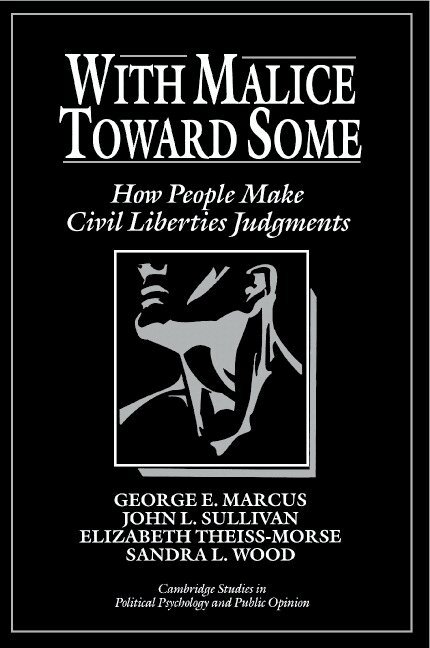
With Malice toward Some: How People Make Civil Liberties Judgments addresses an issue integral to democratic societies: how people faced with a complex variety of considerations decide whether or not to tolerate extremist groups. Relying on several survey-experiments, Marcus, Sullivan, Theiss-Morse, and Wood identify and compare the impact on decision making of contemporary information, long-standing predispositions, and enduring values and beliefs. Citizens react most strongly to information about a group's violations of behavioral norms and information about the implications for democracy of the group's actions. The authors conclude that democratic citizens should have a strong baseline of tolerance yet be attentive to and thoughtful about current information.
Inbunden, Engelska, 1995
721 kr
Skickas inom 7-10 vardagar
This book, first published in 1995, explores how the everyday person reasons about nuclear strategy. James DeNardo's data reveals surprising patterns of thinking on basic issues from SDI, arms control, and proliferation to the end of the Cold War. The book describes a fascinating cast of players, including 'Nice Hawks' like Ronald Reagan, who wanted to give SDI to the Russians, and the 'NIFFs,' whose procurement rule, expressed simply, was: 'If they have it, we don't want it, but they don't have it, we should get it.' To explain his remarkable evidence, Professor DeNardo presents an innovative theory of intuitive deterrence reasoning. He then confronts the theory with data from professional nuclear strategists. His discovery that the amateur's strategic reasoning defies all conventional theories lays the groundwork for a new understanding of national security politics. His demonstration that professional strategists reason like novices - that we are all Amateur Strategists - challenges the intellectual foundations of modern deterrence theory, public opinion studies, and game theory.
Inbunden, Engelska, 1995
773 kr
Skickas inom 7-10 vardagar
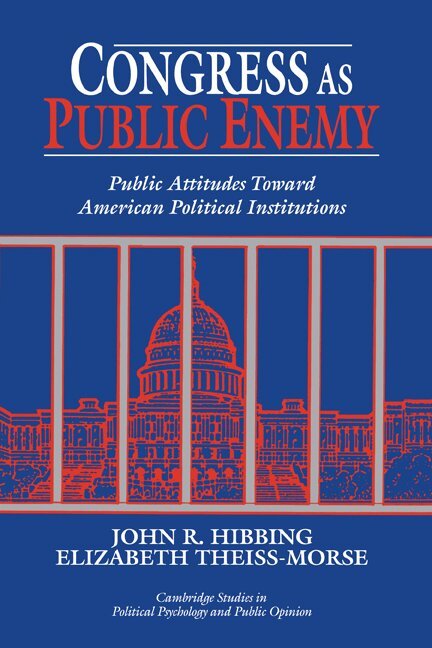
This timely book describes and explains the American people's alleged hatred of their own branch of government, the US Congress. Intensive focus group sessions held across the country and a specially designed national survey indicate that much of the negativity is generated by popular perceptions of the processes of governing visible in Congress. John Hibbing and Elizabeth Theiss-Morse argue that, although the public is deeply disturbed by debate, compromise, delicate pace, the presence of interest groups, and the professionalization of politics, many of these traits are actually endemic to modern democratic government. Congress is an enemy of the public partially because it is so public. Calls for reform, such as term limitations, reflect the public's desire to attack these disliked features. But the authors conclude, the public's unwitting desire to reform democracy out of a democratic legislature is a cure more dangerous than the disease.
Inbunden, Engelska, 1995
1 071 kr
Skickas inom 7-10 vardagar
Public opinion has played a crucial role in the transitions from war to peace in Israel since the 1967 Six Day war. Security Threatened is the first major analysis of the interactions among opinion, politics and policy in that period, based on opinion surveys of thousands of adult Jews conducted between 1962 and 1994. The public divided during those years into militant hardliners and more conciliatory security positions, and power either shifted between, or was shared by, the Likud and Labour parties. In the late 1980s and early 1990s, with the onset of the intifada, the collapse of the Soviet Union, and the American victory in the Gulf War, all segments of the Israeli public became more conciliatory. Policy initiatives reflected shifts in political power which in turn magnified changes in public opinion. Leaders were constrained by public opinion and by perceptions of threat, but they could also alter policy if they had the will because opinion was rather equally divided; since most people had their minds made up, the opposition could not block their policy.
Häftad, Engelska, 1995
448 kr
Skickas inom 7-10 vardagar
This book, first published in 1995, explores how the everyday person reasons about nuclear strategy. James DeNardo's data reveals surprising patterns of thinking on basic issues from SDI, arms control, and proliferation to the end of the Cold War. The book describes a fascinating cast of players, including 'Nice Hawks' like Ronald Reagan, who wanted to give SDI to the Russians, and the 'NIFFs,' whose procurement rule, expressed simply, was: 'If they have it, we don't want it, but they don't have it, we should get it.' To explain his remarkable evidence, Professor DeNardo presents an innovative theory of intuitive deterrence reasoning. He then confronts the theory with data from professional nuclear strategists. His discovery that the amateur's strategic reasoning defies all conventional theories lays the groundwork for a new understanding of national security politics. His demonstration that professional strategists reason like novices - that we are all Amateur Strategists - challenges the intellectual foundations of modern deterrence theory, public opinion studies, and game theory.
Häftad, Engelska, 1995
417 kr
Skickas inom 7-10 vardagar
Public opinion has played a crucial role in the transitions from war to peace in Israel since the 1967 Six Day war. Security Threatened is the first major analysis of the interactions among opinion, politics and policy in that period, based on opinion surveys of thousands of adult Jews conducted between 1962 and 1994. The public divided during those years into militant hardliners and more conciliatory security positions, and power either shifted between, or was shared by, the Likud and Labour parties. In the late 1980s and early 1990s, with the onset of the intifada, the collapse of the Soviet Union, and the American victory in the Gulf War, all segments of the Israeli public became more conciliatory. Policy initiatives reflected shifts in political power which in turn magnified changes in public opinion. Leaders were constrained by public opinion and by perceptions of threat, but they could also alter policy if they had the will because opinion was rather equally divided; since most people had their minds made up, the opposition could not block their policy.
Inbunden, Engelska, 2001
1 707 kr
Skickas inom 7-10 vardagar
Citizens and Politics: Perspectives from Political Psychology brings together some of the research on citizen decision making. It addresses the questions of citizen political competence from different political psychology perspectives. Some of the authors in this volume look to affect and emotions to determine how people reach political judgements, others to human cognition and reasoning. Still others focus on perceptions or basic political attitudes such as political ideology. Several demonstrate the impact of values on policy preferences. The collection features chapters from some of the most talented political scientists in the field.
Inbunden, Engelska, 2002
864 kr
Skickas inom 7-10 vardagar
In this 2002 volume, political psychologists take a hard look at political psychology. They pose and then address, the kinds of tough questions that those outside the field would be inclined to ask and those inside should be able to answer satisfactorily. Not everyone will agree with the answers the authors provide and in some cases, the best an author can do is offer well-grounded speculations. Nonetheless, the chapters raise questions that will lead to an improved political psychology and will generate further discussion and research in the field. The individual chapters are organised around four themes. Part I tries to define political psychology and provides an overview of the field. Part II raises questions about theory and empirical methods in political psychology. Part III contains arguments ranging from the position that the field is too heavily psychological to the view that it is not psychological enough. Part IV considers how political psychologists might best connect individual-level mental processes to aggregate outcomes.
Häftad, Engelska, 1998
417 kr
Skickas inom 7-10 vardagar
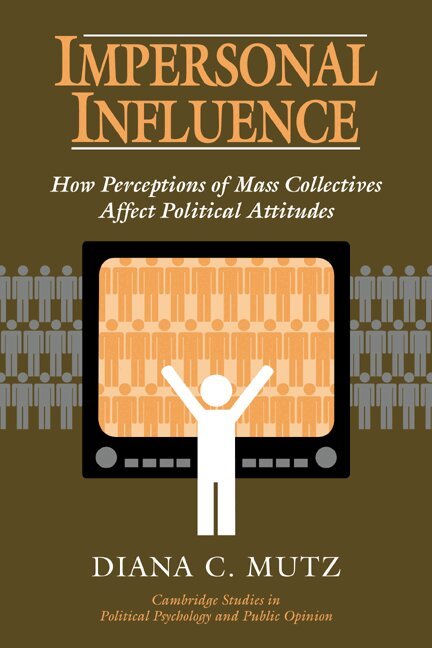
People's perceptions of the attitudes and experiences of mass collectives are an increasingly important force in contemporary political life. In Impersonal Influence, Mutz goes beyond simply providing examples of how impersonal influence matters in the political process to provide a micro-level understanding of why information about distant and impersonal others often influence people's political attitudes and behaviors. Impersonal Influence is worthy of attention both from the standpoint of its impact on contemporary politics, and because of its potential to expand the boundaries of our understanding of social influence processes, and media's relation to them. The book's conclusions do not exonerate media from the effects of inaccurate portrayals of collective experience or opinion, but they suggest that the ways in which people are influenced by these perceptions are in themselves, not so much deleterious to democracy as absolutely necessary to promoting accountability in a large scale society.
Inbunden, Engelska, 2002
980 kr
Skickas inom 7-10 vardagar
Americans often complain about the operation of their government, but scholars have never developed a complete picture of people's preferred type of government. In this provocative and timely book, Hibbing and Theiss-Morse, employing an original national survey and focus groups, report the governmental procedures Americans desire. Contrary to the prevailing view that people want greater involvement in politics, most citizens do not care about most policies and therefore are content to turn over decision-making authority to someone else. People's wish for the political system is that decision makers be empathetic and, especially, non-self-interested, not that they be responsive and accountable to the people's largely nonexistent policy preferences or, even worse, that the people be obligated to participate directly in decision making. Hibbing and Theiss-Morse conclude by cautioning communitarians, direct democrats, social capitalists, deliberation theorists, and all those who think that greater citizen involvement is the solution to society's problems.