• Fri frakt över 249 kr
  • •
  • Snabba leveranser
  • •
  • Billiga böcker
Kundservice

Du är på sajten för privatpersoner.

Företag, bibliotek eller offentlig verksamhet?

Du handlar på classic.bokus.com, där alla dina funktioner finns intakta.
Till classic.bokus.com
Bokus logotyp. Gå till startsidan.
  • Erbjudanden
  • Nyheter
  • Student
  • Topplistor
  • Barn & ungdom
  • Bokus Play
  • E-böcker
  • Pocketböcker
  • Spel & pussel

10% rabatt på allt med kod: NYSTART10 →

Sidfot

Mina sidor

    Hjälp

    • Kundservice
    • Vanliga frågor och svar
    • Frakt och leverans
    • Retur vid ångerrätt
    • Reklamera vara
    • Betalning
    • Köpvillkor
    • Allmänna villkor
    • Information om webbplatsens tillgänglighet

    Om Bokus

    • Om oss
    • Pressrum
    • För studenter
    • För företag
    • För bibliotek och offentlig verksamhet
    • För leverantörer
    • Hållbarhet

    Populärt

    • Aktuella erbjudanden
    • Presentkort
    • Studentlitteratur
    • Nya böcker
    • Topplistor
    • Signerade böcker
    • Engelska böcker

    Inspiration

    • Boktips
    • BookTok
    • Populära bokserier
    • Barnbokskaraktärer
    • Populära författare
    Logotyp för Bokus
    Följ oss på Facebook (extern länk)Följ oss på Instagram (extern länk)Följ oss på YouTube (extern länk)Följ oss på TikTok (extern länk)
    bokus @ CookiesAnpassa cookiesIntegritetspolicyKöpvillkor
    Till Citymail hemsida (extern länk)Till Budbee hemsida (extern länk)Till Postnord hemsida (extern länk)Till Schenker hemsida (extern länk)Till Early Bird hemsida (extern länk)Till Walleys hemsida (extern länk)
    1. Samhälle och politik
    2. Politik och statsskick
    3. Statsvetenskap och politisk teori

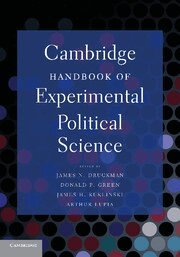
    Cambridge Handbook of Experimental Political Science

    AvJames N. Druckman,Donald P. Greene

    Inbunden, Engelska, 2011

    1 536 kr

    Beställningsvara. Skickas inom 10-15 vardagar. Fri frakt över 249 kr.

    Beskrivning

    Laboratory experiments, survey experiments and field experiments occupy a central and growing place in the discipline of political science. The Cambridge Handbook of Experimental Political Science is the first text to provide a comprehensive overview of how experimental research is transforming the field. Some chapters explain and define core concepts in experimental design and analysis. Other chapters provide an intellectual history of the experimental movement. Throughout the book, leading scholars review groundbreaking research and explain, in personal terms, the growing influence of experimental political science. The Cambridge Handbook of Experimental Political Science provides a collection of insights that can be found nowhere else. Its topics are of interest not just to researchers who are conducting experiments today, but also to researchers who think that experiments can help them make new and important discoveries in political science and beyond.

    Produktinformation

    • Utgivningsdatum:2011-06-06
    • Mått:178 x 254 x 32 mm
    • Vikt:1 160 g
    • Format:Inbunden
    • Språk:Engelska
    • Antal sidor:578
    • Förlag:Cambridge University Press
    • ISBN:9780521192125

    Utforska kategorier

    • Statsvetenskap och politisk teori inom Samhälle och politik

    Mer om författaren

    James N. Druckman is Payson S. Wild Professor of Political Science at Northwestern University. He has published articles in journals such as the American Political Science Review, the American Journal of Political Science and the Journal of Politics. He currently is the editor of Public Opinion Quarterly. Professor Druckman's research focuses on political preference formation and communication, and his recent work examines how citizens make political, economic and social decisions in various contexts. Donald P. Green is A. Whitney Griswold Professor of Political Science at Yale University. He is the author of four books and several dozen articles on a wide array of topics, including partisanship, campaign finance, voting and prejudice. Since 1998, his work has focused on the design, implementation and analysis of field experiments. James H. Kuklinski is Matthew T. McClure Professor of Political Science at the University of Illinois, Urbana-Champaign. His interests include citizen decision-making and the formulation of experimental designs that generate more accurate inferences about the external world than the traditional random assignment experiment. Arthur Lupia is Hal R. Varian Professor of Political Science at the University of Michigan. He studies politics with a focus on how people make decisions when they lack information. Professor Lupia co-founded TESS (Time-Sharing Experiments for the Social Sciences) and served as Principal Investigator of the American National Election Studies.

    Recensioner i media

    'This handbook is a monumental undertaking. It contains something of value for political scientists of every methodological and substantive stripe.' Morris P. Fiorina, Stanford University

    Innehållsförteckning

    • 1. Experimentation in political science James N. Druckman, Donald P. Green, James H. Kuklinski and Arthur Lupia; Part I. Designing Experiments: 2. Experiments: an introduction to core concepts James N. Druckman, Donald P. Green, James H. Kuklinski and Arthur Lupia; 3. Internal and external validity Rose McDermott; 4. Students as experimental participants: a defense of the 'narrow data base' James N. Druckman and Cindy D. Kam; 5. Economics vs. psychology experiments: stylization, incentives, and deception Eric S. Dickson; Part II. The Development of Experiments in Political Science: 6. Laboratory experiments in political science Shanto Iyengar; 7. Experiments and game theory's value to political science John H. Aldrich and Arthur Lupia; 8. The logic and design of the survey experiment: an autobiography of a methodological innovation Paul M. Sniderman; 9. Field experiments in political science Alan S. Gerber; Part III. Decision Making: 10. Attitude change experiments in political science Allyson L. Holbrook; 11. Conscious and unconscious information processing with implications for experimental political science Milton Lodge, Charles Taber and Brad Verhulst; 12. Political knowledge Cheryl Boudreau and Arthur Lupia; Part IV. Vote Choice, Candidate Evaluations, and Turnout: 13. Candidate impressions and evaluations Kathleen M. McGraw; 14. Media and politics Thomas E. Nelson, Sarah M. Bryner and Dustin M. Carnahan; 15. Candidate advertisements Shana Kushner Gadarian and Richard R. Lau; 16. Voter mobilization Melissa R. Michelson and David W. Nickerson; Part V. Interpersonal Relations: 17. Trust and social exchange Rick K. Wilson and Catherine C. Eckel; 18. An experimental approach to citizen deliberation Christopher F. Karpowitz and Tali Mendelberg; 19. Social networks and political context David W. Nickerson; Part VI. Identity, Ethnicity, and Politics: 20. Candidate gender and experimental political science Kathleen Dolan and Kira Sanbonmatsu; 21. Racial identity and experimental methodology Darren Davis; 22. The determinants and political consequences of prejudice Vincent L. Hutchings and Spencer Piston; 23. Politics from the perspective of minority populations Dennis Chong and Jane Junn; Part VII. Institutions and Behavior: 24. Experimental contributions to collective-action theory Eric Coleman and Elinor Ostrom; 25. Legislative voting and cycling Gary Miller; 26. Electoral systems and strategic voting (laboratory election experiments) Rebecca B. Morton and Kenneth C. Williams; 27. Experimental research on democracy and development Ana L. De La O and Leonard Wantchekon; Part VIII. Elite Bargaining: 28. Coalition experiments Daniel Diermeier; 29. Negotiation and mediation Daniel Druckman; 30. The experiment and foreign policy decision making Margaret G. Hermann and Binnur Ozkececi-Taner; Part IX. Advanced Experimental Methods: 31. Treatment effects Brian J. Gaines and James H. Kuklinski; 32. Making effects manifest in randomized experiments Jake Bowers; 33. Design and analysis of experiments in multilevel populations Betsy Sinclair; 34. Analyzing the downstream effects of randomized experiments Rachel Milstein Sondheimer; 35. Mediation analysis is harder than it looks John G. Bullock and Shang E. Ha; Afterword: 36. Campbell's ghost Donald R. Kinder.